State’s new overtimes rules take effect in July 2020
A controversial plan
to overhaul the state’s overtime rules will change the way tens of thousands of
workers will be paid.
The new rules increase
the minimum amount workers must earn to be exempt from overtime.
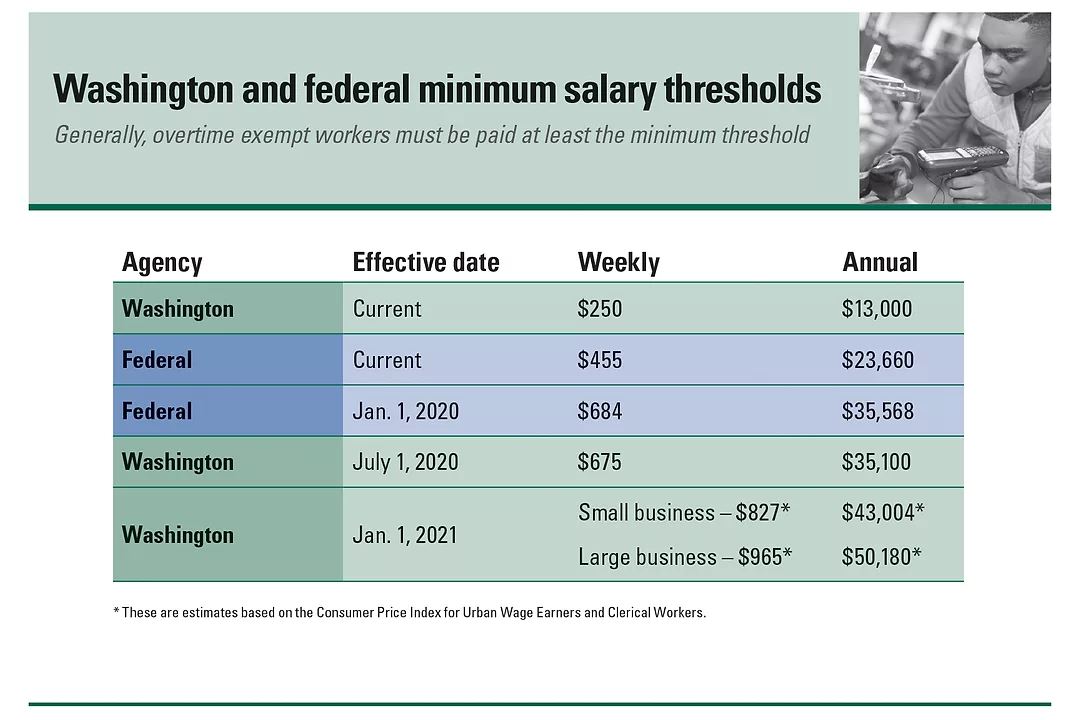
Beginning July 1, the
state minimum salary threshold will increase to $675 a week, or $35,100 a year,
for all businesses, which is 1.25 times the state’s minimum wage.
The threshold will
increase incrementally until 2028, when it is expected to reach about $1,603 a
week, or about $83,356 a year, for an overtime exempt worker, 2 1/2 times the
minimum wage.
In addition to
qualifying for overtime pay, non-exempt workers also must receive other
protections under the state’s Minimum Wage Act, including paid sick leave.
The state Department
of Labor and Industries announced the new rules Dec. 11.
The state agency
received 2,266 comments from the public and heard testimony from 182 people at
seven public hearings held around the state in July and August.
An August public
hearing in Kennewick drew several Tri-City employers and nonprofit leaders who
criticized the proposal, citing concerns about their bottom lines and ability to
be flexible with employee scheduling.
The new rules also
change job duties descriptions used along with the salary threshold to
determine if an employee can be exempt from overtime and bring the state more
in line with federal standards, said Joel Sacks, director of Labor and
Industries.
The changes will
restore overtime eligibility to an estimated 259,000 workers when fully
implemented, and strengthen overtime protection for about 235,000 other
workers. They are the first major updates to the state’s overtime rules in more
than 40 years.
Sacks said he
understands the effect the new rules will have on businesses.
“We recognize how all
this might impact businesses. That’s why the implementation of the new state
rules won’t begin until next July, and they will be phased in over several
years. We also have an outreach plan to assist businesses with the transition,”
he said in a statement.
Employers have
multiple options to comply with the rules. For example, they can convert
current salaried exempt employees to salaried non-exempt or hourly non-exempt,
and pay overtime for any work over 40 hours in a work week.
To reduce overtime
costs, employers could limit the number of hours of work to 40 per week, or
less. If they wish to maintain the employee’s exempt status, they would need to
ensure the employee meets the duties test requirements and is paid at least the
updated salary threshold requirements.
The changes
specifically focus on white-collar employees typically working in a management
or professional capacity who receive a set salary.
Initially, Washington
employers will be required to follow the new federal overtime rule taking
effect on Jan. 1. The new federal threshold, at $684 a week, or $35,568 a year,
will be slightly higher than Washington’s until 2021. When state and federal
thresholds conflict, businesses must meet the threshold most favorable to
employees.
Washington’s threshold
will exceed the federal level on Jan. 1, 2021. At that time, businesses with 1
to 50 employees will have to pay exempt employees at least 1 1/2 times the
state minimum wage, about $827 a week, or $43,004 a year. For businesses with
51 or more employees, the threshold will be 1.75 times the minimum wage, about
$965 a week, or $50,180 a year.
“These updates to the
state overtime rules are a big step toward ensuring Washington workers are
treated fairly and properly paid for the work they perform,” Sacks said. “This
decision corrects a wrong, and is long overdue.”
To be overtime exempt,
an employee generally must be paid a fixed salary, must perform certain defined
job duties, and the salary must meet or exceed the salary threshold. Under
current federal guidelines, that threshold is $455 a week. The current state
threshold set more than 40 years ago is $250 a week.
“This is an incredible
day for Washington,” Gov. Jay Inslee said in a statement. “We need to make sure
the middle class shares in our state’s prosperity. Overtime protections ensure
workers are fairly compensated when they work more than 40 hours in a given
week — time that would otherwise be spent with their families and in their
communities.”
To learn more about
the process to change the rules, go to Lni.wa.gov/OvertimeRulemaking.