
Want equal pay, protection from harassment? Put more women in leadership
Washingtonians have a lot to be proud of with regard to progressive policies that support equality, fairness and democratic principles. But news that Washington state ranks second worst, behind only Utah, with regard to equal pay for women, shows we have a long way to go.
Our entire economy depends on a service industry workforce that’s majority women, who deliver the bulk of frontline grocery, retail, health care and education labor. Women are also the primary decision-makers for household spending, and therefore the most powerful consumers in America, but their buying power is still 81 cents for every dollar a man makes. Women hold power in job growth, yet our wage disparities are growing, not shrinking. Not surprisingly, the majority of workers organizing for union representation are women.
Grocery workers, hospital workers, domestic workers, child care providers, nursing home aides and factory workers are considered essential, but are among the lowest-paid workers in America. Most must rely on government assistance for food, health care and education – social services and resources that are being slashed by the Trump administration and Republicans in Congress.
Cuts to food benefits are disproportionately harming American women (60% of SNAP participants are women), especially women of color who most often fill frontline service jobs. Women are also most often the primary caregiver in their families, reducing or eliminating their income.
Women make up roughly half of the workforce in the U.S., yet our leadership is still dominated by men. Only 11% of Fortune 500 companies have women CEOs. Women make up less than 30% of Congress, and only 10 of the nation’s 30 major labor unions are led by women. My own international union’s membership is majority women – mainly grocery, retail and health care workers – yet we’ve never had a woman as union president, and there have only been a small handful of women in top leadership positions in our history.
It’s time for women to occupy at least half of all leadership positions in government, business, and, importantly, the labor movement.
News of Cesar Chavez’s record of sexual harassment and abuse may be shocking to millions of people who viewed him as one of the greatest labor leaders in history. But sexual harassment and abuse by men in power is not a one-off. Many women have reported widespread sexual harassment inside multiple unions, including my own, UFCW, where a local union president was accused of sexual harassment, including assault, by four women, and then used his members’ money to settle three of the lawsuits.
We need leadership change now for women to have any hope of achieving equal economic power and protection from abuse. Representation matters as women are more vulnerable in the workplace today, with the Trump administration gutting government unions and the agencies responsible for enforcing protection from civil and labor rights violations, discrimination, and workplace harassment. Without enforcement, the Fair Labor Standards Act and Lilly Ledbetter Fair Pay Act, which require equal pay for equal work, are more wishes than requirements.
More than ever, the most powerful tools for women to gain pay parity are legally enforceable contracts collectively bargained by workers that specify pay rates and raise schedules. Union jobs help close the gap between wages and the cost of living. Workers represented by a union make, on average, 12% more than people in the same non-union job.
But we need to stand for more than economic justice alone. Union contracts also often include strong anti-harassment policies and provide safe, confidential grievance procedures for workers that can be faster and more effective than legal proceedings. If women can’t rely on our government to protect us, then we must protect ourselves through binding contracts collectively bargained by all workers through our democratically elected unions.
More women in leadership is our best hope to close the wage gap and hold corporations and government accountable when our rights are violated. Together, we can work in solidarity to continue the fight of Dolores Huerta and millions of women whose organizing won better conditions for all workers. It’s up to all of us – no matter what gender we identify as – to make good on the promise of equal pay for equal work, prevent sexual harassment and abuse and hold perpetrators accountable when it happens.
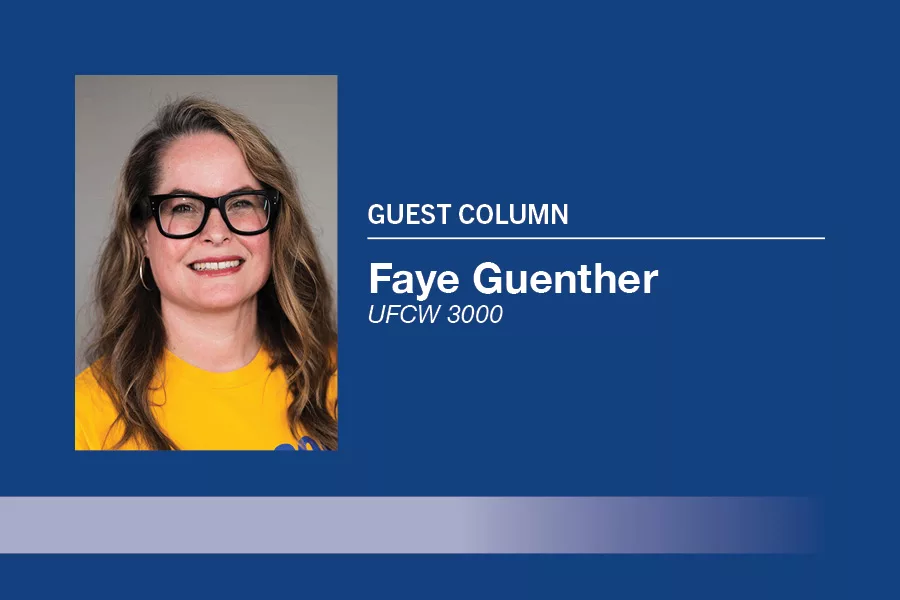
Faye Guenther is a labor lawyer and president of the UFCW 3000, the nation’s largest local union with more than 50,000 retail, health care and grocery workers.