
Tri-City entrepreneur builds Amazon delivery team in his hometown
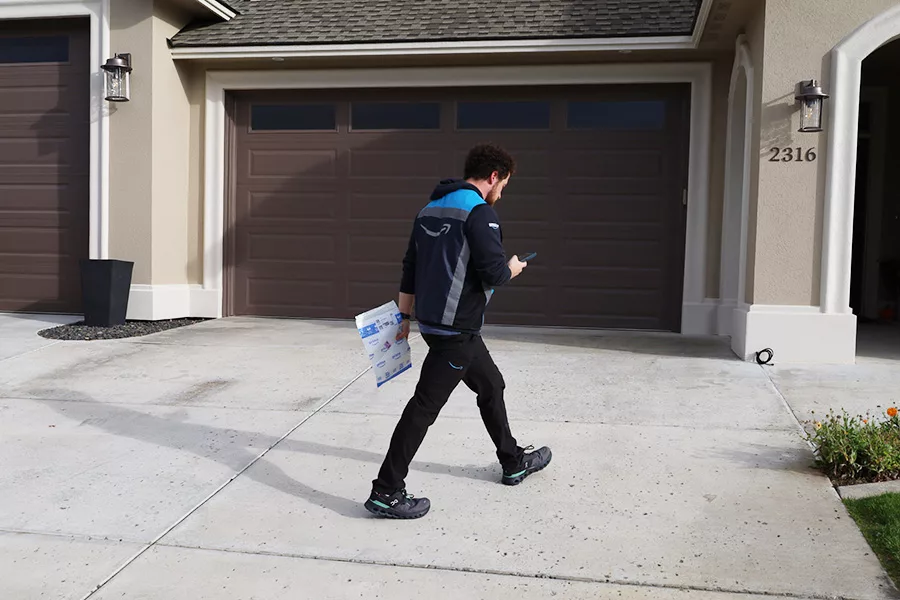
Bradley Wilson, owner of Apcore Logistics, makes an Amazon delivery in Richland. His team handles more than half of the packages processed daily at Amazon’s delivery station in Pasco.
Amazon packages crisscross the country every day, but in the Tri-Cities, many of them arrive thanks to a delivery service owned and operated by someone who calls the area home.
Bradley Wilson first launched his Amazon delivery business in Portland where he learned the rhythm of big-city logistics.
A year ago, when Amazon opened its first local delivery station in Pasco, he saw the chance to come home, raise his family where he grew up, and build a team rooted in the community. Wilson, 39, of West Richland, grew up in Kennewick and graduated from Southridge High School in 2005.
Today, his drivers move roughly 20,000 packages a day – more than half of the facility’s 35,000-40,000 daily volume – turning a global network into a local livelihood.
Wilson’s business, Apcore Logistics, got its start four years ago. He named it after an engineering company Wilson’s late grandfather once owned.
In Amazon’s world, the business is known as a delivery service partner, or DSP, a third-party company with a contract to deliver for Amazon’s Pasco facility. Apcore’s contract includes having an Amazon-branded fleet and drivers wearing Amazon’s logo.
Amazon doesn’t directly deliver its own packages, so Apcore covers the bulk of deliveries in the Tri-Cities area.
Since the delivery station has opened, Wilson said he’s seen a spike in demand from the Tri-Cities as people have realized they can get packages within two days.
Now, as Amazon works its busiest season, Apcore expects to increase the routes it serves during the holiday rush.
“Amazon is happy to be in the Tri-Cities and the community,” Wilson said.
Portland to Pasco
After a 15-year career in fitness, Wilson decided to change courses during the Covid-19 pandemic, when his fitness center was indefinitely shut down. He applied for a position with Amazon that would allow him to launch his own logistics company as a DSP for the Seattle-based company.
It took a year of interviews to secure the position, which enabled Wilson to build his company from scratch. He operated for three years in Portland, and when his contract came to a close, he knew what his next step needed to be: a return to the Tri-Cities.
When the distribution center opened about a year ago, Wilson came in to launch his team of drivers. Though there was a lot to get used to, he already had the knowledge of Amazon’s operations gained from his time in Portland, so he didn’t have to start from scratch again.
Wilson grew up in the area but hadn’t returned since he left after high school. Now, he’ll get the chance to raise his two sons here, with a flexible schedule the fitness industry might not have allowed, he said.
Daily operations
Apcore Logistics employs about 200 drivers, with more hired for seasonal work as holiday shipping ramped up. On an average day, the team covers about 75-80 routes, or 90-100 during peak season.
Before drivers depart each day, they get together for a debrief and Wilson checks in with everyone.
Drivers check to ensure they have everything from dog whistles to battery packs with them, then check their lights, mirrors and tires before hitting the road.
A few dispatchers stay behind to monitor the routes. They began their work as drivers and can head out to help with deliveries if needed.
When a driver falls behind on a route or struggles to navigate a confusing apartment complex, Apcore sends out “sweepers” to support drivers by taking packages off their load.
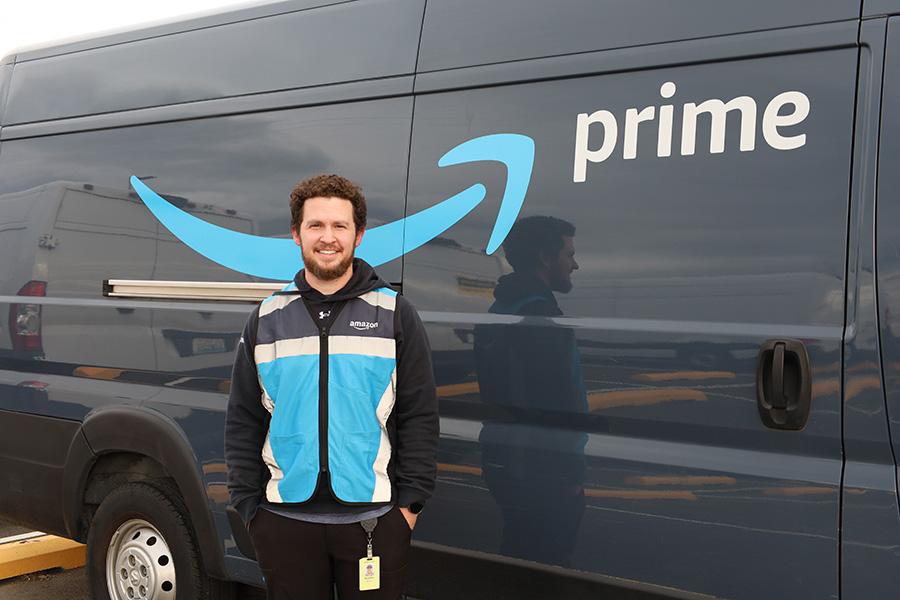
After a 15-year career in fitness, Bradley Wilson decided to change courses and launch his own logistics company delivering for Amazon. Now, he’s brought the company back to his hometown.
|Photo by Rachel Visick
Drivers load up packages to take out in 10-hour shifts, though they’ll be paid the same amount if they finish earlier, Wilson said, noting the routes are designed to be completed in eight hours.
Drivers, who must be 21 years old or older, are paid $23 to $25 an hour and are eligible for health, dental and vision benefits after completing their training.
On a typical day, drivers make about 190 stops and average about 30 miles of driving. They’ll head to one particular area and focus their deliveries there.
The Pasco distribution center also serves some areas that are farther away, like Walla Walla and Othello, and drivers also go out to rural areas, like farms, that other delivery centers might not travel to.
Larger items, like washers and dryers, are often contracted for delivery through UPS or other companies, but Wilson said that the Tri-Cities area will eventually be equipped to deliver those larger items.
When delivery drivers arrive at their destination, they scan in the package and the app double-checks that they are in the right spot.
Although Wilson’s daily routine doesn’t involve delivering, he devoted his time early on to driving the various routes and now goes out once a quarter or when there’s a new delivery area.
He said he wanted to understand what all drivers go through and confidently answer any questions they might have. That way, “they know we understand what it takes to get into a new area, or lose cell service,” he said.
Technology and safety
Each vehicle is equipped with cameras to watch the inside, outside and sides of the vehicles, checking for stop signs, speeding, signs of drowsiness and whether a driver has a phone in their hand.
Everything is recorded at all times to ensure drivers are making deliveries safely.
“Safe driving is always the most important part,” Wilson said. Being highly organized is the key to completing routes quickly, not speeding, he said.
Drivers use an app for their deliveries, which maps the stops along their route, gives driving directions, and shows gas stations along the way. It also shows drivers what kind of package or envelope they are looking for at any given stop and what code it will be marked with.
Wilson’s fleet is typically about 70-80 vehicles, increasing up to 110 during peak season. Sometime in the next year, he anticipates getting an all-electric fleet, with the Amazon app built into the vehicles’ dashboards.
Strenuous job
Delivering is strenuous and not for everyone. Delivery drivers walk an average of 10 miles per day ferrying packages to doors, Wilson said.
He said some people may see a delivery and think, “I could do that.” “You could, but could you do it 190 times a day?” he said.
Drivers just starting at Amazon will learn from a more experienced driver and start out with a smaller percentage of a normal route.
Although the job is labor-intensive, those who make it past the first 90 days are likely to stay on for a long time, Wilson said.