
Safeguarding consumers
City weighs whether to crack down on crypto kiosks
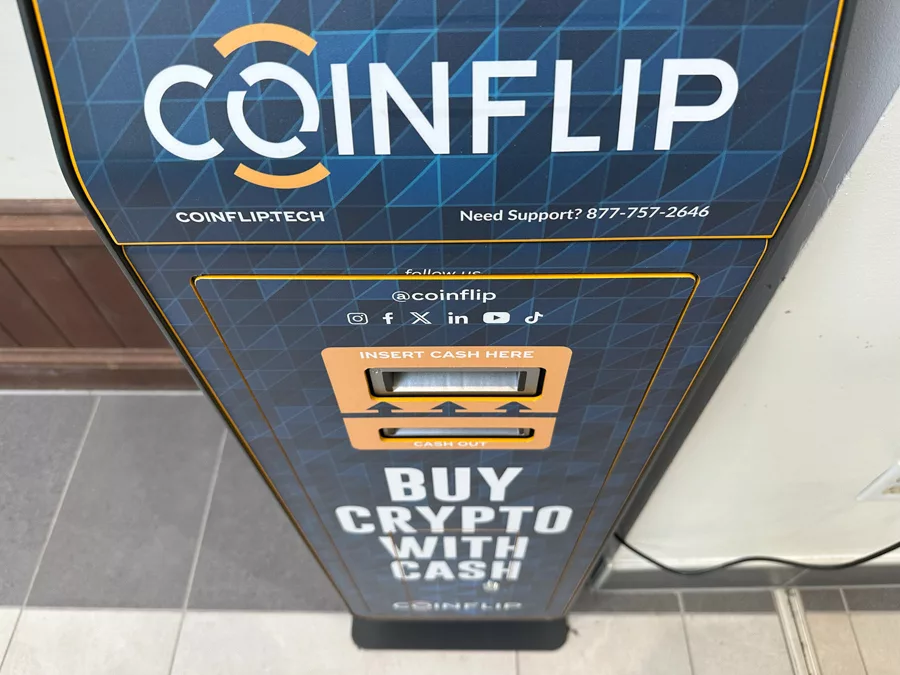
The Kennewick Police Department has asked the Kennewick City Council implement an ordinance that would ban cryptocurrency kiosks in the city. Poli investigators have documented about 16 such kiosks operating in convenience stores, grocery stores and other retail spaces and that they are being increasingly being used by scammers to defraud city residents, particularly the elderly.
Photo by Nathan FinkeCryptocurrency investors in Kennewick could have one less means to access those digital assets if a proposed city ordinance is approved.
The Kennewick City Council is considering a proposal from its police department to ban all ATMs and similar kiosks used to buy and trade cryptocurrency. Police officials told the council during a March workshop that the machines located in some retail spaces are increasingly being used to scam city residents, particularly the elderly, with no recourse to recover their financial losses.
“There are a lot of investigative hardships with this – that’s even at the federal level,” Sgt. Remie Rees said. “So think of Kennewick doing the best we can to recover money for people. It is very difficult, if not impossible.”
Council delayed a vote on the proposed ordinance in March to give city staff and police more time to answer questions and find data for council members. At least one council member, who acknowledged he is a proponent of cryptocurrency, expressed a wariness about moving forward.
“Where do we draw the line and say it’s our responsibility?” asked Councilman Brad Beauchamp.
Senior victims
According to law enforcement, scammers use the machines to convince victims to deposit cash into untraceable cryptocurrency wallets either by impersonating loved ones or others, such as government entities. Police have documented 16 such kiosks within city limits, half of them in convenience stores and the remainder in grocery stores and other retail locations such as Target and at the Columbia Center mall.
Ownership of those wallets and transactions involving them are anonymous, making recovery of funds near impossible. The machines themselves also charge transaction fees between 15% and 25%, increasing victims’ losses.
Rees told the council that Kennewick police have investigated nearly 40 cases of scams involving cryptocurrency kiosks since 2023, with total losses estimated at $923,771.
The biggest individual losses involve those over the age of 60, with one victim losing $140,000 in 2025, and a 78-year-old being scammed out of $100,000 this year.
The companies that own and operate the machines have refused to cooperate in investigations and threatened legal action if machines are seized as evidence, Rees said.
The proposed ordinance would ban any new cryptocurrency kiosks from being installed and require any existing ones to be removed from local businesses within 60 days of the ordinance going into effect.
A request for comment on the ordinance from the Tri-Cities Area Journal of Business to CoinMe, one cryptocurrency kiosk operator in the Tri-Cities, was not returned.
Crypto crackdown
A ban on such machines wouldn’t be novel. Spokane instituted one in 2025. State lawmakers made Indiana the first state to ban such kiosks in early March, and lawmakers in Minnesota and Tennessee are considering similar legislation. U.S. Sen. Dick Durbin, D-Illinois, is sponsoring federal legislation targeting fraud involving the machines.
AARP is one of the national organizations supporting many of those efforts.
“What makes crypto ATM fraud so devastating is that there are no consumer protections built into the transaction. Once cash goes into one of these machines and converts to cryptocurrency, it’s gone,” said David Meyer of Columbus, Ohio-based Meyer Wilson Werning Law, which specializes in cryptocurrency fraud, investor abuse and scams.
“These victims aren’t careless people,” Meyer said. “They’re smart, hard-working people who were deliberately targeted by sophisticated criminal operations. This is a billion-dollar industry, and it's only now getting the government scrutiny it deserves.”
Councilman Beauchamp said he has used cryptocurrency himself and sees it as a tool for the unbanked, or those who don’t have access to mainstream banking and credit resources.
He posed questions on how the number and losses of cryptocurrency scams compared to other scams investigated by police, such as those involving gift cards.
“Is it our responsibility to stop people from buying gift cards at Walmart because (people) lose $5 million a year? No,” he said. “Don’t use your debit card at a gas station because there are skimmers and they got $20 million? No. So I struggle with it.”
Rees said the city has had more than 50 gift card scam investigations since 2023. However, the number of those cases has declined the last few years and the individual and collective financial losses from them are a fraction of those for cryptocurrency.
The council tasked police with finding out what cryptocurrency kiosk operators are doing to combat fraud and finding other data on the machines. Council is expected to revisit the ordinance at its April 14 workshop meeting before possibly bringing it up for a vote at the April 21 regular meeting.