
Soldier settlements
A plan to settle war veterans on local farmland fizzles out

A century ago a new community emerged from Benton County’s sagebrush land between the towns of White Bluffs and Hanford – a soldier settlement.
It was one of the few so-named communities arising from the ashes of World War I as the United States sought to care for its returning veterans from the “war to end all wars.”
The community was the offshoot of an idea promoted by Franklin Knight Lane who served as secretary of the interior to President Woodrow Wilson before, during and after the war.
Soldier settlements were designed for an anticipated exploding labor supply of returning veterans.
A worldwide agriculture shortage also influenced the creation of these ag-oriented settlements.
When World War I began, the U.S. Army had some 200,000 men serving.
Mobilized for the war were more than 4.7 million new U.S. service members, an increase of 2,250% over its 200,000 pre-war levels.
The war took the lives of nearly 117,000 Americans, including 53,402 lost in battle, and more than 63,000 to disease, accidents and other afflictions before the signing of the armistice on Nov. 11, 1918.
Lane’s idea was to create farm colony-like settlements with veterans working side by side. Of those called into service for the war, some 1.5 million came from farms or ag backgrounds.
Agricultural colleges were enlisted to help train those lacking farming background.
The organized settlements received both federal and state support.
Lane’s plan was never passed into law but six states did experiment, including Washington.
The soldier settlement near Hanford came about in 1921 and was for veterans of World War I and the Spanish-American War of 1898.
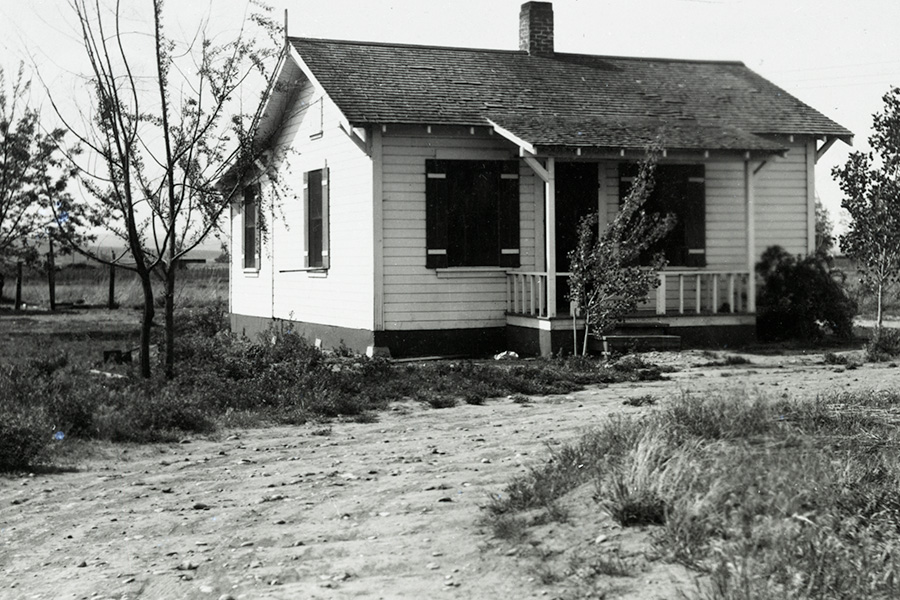
Soldier settlements, like the one between the towns of White Bluffs and Hanford, were designed to deal with an anticipated exploding labor supply of returning veterans. This photo is of one of the homes in the settlement, courtesy of the Hanford History Project.
| Courtesy of the Hanford History Project at Washington State University Tri-CitiesStrawberries and roses
Existing communities were allowed to submit bids for the settlements. White Bluffs and Hanford working together were among 20 communities in Washington seeking them.
Their prospectus outlined what they felt were good reasons to have the government place a settlement near the towns: “strawberries and roses on the table for Thanksgiving” and “two cracking good ball teams.”
Community takes shape
Their pitch worked and it was spring 1923 before the first units on 20-acre tracts were occupied. Subsidized by Washington state and administered by the Department of Conservation and Development, each tract included an unpainted three-room house. Fencing and an irrigation system of well, pump and piping came with the project.
Livestock, barns and outbuildings also were provided and most of the cost was paid by the state.
At its peak, some 58 tracts were situated between the rural communities. Two miles to the northwest of White Bluffs were another 42 units.
A network of roads was established. Soldier Settlement Road A connected the soldier settlement with Hanford and White Bluffs. The units northwest of White Bluffs were linked by Soldier Settlement Road B.
Project failure
In time, the project failed due to issues of management and operation, or restrictions on resale or lease.
Deemed by some as a “costly white elephant,” it was closed by the Washington Legislature two years after the first units were occupied in spring 1923.
In 1926, some 21 unassigned tracts were sold at auction.
“The State of Washington sold its lands on the White Bluffs soldier settlement project at public auction recently, realizing something over $50,000 on its half-million interest,” the Benton Advocate reported in its June 11, 1926, edition.
Terms were offered for the few settlers who wanted to stay.
According to one historical review of the soldier settlement idea, “these experiments failed miserably because of the agricultural recession of the 1920s and other factors.”
While much of the U.S. experienced prosperity in the 1920s, it was a decade of almost Great Depression years for the farmer. Farm prices were falling and buying farm equipment was becoming more expensive.
And the plan was not without major influences fighting it.
A major opponent was the commercial farmer who believed that adding more farmers and increasing the amount of farmland would only lead to more oversupply than what was already beginning to hurt the industry.
Others, including The National Grange and the U.S. Department of Agriculture, pitted one presidential cabinet department against another.
Gale Metcalf of Kennewick is a lifelong Tri-Citian, retired Tri-City Herald employee and volunteer for the East Benton County Historical Museum. He writes the monthly history column.