AI takes center stage in PNNL’s new biotech lab
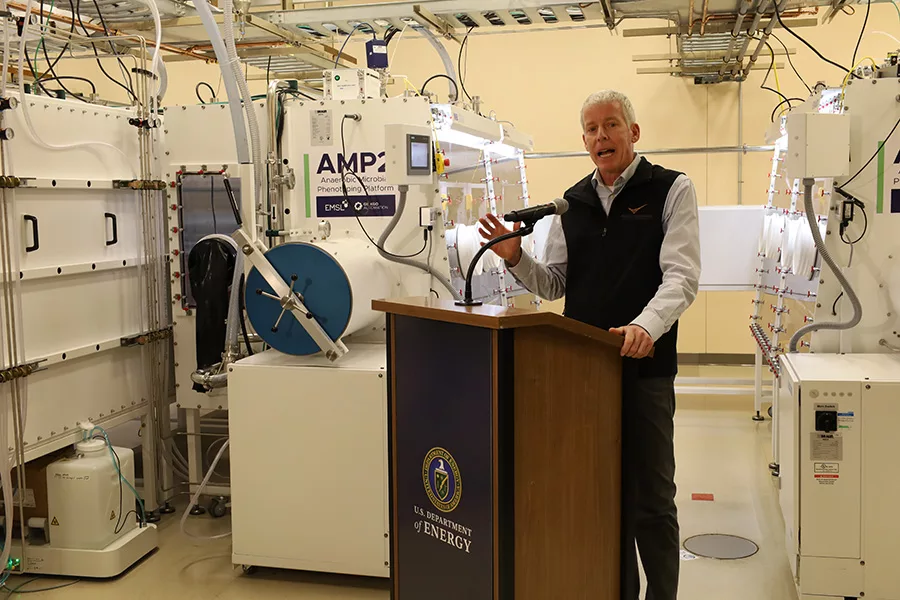
U.S. Energy Secretary Chris Wright spoke at the Pacific Northwest National Laboratory during a Dec. 4 trip to the Tri-Cities.
Photo by Rachel VisickPacific Northwest National Laboratory has opened a first-of-its-kind automated biotechnology lab that places artificial intelligence at the center of biological discovery.
The new capability expands the Richland lab’s portfolio in microbial and data-intensive science, providing the speed and scale needed for rapid advances that could lead to discoveries in health care and other areas, including energy.
The new lab – called the Anaerobic Microbial Phenotyping Platform, or AMP2 – was formally commissioned during a Dec. 4 visit by U.S. Energy Secretary Chris Wright, underscoring the broader national push to integrate AI into core research infrastructure to speed up scientific advancements as part of the Trump administration’s Genesis Mission.
Instead of cutting a ceremonial ribbon to launch the new lab, Wright pressed a few keys on a laptop.
“Biology is amazingly varied but complicated; now we finally have the tools to grasp (and) understand how it behaves,” Wright said.
Through 2026, AMP2 will support projects that further the Genesis Mission initiative. Then, in 2027, the lab will be available for use by the broader research community through a competitive proposal process.
As high-tech as the AMP2 is, the 1,800-square-foot lab is merely a prototype for a much larger lab expected to come online in four years.
In 2026, a groundbreaking is anticipated for the larger version of AMP2: the Microbial Molecular Phenotyping Capability, or M2PC, platform.
The 32,000-square-foot facility for M2PC also will be a part of the Environmental Molecular Sciences Laboratory, or EMSL, at PNNL, as the AMP2 is, and will be filled with more than 100 connected and automated phenotyping instruments.
Ginkgo Bioworks – which built AMP2 – received a $47 million contract to build this facility, which is expected to be operational by 2030.
Secretary’s Tri-City tour
The Richland national lab was the 16th Wright has visited since becoming the secretary of energy in February.
The tour comes on the heels of the Genesis Mission launched by executive order by President Donald Trump on Nov. 24. As part of the work, the 17 national labs will help build an integrated platform connecting high-tech computers and AI systems with advanced scientific instruments.
Wright’s PNNL stop followed a visit earlier in the day to the Ice Harbor Dam and preceded a tour of Hanford on Dec. 5 where he saw for the first time the Tank Waste Treatment and Immobilization Plant, or vit plant, that’s converting radioactive and chemical waste into glass.
Republican Congressman Dan Newhouse said it was a pleasure to show Wright how much Central Washington contributes to reliable, affordable American energy and innovation.
“This administration understands the role our national lab plays in the future of our nation’s energy capabilities, that our Lower Snake River dams are the shining example of hydropower in our vast energy portfolio, and that Hanford is delivering on the government’s commitment to clean up the site,” Newhouse said in a statement.
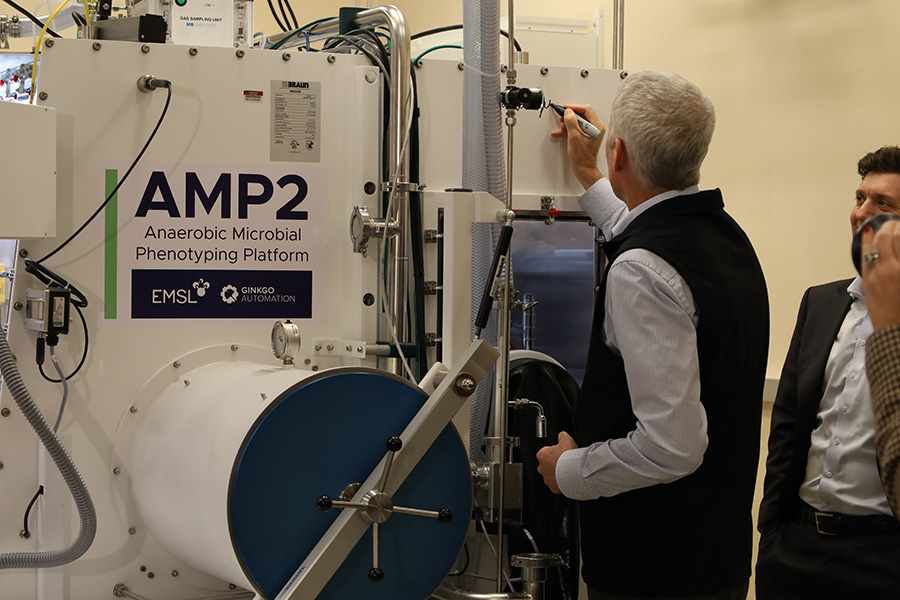
U.S. Energy Secretary Chris Wright officially commissioned a first-of-its-kind automated biotechnology lab at Pacific Northwest National Laboratory on Dec. 4.
| Photo by Rachel VisickAMP2’s role
During Wright’s PNNL stop, the themes of innovation took tangible form inside the AMP2 lab, where scientists are investigating microbes that cannot survive in oxygen, making them challenging to study. The lab allows scientists to accomplish in days what might have taken weeks, months or years, said Douglas Mans, associate laboratory director for Earth and Biological Sciences at PNNL.
“Microbes are useful for advancing the bioeconomy by converting a wide variety of natural resources and feedstocks into critical products like fuels and energy sources, chemicals, pharmaceuticals, obtaining critical minerals and metals, as well as managing legacy nuclear waste – but they’re largely unstudied,” Mans said.
The global bioeconomy is valued at more than $4 trillion but is expected to grow to more than $30 trillion within three decades – and AMP2 is expected to a critical role in the field, according to PNNL.
AI in the lab
AMP2 is made up of rows of equipment called “pods.” Each pod serves a specific function, from growing microbes in incubators to testing different functions.
In each pod, various factors can be manipulated, like what conditions the microbes are grown in and the food they are given. Often, these various stages are done in separate areas, perhaps even separate labs.
The role of artificial intelligence is linking all of these functions together, Mans said. In real time, AI can tell the software to take out a plate in an incubator, test it, and then look at the data and make adjustments to temperature, pH and more, and robotics perform the functions.
The AMP2 is special in that it helps scientists study microbes that can’t survive in oxygen, a difficult environment for scientists to work in. Functions scientists might seek to understand include extracting minerals and metals from the ground or converting CO2 or sulfur into materials they might want to use, Mans said.
Human involvement
Wright said that innovations like AMP2 won’t eliminate the need for human involvement. “Humans drive science and innovation. They always have and they always will. It won’t be fewer scientists working on science,” he said.
Mans explained that the platform is also built to be very flexible: Humans can do the experimental design and have the robotics carry it out, or humans could use the AI but ask to approve any changes, or the functions could be fully autonomous, with humans asking AI to work on a problem until a certain point.
When asked about the dangers of AI hallucination – when artificial intelligence fabricates information – Wright said that he wasn’t concerned because science is data-based and follows rigorous methods.
While PNNL has experienced recent staffing cuts, Wright said this technology will “increase positions and opportunities here.”