
WA governor looks to sharply pare spending in face of $4B budget shortfall
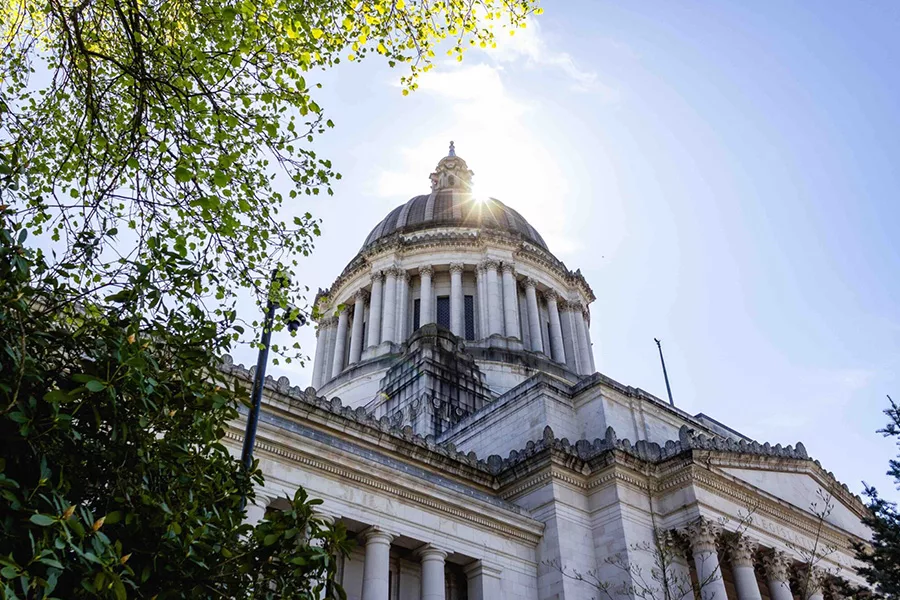
The Washington state Capitol on April 18, 2025.
Photo by Jacquelyn Jimenez Romero/Washington State StandardWashington Gov. Bob Ferguson directed state agencies to make deeper spending cuts after the latest economic forecast showed tax receipts will not make a dent in a projected $4 billion shortfall next fiscal year.
Ferguson wants agency leaders to find ways to reduce costs and pare expenditures by up to 15% through mid-2028, underscoring the state’s lingering financial difficulties amidst slow and steady growth in the economy.
“Between rising costs and billions of dollars in federal cuts, including massive cuts to health care, we are facing a significant challenge in the first year of the next budget. Today’s revenue forecast does not change that,” Ferguson said in a Nov. 16 statement.
“We now project an approximately $4 billion shortfall in the first year of the next budget. Bridging that one-year shortfall will not be easy,” he said.
It’s a better situation in the second year when the new income tax on high earners that Ferguson championed is expected to generate roughly $3.5 billion.
“The good news is our budget situation will be stable beginning July 1, 2028,” he said.
Ferguson issued his statement shortly after the bipartisan Economic and Revenue Forecast Council learned tax receipts will be $195 million higher for the budget that ends June 30, 2027, and $75 million lower in the next biennial spending cycle than what chief economist David Reich predicted in September.
Overall, the forecast shows $76.5 billion will be available for the current budget and $82.5 billion for the 2027-29 biennium.
Ferguson will rely on those data points for two documents he will release by Dec. 20: a supplemental spending plan for the current fiscal cycle and a full operating budget for the 2027-29 biennium. Those blueprints will serve as templates for legislative budget writers in the 2027 session.
K.D. Chapman-See, director of the Office of Financial Management, sent a memo to agency leaders on Nov. 16 highlighting areas of the operating and transportation budgets to consider for savings. The memo also went to presidents of colleges and universities, and other state elected officials.
The directives call for eliminating, reducing and delaying programs or services that do not meet the agency’s core mission or directly support essential services for residents. Chapman-See also instructs leaders not to submit proposals that create savings for their agency but increase costs for another program or agency.
Options for additional reductions are due to the budget office by Nov. 23. The short timeline indicates Ferguson is looking for more items to include in his budget proposal.
Ferguson also plans to update the freezes on hiring, travel, contracts and discretionary purchases, according to the memo.
The governor, who relied on new and higher taxes to balance the current budget, has said he would not propose doing so in his budget.
“I think the governor has been very consistent in his comments, both publicly and privately, that we’re not considering new revenue as part of our solution for the budget problem,” Chapman-See said in the Nov. 16 meeting of the forecast council.
More taxes are not on the drawing board of Rep. April Berg, D-Mill Creek, chair of the House Finance Committee.
“We’re not looking at revenue sources at this time,” Berg said during the council meeting. “There’s not a revenue package per se that’s coming up. We’re looking at implementation of current bills and current legislation, and looking forward to just figuring out a sustainable path forward given our budget challenges.”
Asked the same question, Rep. Ed Orcutt, R-Kalama, a council member and the ranking Republican on the finance committee, joked, “when have I ever had tax increases on the table?”
Asked if he thought the Democrats could overcome the shortfall without new or higher taxes, he said, “They absolutely can. The question is, will they?”
Budget challenges and taxes have defined Ferguson’s tenure thus far.
When he settled into office in January 2025, he claimed the chasm between incoming revenues and ongoing expenses was $16 billion. One of his first actions was to call on agencies he oversees to pare spending by 6%.
In his first session, he signed a two-year $78 billion budget crafted by majority Democrats that was balanced with spending cuts and billions of dollars in new and higher taxes. The tax package Democrats assembled totals around $9.4 billion over four years to fully cover the gap.
In the 2026 session, Ferguson championed a statewide income tax, insisting it be imposed on households with an annual income in excess of $1 million. Democrats used their majorities in the House and Senate to pass it and voters upheld the tax in the Nov. 3 election.
The tax, if it survives a legal challenge, is set to take effect in January 2028, with the first payments due in 2029. Reich estimates it will generate $3.5 billion in its first year, with collections rising in future years.
This story is republished from the Washington State Standard, a nonprofit, nonpartisan news outlet that provides original reporting, analysis and commentary on Washington state government and politics.

Stay Informed. It’s Free.
Subscribe to our newsletters and get the latest news and insights delivered to your inbox.
We respect your privacy.
Unsubscribe anytime.
Thank you!
You’re subscribed. Keep an eye on your inbox for the latest updates.