$5M allocated to ease Highway 240 gridlock
The state is ready to spend $5 million
to reduce the snarl of traffic along Highway 240 in Richland, with up to half
going toward improvements at the Duportail Street intersection once the new
bridge is completed.
Plenty of Hanford commuters, drivers, cyclists and
pedestrians have weighed in on what they think the best solutions would be.
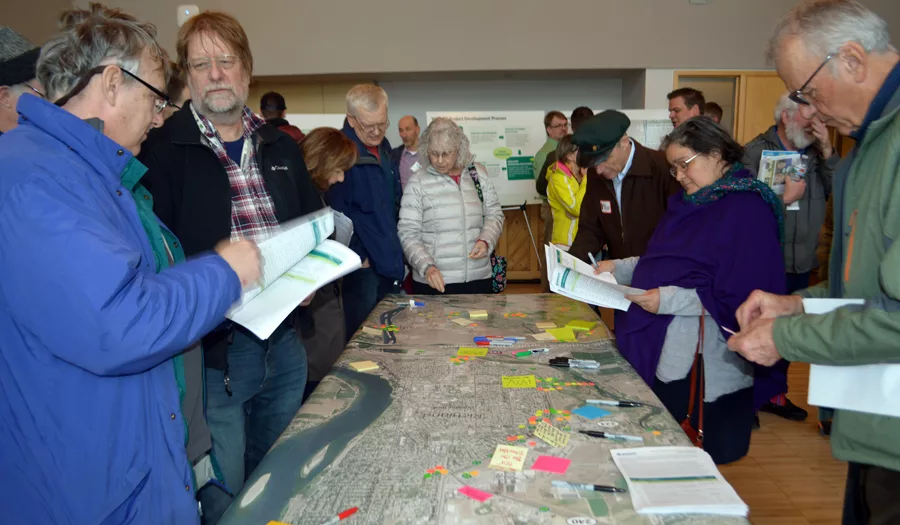
They placed stickers on a map during a recent state Department of Transportation open house to indicate the solutions they preferred, or thought would have the greatest effect on the congestion along the busy stretch of highway.
The Richland corridor covers the intersection of highways
240 and 225 to the north, near the Hanford nuclear reservation, and Interstate
182, near Queensgate Drive, to the south.
WSDOT and local partners — known as the M3 team for its
multi-agency, multi-disciplinary and multi-modal approach — developed a list of
potential solutions.
The M3 team scored each potential solution on its
effectiveness and feasibility, factoring in issues like traffic, safety, air
quality and cost. None of the offerings earned a score higher than 49.
“They were tasked within their agency to look at all
different options, not only what can you get with $5 million, but maybe, ‘What
else can we look at?’ ” said Julie West, transportation and development manager
for public works for the city of Richland.
Hanford worker Kurt Gustafson deals with the backups on a
regular basis. “I leave for work two hours early because if I leave half an
hour later than that, it’s a nightmare,” he said.
At the end of the workday, he chooses a longer route that
has fewer stops for traffic lights or slowdowns.
“It takes about the same amount of time, but with this way,
I’m driving and I’m driving and I’m driving. It’s a psychological thing,” he
said.
Gustafson and his friend Brandon Dieter attended the
mid-March open house to review the potential solutions. They added their
stickers to endorse the idea of building a bridge across the Columbia River at
the north end of Richland to connect with Pasco and Franklin County.
“I think that’s the biggest, single thing you could do,”
Dieter said.
The bridge, estimated to cost from $195 million to $260
million, would be near Washington State University Tri-Cities and Hanford High
School.
Gustafson said the proposed bridge would resolve congestion
most effectively by allowing drivers headed to Kennewick and Pasco to skip
central Richland altogether.
“If you divert a bunch of the traffic before they even get
to these points (southernmost George Washington Way), then the rest of these
solutions, I don’t think, matter as much,” Gustafson said. “Added capacity
options won’t matter if you’ve already diverted.”
Keeping traffic out of central Richland is an idea Debbie
Berkowitz supports, but she’d rather not see it come with a new bridge.
“I think there are ecological factors that aren’t being
considered,” she said.
She would rather send more traffic to the bypass highway.
“I want to see the traffic relegated from George (Washington
Way) onto the bypass so you don’t have a through-street on George. That way,
it’s just a city street. What they call, grade-separated interchanges,” she
said.
The bridge favored by Gustafson and Dieter scored 37, making
it the second-highest on the list in the “add capacity” category, just behind a
much cheaper option to add capacity between Stevens Drive-Jadwin Avenue and
I-182. This scored a 39, with an estimated cost varying from $16 million to $22
million.
The money for the traffic study and possible solutions
covered by $5 million will be paid for through the Connecting Washington
funding package, primarily sourced with an 11.9-cent state gas tax put in place
in 2016.
The overall package is expected to
raise $16 billion across the state over 16 years.
Richland received $20 million from this
same funding package toward construction of the Duportail Street Bridge, which
will connect the Queensgate area with the central part of town, near Wellsian
Way.
This bridge, currently under construction, is still in its
first of two phases, but Rudy Guercia of Richland already thinks mistakes were
made on alleviating congestion.
“The state screwed up by not requiring an overpass at
Duportail when the city put that bridge in. The state ought to tell the city,
‘Put it in.’ It shouldn’t be the state’s problem that the city was stupid.”
Guercia believes local congestion is a mess of its own
making, and that drove him to attend the open house. He believes the flow of
traffic could increase on the bypass highway if most of the intersections were
removed entirely.
“I have an iconoclastic view. My view
is that they ought to shut the traffic lights off on the bypass and force the
traffic into the city,” Guercia said. “I was talking to the county air guy, and
he doesn’t want all these cars idling. I agree with him. Take the stupid lights
out, people won’t be idling.”
Removing intersections wasn’t a solution offered by the
state, but attendees were welcome to add their own suggestions to the list.
Synchronizing the lights on the bypass
was an option. Other plans for the bypass, on the list presented to the
community, included permanently changing the direction of one northbound lane
to southbound.
With a ranking of 34, this came in just behind the bridge to
Pasco as far as effectiveness in the “added capacity” category.
Other high-ranking solutions in a category titled, “traffic
systems management and operations,” included creating a high-occupancy vehicle,
or HOV, express lane during rush hour, changing a current lane to be an HOV
lane during peak travel times, or creating two new reversible lanes that would
work similar to the express lanes on Interstate 5 in the Seattle area. The
latter option would open the new, reversible lane northbound in the morning and
then turn it southbound in the afternoon.
Many in attendance were in favor of a return to the busing
system once used to bring Hanford workers to the site.
“I think if they had Hanford-use buses again, like they used
to, and not having the parking at the 1100 Area, but in the south part of town,
or Kennewick or Pasco, it would actually free up the bypass,” Berkowitz said.
The buses were once operated by the Department of Energy and eventually phased
out.
WSDOT is committed to spending the full $5 million, but the
sky is still the limit on ideas for improving congestion.
“There are several intersection projects we can stitch
together with that $5 million,” said Paul J. Gonseth, WSDOT regional planning
engineer. “We’re going to take what people consider the most important, of the
lower cost ones, to spend that $5 million. And then we’re going to take some of
the higher suggestions and do some further study to refine them and figure out
what they will be, so we can get the big picture of what they’re going to cost.
We can then take it to the Legislature to work on finding funding.”
The state hasn’t yet determined which projects to fund,
other than spending up to $2.5 million on intersection improvements at
Duportail. Construction wouldn’t begin until next year, Gonseth said.
The state Legislature would need to approve a project like
the bridge to Pasco, which was the most expensive choice on the list of
potential solutions. But other options cost less than $50,000 and were ranked
25 and higher for their impact, including coordinating traffic signals on 240,
promoting vanpools and implementing anti-idling ordinances.
Other inexpensive solutions to increase the connectivity for
cyclists and pedestrians included creating separate bicycle lanes at Duportail
and Highway 224-Van Giesen Street, as well as relocating the Greenbelt Trail
crossing at Van Giesen to Highway 240. The most inexpensive solution on the
list was a $10,000 project to restrict northbound U-turns near the MoonRiver RV
Resort on Saint Street in north Richland.
The state also is looking at ways to
improve congestion at Aaron Drive, where traffic often backs up onto Wellsian
Way near the Richland Fred Meyer, as drivers head west on Aaron to access I-182
or 240.
Potential solutions cost between $3.4 million to $4.6
million for a roundabout, to 10 times that cost to create a grade-separated
interchange.
The recent open house was the culmination of a process that
began in September 2018 to identify the root of the congestion problem and its
possible solutions. This included two separate online surveys, with the first
including about 2,600 respondents between September and October 2018. What was
learned from this survey was that the heaviest users of the bypass, those who
travel it five or more days a week, cited “traffic” as the biggest problem in
the corridor.
Those surveyed who traveled the bypass one or fewer times a
month cited “unsafe passing” as the biggest problem.
A second survey of about 1,000 respondents took place
between November 2018 and early January 2019. About two-thirds said they drive
on the bypass five to seven days a week. The most favored solutions from this
group included adding lanes on the bypass between Stevens and Highway 225,
programming the signals on the bypass to favor traffic and building a bridge
near WSU Tri-Cities to improve the bypass from Stevens to I-182.
Now, the state and M3 team will work to refine and implement
some of the options using the $5 million currently available.
“We have a team of partners we’re working with,” Gonseth
said. “We’re going to take this information, and all the stuff that we’ve done
so far with rating projects, to them, to help filter through and find out how
to prioritize. DOT as an entity of its own will not do it.”
Larger, expensive projects will require approval by the
state Legislature. Design work on any of the initially-chosen projects will
begin this summer, with the goal of completing the work by the end of 2020.
Additionally, the city of Richland will find ways to improve
240 with another north-south option that runs parallel to the bypass, near
Kingsgate Way. Ben Franklin Transit also will look for funding to create
additional park-and-ride locations and increase vanpool use.
“Let’s use what we already have more efficiently,” Gonseth
said.