
98-year old remembers Day’s Pay campaign that helped build Kadlec
Hanford workers gave up a day’s pay in 1944 to buy a B-17 Flying Fortress for the Army Air Forces.
A less known fact: Hanford workers were rallied to support a civic effort again 1970. This time, they were asked to contribute to a new building for what was then called Kadlec Methodist Hospital in Richland.
Hanford retiree Virginia Sather—Ginger to her friends—wants to make sure the second day’s pay effort doesn’t pass unnoticed as the hospital comes off its 75th anniversary celebration in 2019.
Sather, 98, arrived in Richland as a young woman to work for DuPont at the Public Exchange at Camp Hanford in the early days of the World War II. She committed to four months. She worked at Hanford for 40 years, working in positions across the site, including at N Reactor.
She figures she’s one of the few—if any—workers left who remember being asked to donate a day’s pay when the hospital outgrew its old barracks-like quarters. Kadlec had to raise local funds to qualify for government dollars.
To her, it seemed natural that Kadlec would enlist Hanford workers. A generation earlier, Hanford Engineering Works employees donated a day’s pay, raising more than $300,000 to buy the bomber christened Day’s Pay.
“It worked with the airplane. Why don’t we try it for the hospital?” she said. “So they did and it worked.”
So once again, Hanford workers were asked to give up a day’s pay.
Sather and her husband, Dick, also a Hanford worker, signed the paperwork. She doesn’t recall the amount that came out of their paychecks. She wasn’t one to save pay stubs, she said.
She did save the souvenir she received for signing up—a small plaque honoring their participation in Kadlec’s “TARGET ’70” community fundraising campaign.
A document glued to the back acknowledges the gift from “Mr. and Mrs. Robert Sather.”
The president of the Kadlec Medical Center Foundation, A.M. Waggoner, signed it.
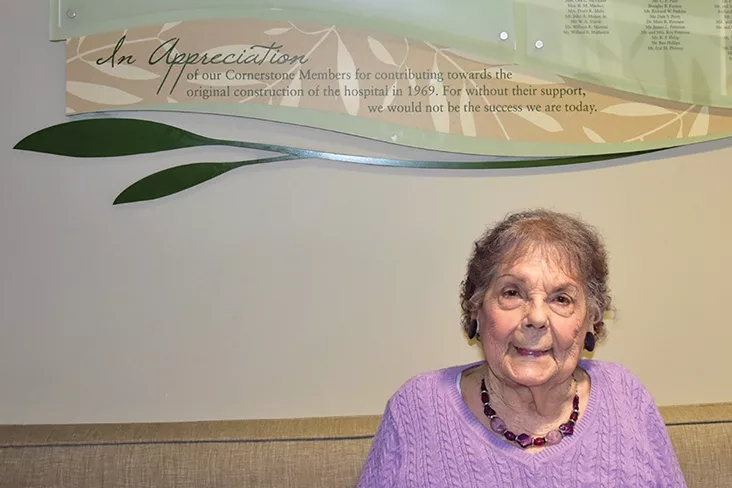
Kadlec’s own account of its history confirms the community support that made the new building possible. Donors names are highlighted on a plaque in one of the hospital’s waiting rooms. Sather visited the hospital to share her story. A photographer recorded the occasion.
The TARGET ’70 campaign was led by the widow of the hospital’s namesake, Lt. Col. Harry Kadlec. Kadlec, the officer, was deputy area engineer and chief of construction for the Army Corps of Engineers—one of the top officials involved with the Hanford project. He was also the first to die at the hospital following a heart attack reportedly brought on by overwork.
The community campaign raised $1 million. The four-story building with 138 beds and an entrance on Swift Boulevard opened on April 7, 1971. The hospital has expanded since then, but the four-story building is still a part of the complex.
Sather experienced the hospital firsthand as a patient more than once.
An independent spirit, she hailed from Des Moines, Iowa. Her mother, who shared her spirit and had her own car long before women dreamed of driving, died of breast cancer when Sather was 10.
Sather’s relationship with her father was difficult and inspired her to seek out ways to live independent of him and of Iowa.
When she finished high school, counselors told her girls got married and college was for boys.
She rejected the notion, choosing adventure with friends and a romance with a tall man who would join the Air Corps and perish when his bomber was shot down over Germany.
In time, she found her way to Southern California, following a friend who told her it was booming for the war effort and jobs were plentiful. Sather had trained as a welder. In California, she went to work in a Navy hospital near Los Angeles.
The desert was dusty, but she enjoyed the jaunts into town to see shows. Gasoline was scarce but doctors usually had the means to travel and it wasn’t hard to find rides.
She wasn’t interested in leaving, but her friend enticed her to consider moving to Alaska for another project on another job. The project was iced for bad weather. The recruiter suggested the two young women consider Hanford instead.
Sather had traveled a bit after high school, but Washington was fresh territory for her.
The offer appealed to her. If workers stayed for four months, the company would pay their return fare. She decided to give Camp Hanford four months. Her friend lasted four months. Fate had other plans for Sather.
In a camp where men vastly outnumbered women, she met Robert Sather. He was 6-foot-3 and handsome enough to be mistaken for a movie star.
The couple married. Sather didn’t initially want to take her husband’s name and only did so reluctantly when her job was threatened. “You can’t do that!” was one of her husband’s favorite sayings. “Thank God I was born in America!” was another.
The couple qualified for a prefabricated house, but disaster struck on a cold December day when an electric fire broke out. Sather, who was home, fled with a drawer containing keys and other important items.
Her hands were blistered, and her hair burned. She was taken to the government hospital that would eventually become Kadlec.
That wasn’t her only visit. An ectopic pregnancy led to a ruptured appendix and other complications. She was rushed to the hospital again. The hospital’s three surgeons worked to save her life. Hanford workers with the same blood were summoned for transfusions —there was no blood bank then.
The Sathers would in time adopt a son and build a home in Kennewick, overlooking the Columbia River above what is now Columbia Park.
They didn’t expect to remain in the Tri-Cities beyond World War II. Both anticipated layoffs when the war ended, but instead they were transferred from job to job until both retired in the 1980s. Sather, always ambitious, was always looking to advance.
She enrolled in night courses at Columbia Basin College when it first opened, taking shorthand, typing and any business class she thought would help her move up. She’d moved to Richland as a young adult to work for DuPont in the Post Exchange at what was then Camp Hanford during World War II.
Her clear eye for detail and sharp memory have attracted attention of those working to record the history of Hanford’s early days. The Hanford History Project, an initiative of Washington State University Tri-Cities, conducted a detailed interview to record insights into early life and operations of the nuclear reservation.
Sather was widowed in 2015 when Dick suffered the last in a series of strokes following 71 years of marriage.
Today, she lives in the house they built with an orange tabby named Kitty Cat that once kept Dick company. She has congestive heart failure and uses a walker to get around.
She is unsparing in her assessment of outliving her husband, friends and siblings.
“It’s sad,” she said. “All my friends are gone. It’s a very lonely business.”