
Precision play
Tri-Cities couple builds a luxury puzzle empire, one piece at a time
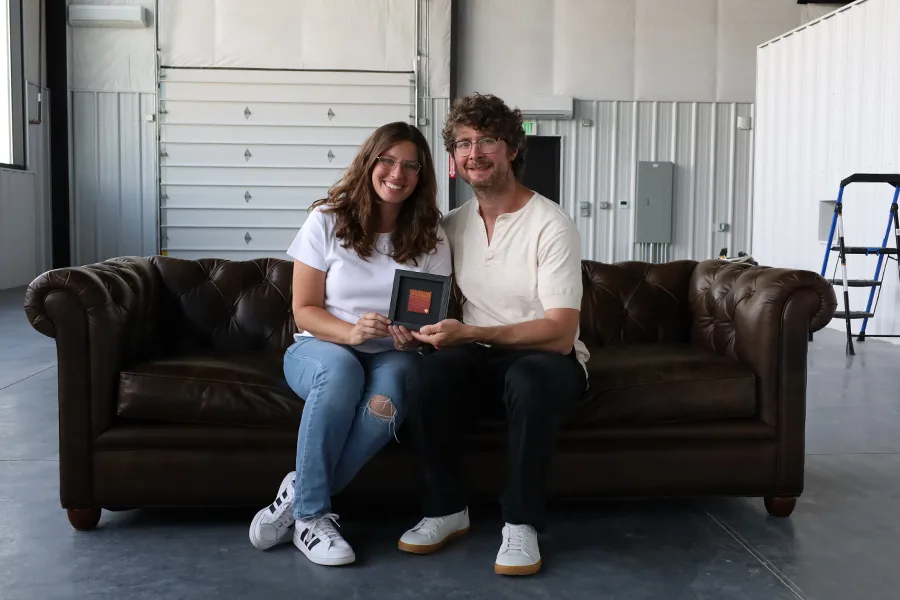
Kayla and Peter Clyde, owners of Lazels, a high-end puzzle company, sit on a couch inside their new Kennewick workshop.
Photo by Rachel VisickThe makers of tiny, high-end titanium puzzles that are sold worldwide live and work here in the Tri-Cities – and their growing business is about to outgrow its garage-turned-workshop roots.
Owners Peter and Kayla Clyde have been all-in on their limited-edition puzzle business, Lazels, since Peter Clyde first figured out how to make detailed puzzles out of titanium about six years ago.
The couple invested their life savings, and Peter Clyde quit his job to chase the venture, which has ultimately been a pursuit of craftsmanship.
“We’re trying to figure out what is the most beautiful thing we can make each time, and then after each design we finish, we then try to push ourselves and try something new that then makes the intricacy and complexity higher,” he said.
Their attention to detail and commitment to quality have built a loyal following in the luxury puzzle world.
Each new design regularly sells out. Their puzzles are on display in an Italian puzzle museum. Their business was featured in a New York Times story last year about couture puzzles. And many of their mini works of art sell for about $1,000 apiece.
“We want every puzzle that we make to be the best puzzle we’ve ever made,” Peter Clyde said.
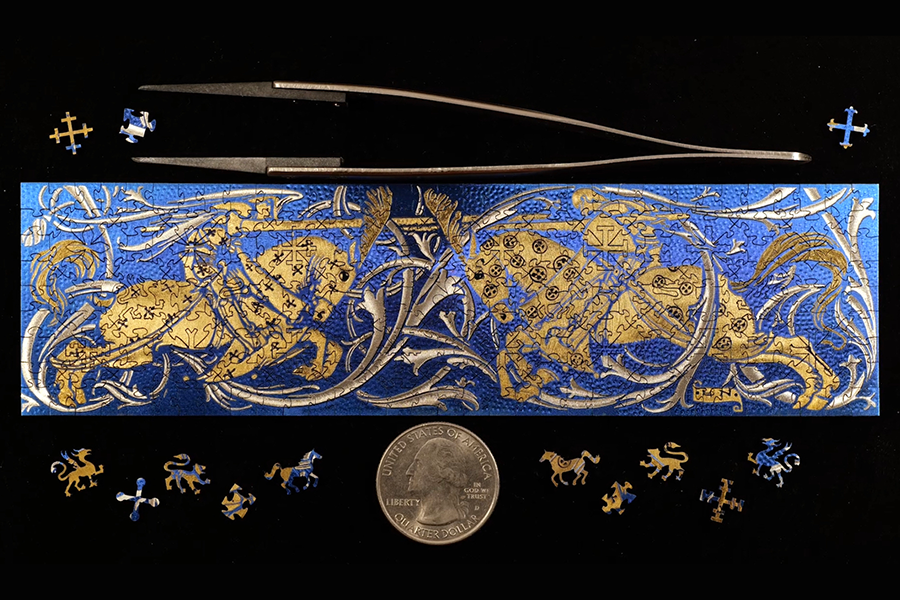
Peter Clyde often gets his inspiration from old books and illustrations. In “Joust,” the history inspired not only the design, but the shapes of the pieces as well.
| Courtesy LazelsPuzzles like jewelry
Peter Clyde’s background is in the miniaturization of technology as an engineer, and before that, he wanted to be a jeweler. He found the engineering industry frustrating because with each year, new technologies would emerge and his work would need to be redone.
“I wanted to make something that would last and never be forgotten and not have to be just redone,” he said.
He focused his interest on titanium, a material that could be shaped, colored and wouldn’t tarnish, with the concept of making “puzzles like jewelry.”
Lazels puzzles are so small they need to be put together with tweezers, faceted like a watch so that they reflect light just right, and they’re intricately cut, often with a variety of “whimsy pieces,” or puzzle pieces shaped like animals or other figures.
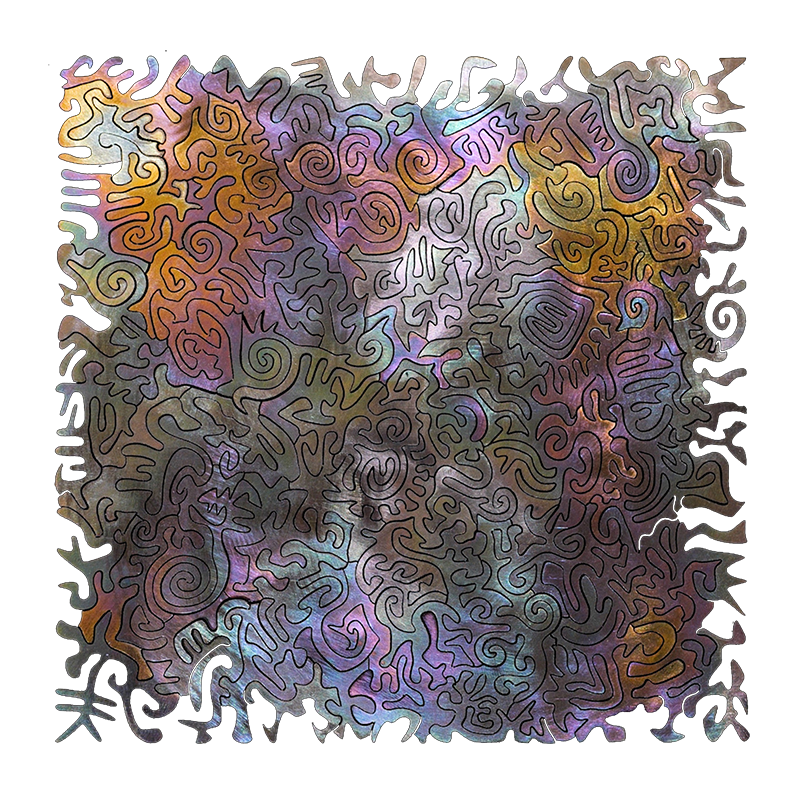
Lazels’ titanium puzzles are colored by applying heat or voltage to the metal.
|Courtesy Lazels
To make puzzles that had never been made before, Peter Clyde had to engineer his own machines to do what he was looking for. It’s a process entirely different from making puzzles from wood.
The first step is idea gathering. Peter Clyde likes collecting old books, and for one puzzle, “Joust,” that’s where the design came from: an old black-and-white illustration.
He scanned the drawing in high resolution, then digitally hand-sculpted the scrollwork, the texture on the horse, and the small, hammered dimples in the background. The design was then converted to be lasered, so that when the light reflects off the puzzle, it shows the textured background, the muscles on the horse, and the shine of the scrollwork.
Paints and dyes aren’t used to color the titanium. Instead, heat or voltage is applied to bring out certain colors in the metal.
Peter Clyde said that about 90% of their work is hand processes, while 10% is done by machine.
Over time, Lazels has accumulated a four-person team in addition to the Clydes. Peter Clyde said they wanted to grow slowly because each step in the process is so intricate that a person has to be a master at it. A lot of training has been involved, he said, because no one else does what they do.
Limited quantity
Once a puzzle is complete, Lazels plans a puzzle drop. Those interested in buying a Lazels puzzle can sign up online for a notification list, and about 24 hours before the drop, they send a text announcing the drop time.
Only a set number of each puzzle are made, so once all the orders are spoken for, they’re sold out. The numbers are limited so that Lazels can give each puzzle as much time as possible rather than making them fast.
The puzzles get snapped up quickly, sometimes selling out in 10 minutes, Peter Clyde said, with people all over the world setting alarms for the drop times. Lazels also posts new designs on its Instagram page, which boasts about 190,000 followers.
Lazels spends about 16 weeks producing all the puzzles in one set, each one numbered, and then that puzzle will never be made again. Peter Clyde said about half of his time is spent designing the next puzzle, while the other half is in production. Currently, Lazels is about a quarter of the way into its next puzzle design.
The puzzles typically cost $2 to $4 per puzzle piece for titanium puzzles. The most expensive was priced at around $1,300, Kayla Clyde said, and many are around $1,000.
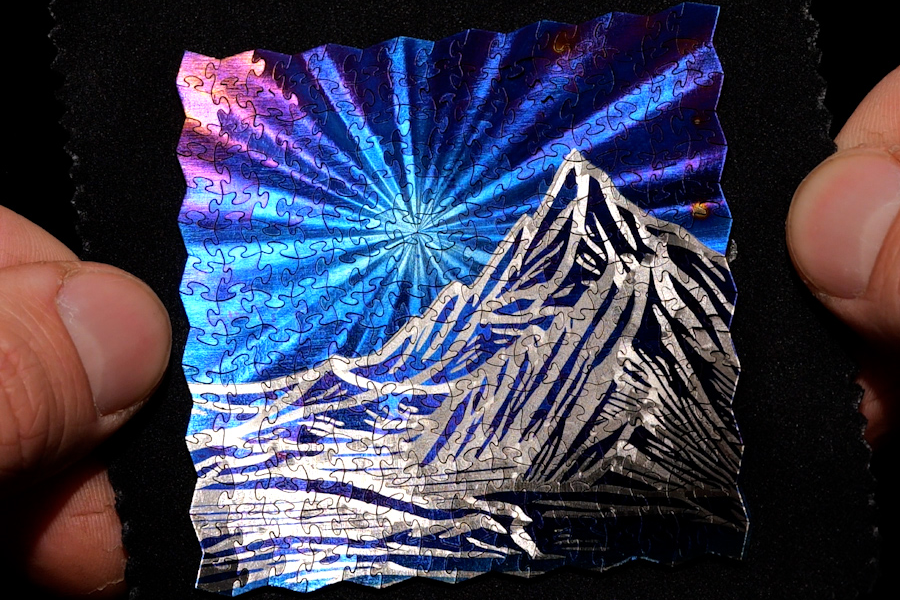
Lazels specializes in puzzles on a tiny scale. Each puzzle comes with a pair of tweezers to piece it together.
| Courtesy LazelsWorking in wood
After years building a titanium-focused brand, Lazels has ventured into a new medium for its most recent puzzle: wood. But it’s not an ordinary puzzle, and it’s not made of ordinary wood.
Peter Clyde kept coming back to the idea of a wooden puzzle over the years, trying to figure out how to make a wooden puzzle as intricate as he wanted.
In the end, he got to it through the lens of a luthier: How would a craftsman of instruments go about making a puzzle? Peter Clyde said they layer the wood themselves using instrument-grade sugar maple for a strong and dense material, able to handle the fine details the Clydes wanted.
The resulting puzzle, “Anomaly II,” is hand-dyed and features one gold-leafed puzzle piece.
The craftsmanship extends to the puzzle’s display. Lazels puzzles come with a frame, a titanium puzzle tray and tweezers.
The display is made in-house, with a wood frame and leather carefully crafted to fit the edges of the puzzle “like a glove” and hold it vertically.
New workshop
Producing the frames has taken up a lot of space, Peter Clyde said. Lazels started out in their two-car garage, then the couple built a new shop on their property. Now, they’re moving into a proper workshop space: a 6,000-square-foot building with room for a second one behind it.
“Since each step is so important, we want to dedicate a large amount of each space for each step, so that we don’t have to keep resetting our equipment and moving stuff around,” he said.
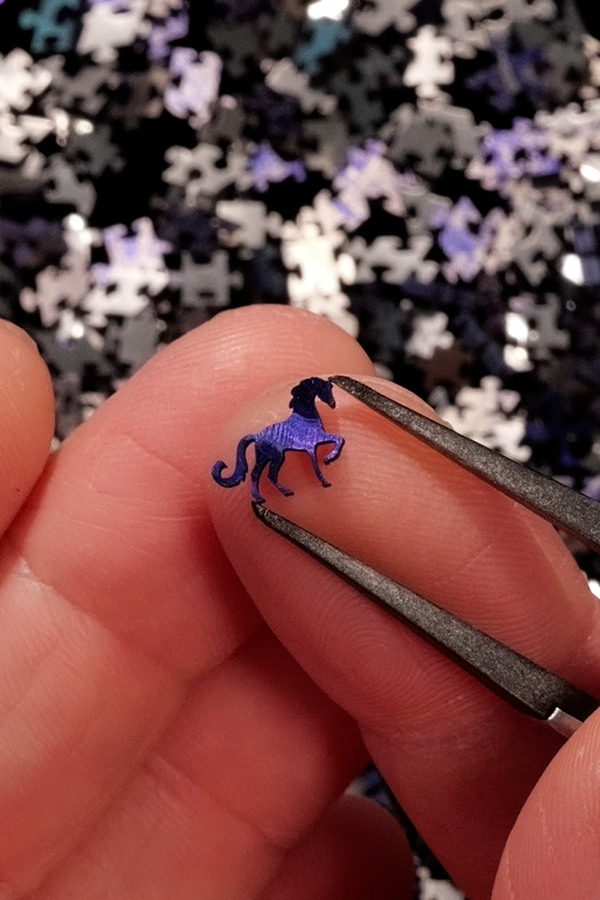
A tiny titanium whimsy puzzle piece in the shape of a horse from the “Galahad” puzzle.
|Courtesy Lazels
Between the land purchase and construction costs, the Clydes have invested more than $1 million in their new Kennewick workshop, according to building permit and property records.
The Badger Canyon building off Wiser Loop features large windows to let in natural light and keep the Clydes connected with the Tri-Cities’ natural landscape.
Lazels began moving into its new space in early July.
Local presence
Lazels puzzles have shown up in interesting places over the years. Some are in the World Puzzle Center, a museum in Panicale, Italy, while others have popped up on eBay, sometimes selling for far more than their original price.
But for the Clydes, hometown connection is important.
Kayla Clyde grew up in the Tri-Cities and brought her husband to the area with her after they met in the Seattle area. Since they’ve worked out of their private studio at home, few people have known that Lazels is here, even if they recognize the name.
While their new workshop won’t be open to the public, “we’ll have a presence, so that people know we’re here,” Peter Clyde said. In the future, the couple hopes to have a public space available to display past designs.
Go to: lazels.com.