End of low-cost power is barrier to economic development
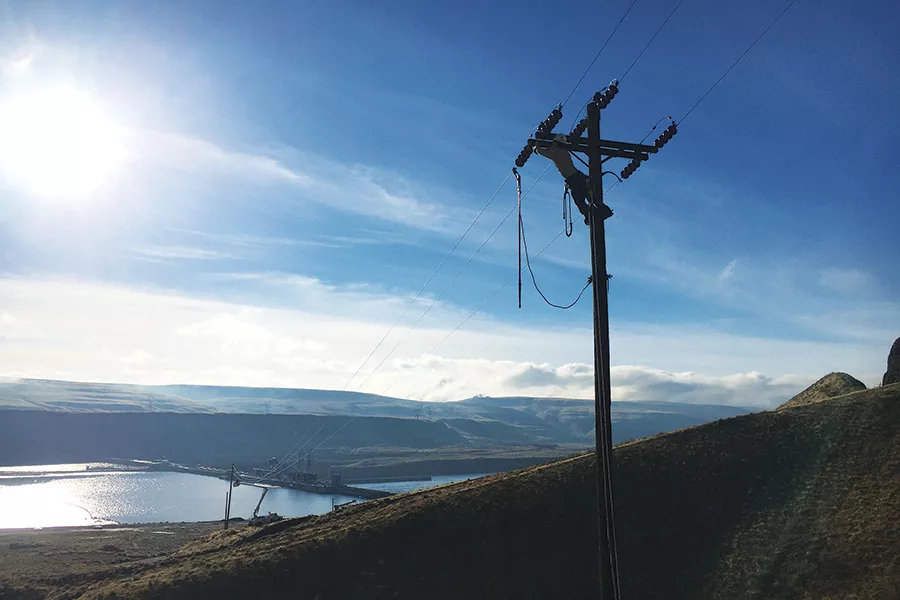
A lineman works on a transmission line above Lower Monumental Dam, which bridges Franklin and Walla Walla counties on the lower Snake River.
Courtesy Franklin PUDIn Ferndale, near Bellingham, a battle is being waged over a shuttered aluminum plant.
Alcoa closed the plant in 2020 – and permanently idled another near Wenatchee in 2021 – but it is targeted to reopen using green energy to produce aluminum. The plan is widely supported as a major job creator, with a notable exception.
The Bonneville Power Administration won’t power it, saying it can’t assure Alcoa Intalco Works the uninterrupted power it needs.
In May, a dozen members of Washington’s congressional delegation moved to intervene, urging BPA to work with Blue Wolf Capital to find a solution and generate 700 jobs at the site.
The stakes couldn’t be higher for the Tri-Cities, or the many Northwest communities served by electric utilities that buy power from BPA.
BPA supplies power to the Benton and Franklin public utility districts, Benton Rural Electric Association and Richland Energy Services.
Effects of power cap
BPA caps new customers for its cheapest Tier 1 power at 10 megawatts. That’s about the power used by 7,000 homes and it rules out power-intensive industry, particularly those that depend on high heat such as aluminum smelting.
The rate essentially doubles when demand rises above the 10-MW cap. The cap, which applies across the system, reflects a simple reality: BPA is nearing its capacity to deliver power, particularly during the so-called low-water years that affect the output of dams.
“We are probably at the capacity of the system right now,” said Bob Schuetz, CEO of Energy Northwest, during a November energy summit in Kennewick organized by the Association of Washington Business.
Energy Northwest operates the
1,200-MW nuclear plant north of Richland, White Bluffs Solar Station, Packwood Lake Hydroelectric Project and the Nine Canyon Wind Project and sends power to BPA.
For the economic development community, the cap means energy intensive industry must look elsewhere or purchase expensive power on the open market.
“We have good rates as long as you don’t exceed 10 megawatts,” said Karl Dye, president of the Tri-City Development Council (TRIDEC), the region’s economic development agency.
Reaching capacity limits
Dye said TRIDEC occasionally fields inquiries from location scouts who still think the Northwest is a haven for cheap, abundant power, which it was in the decades after BPA formed in 1934, thanks to abundant hydropower.
Population and industrial growth have put the system on notice. Coupled with Washington’s ambitious manufacturing goals and a shift away from traditional power sources – think coal and possibly natural gas – BPA’s vast portfolio of generating stations and transmission lines is reaching its limits.
BPA distributes power generated by dams and other facilities to 142 utility customers, including cooperatives, municipalities, public utilities, federal agencies, investor-owned utilities and tribal utilities. Its 300,000-square-mile service area is home to 14.4 million residents and is tied together by more than 15,000 miles of transmission lines and 262 substations.
Dye, who joined TRIDEC in February 2020, said power was the first order of business when he came to the Tri-Cities. In his first week, shortly before pandemic shutdowns took effect, he met with utilities and BPA.
“How do we get more power to the Tri-Cities?” he wanted to know.
The Mid-Columbia is well-positioned to become an energy leader, thanks to local expertise in building and operating nuclear facilities as well as dams, wind farms and solar stations. Producing hydrogen, which entails splitting water, is a potential industrial target, but would exceed the energy cap.
Manufacturing the actual equipment could be feasible.
“We are well-positioned to create clean energy here, but BPA rules are a damper,” Dye said.
Dye sees small modular nuclear reactors as the future, along with potential policy shifts that would prioritize economic development within BPA, as it is with its semi-sister, the Tennessee Valley Authority.
X-energy, together with Energy Northwest and Grant County Public Utility District, aims to develop a fourth-generation nuclear plant to the Energy Northwest campus, though not before 2027.
Electricity is missing piece
In the interim, Darigold Inc., the Seattle dairy cooperative, is a telling example of the type of business the region can expect to attract. It broke ground in September on its $600 million butter-and-milk powder facility in Pasco.
Like all food processors, Darigold relies on heat to turn raw ingredients into consumer products. In Pasco, it will process 8 million pounds of milk, relying on clean-burning, state-of-the-art natural gas systems to do the job.
Natural gas only goes so far. Washington state aims to double manufacturing jobs by 2031 under a bill sponsored by then-Rep. Matt Boehnke, R-Kennewick, in 2021. Boehnke will be seated in the state Senate in January.
His bill, Building Economic Strength Through Manufacturing Act, aims to add 300,000 new jobs and double the number of small manufacturing firms. The bill was unanimously approved in the House and Senate and took effect in July.
At the time, Boehnke said the state, working with business, unions and the building trades can position Washington as a manufacturing “powerhouse.”
Dye applauds the goal, but said there is a piece missing, electricity,
“We need more power to make more stuff,” he said.