
Megabill’s elimination of tax credits for clean energy projects could cost WA $8.7 billion
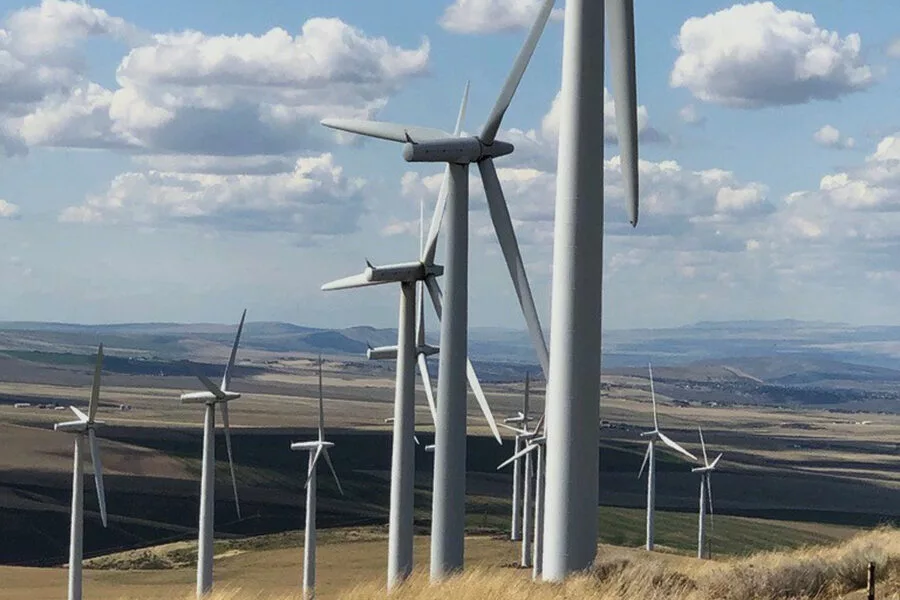
Officials are warning that the megabill passed last week will likely raise Washington households’ electricity costs and eliminate thousands of jobs in Washington’s clean energy and manufacturing sectors.
The federal legislation doesn’t override Washington’s goal to fully transition all electric utilities in the state to clean energy by 2045, but it makes the work more challenging.
“We have these great programs that are working, and now’s a great time to double down on those absent federal leadership so that we truly are getting to these goals, which we think we can still do,” said James Hove, the Washington state director of Climate Solutions, a nonprofit that seeks to accelerate clean energy solutions to address the global climate crisis.
The new law increases the requirements for developers to claim tax breaks for wind, solar and other renewable energy projects, and fully does away with those incentives by 2028.
New projects must be under construction by the end of the year to qualify for the lucrative credits.
The tax credits, passed by Congress in 2022, have generated $978 million in new private-led investment across seven energy manufacturing facilities in Washington, according to analysis by think tank Energy Innovation.
Due to the phase out of those tax credits, an additional $8.75 billion in outstanding investments to 27 facilities in Washington is at risk.
The data has been cited by the U.S. Climate Alliance, a bipartisan coalition of 24 governors, including Washington Gov. Bob Ferguson, committed to advancing state-led, high-impact climate action.
Calling the rollbacks “a disastrous step in the wrong direction,” Ferguson said the legislation threatens Washington’s energy security and electric grid reliability at a time of soaring electricity demand.
Clean energy projects scheduled to begin construction by the end of the year can continue as planned. But many will likely be delayed or stopped as developers scramble to find other funding sources to overcome the loss of federal assistance.
“We’re stopping production of certain energy. We don’t have enough energy as it is and … it’s not like we have other forms that are going to take that place right away,” Hove said.
Washington committed to switching from fossil fuel-generated electricity to clean energy alternatives with passage of the Clean Energy Transformation Act in 2019, so reinvesting in fossil fuels to power the grid isn’t a realistic option.
“You don’t just on a dime switch things and have those things be reversed,” Hove said.
The infrastructure needed to produce electricity from fossil fuels is expensive and harmful to both people and the environment, Hove said. It’s why the state, prioritized investing in clean energy.
“It’s cheaper … and more sustainable and more resilient to climate impacts to have a grid that’s based around those types of resources,” Hove said.
The U.S. Climate Alliance estimates that the decline in clean energy projects as a result of the law will cause electricity costs for Washington households to increase by $115 per year by 2029.
Homeowners can still qualify for credits of up to 30% of the cost of clean energy home improvement projects through Dec. 31. But because construction must be underway by the end of the year, making use of those credits will be difficult for Washingtonians who haven’t already started their projects.
A controversial excise tax on wind and solar was not included in the final bill, but the bill does maintain and expand subsidies for fossil fuel industries.
“This bill is anything but beautiful for Washington. It’s a fossil fuel wish list that penalizes clean energy and favors pollution,” Ferguson said in a news release last week.
Job loss is also a concern, as the U.S. Climate Alliance estimates that 21,800 Washingtonians in the clean energy and manufacturing sectors will lose their jobs by 2030 due to the loss of tax credits, according to information released by Ferguson’s office last week.
Thousands of electricians are already unemployed in Washington due to long project permitting processes, energy shortages, grid unreliability and other investment-related issues, according to Matthew Hepner, the executive director of Certified Electrical Workers of Washington.
The law will only exacerbate the problems, Hepner said.
Washington has been slow to permit projects under the Clean Energy Transformation Act, but projects are now at the point where people are being hired for the work, Hepner said.
“And now they’re drying up at the worst possible time,” he said.
Certified Electrical Workers of Washington represents the six Washington chapters of the labor union International Brotherhood of Electrical Workers, which have a combined total of about 11,000 members.
The bill directly threatens jobs by cutting funding to existing and future energy projects while sending the subsidies to oil refineries, Hepner said.
Energy Innovation estimates that if the 27 projects with funding at risk don’t go forward, Washington will directly lose 10,000 jobs in 2030 and another 9,500 in 2035.
While the forecast is bleak, Climate Jobs Washington, a coalition of labor unions, is encouraging state and local leaders to continue pursuing clean energy projects in the state.
“Clean energy is our greatest opportunity to build an affordable economy in Washington State, with good union jobs for workers and a stronger, more reliable electrical grid. That doesn’t stop today, even if federal leaders strip away support for this vision,” Climate Jobs Washington said in a statement ahead of the megabill’s signing. .
Hove remains optimistic.
“We’re incredibly grateful to have such a resilient state, and we’re well positioned to still lead on this,” Hove said. “But it certainly does not help to have this bill go through like it did.”
This story is republished from the Washington State Standard, a nonprofit, nonpartisan news outlet that provides original reporting, analysis and commentary on Washington state government and politics.