Stroke patient credits Kadlec’s rehab clinic for playing key role in recovery
By Andy Perdue
Every day since I suffered a stroke on Nov. 12 has been part of my long journey back to recovery.
It wasn’t a massive stoke — my doctor gave it a seven on the 1-10 scale — but it left the left side of my body all but useless.
Kadlec’s In-Patient Rehabilitation, or IPR, is a little-known gem in the Tri-Cities that played a key role in my recovery.
After spending three days in acute care, I was admitted to IPR, which would be my home for the next two months.
The concept for IPR is brilliant. The patients live there. It is staffed by nurses who understand the needs of patients with neural injuries. The patients take all their meals there and there is a doctor and specialists on staff for speech, occupational and physical therapy.
This set-up is beautiful because all the focus is on getting the patients better.
While the focus is on stroke victims — 53 perfect of patients admitted last year and 34 percent in 2015 were for strokes — there also are patients recovering from heart attacks, amputations and brain traumas.
Of course, because IPR is in Kadlec Regional Medical Center, all of the hospital’s other services are available to IPR patients. For example, I needed an MRI on my knee, and I was able to have that done without leaving the building.
A typical day for me in IPR looked something like this:
- 7 a.m. Breakfast and get therapy schedule.
- 8 a.m. to noon: Receive therapy until lunch.
- 1 p.m. More therapy.
- Afternoon free to relax until dinner.
I was never one for going to bed early, but I took advantage of that opportunity in IPR, if only to rest and be ready for therapy the next day. I quickly learned that you get out of therapy what you put into it, and I put everything into it. I also learned the therapists will work you as hard as you let them, and the harder you work, the quicker you regain your strength and abilities.
As is typical with me, I brought my own unique circumstances with me.
When I had my stroke, I fell and tore my medial collateral ligament in my left knee. So not only was that side of my body affected by the stroke, but my knee was busted. Typically, MCLs are fixed with surgery, but I wouldn’t be able to rehabilitate the knee post-surgery until I recovered from my stroke — and I couldn’t recover from the stroke until my knee healed. The classic Catch-22. My physical therapy team knew the best way to help me was to get me on my feet but my bad knee kept buckling whenever they tried to stand me up.
The therapists put their heads together then called in Pacific Medical Inc. in Richland to build me a custom knee brace. It arrived just after Christmas, and my therapists were able to really get to work after that.
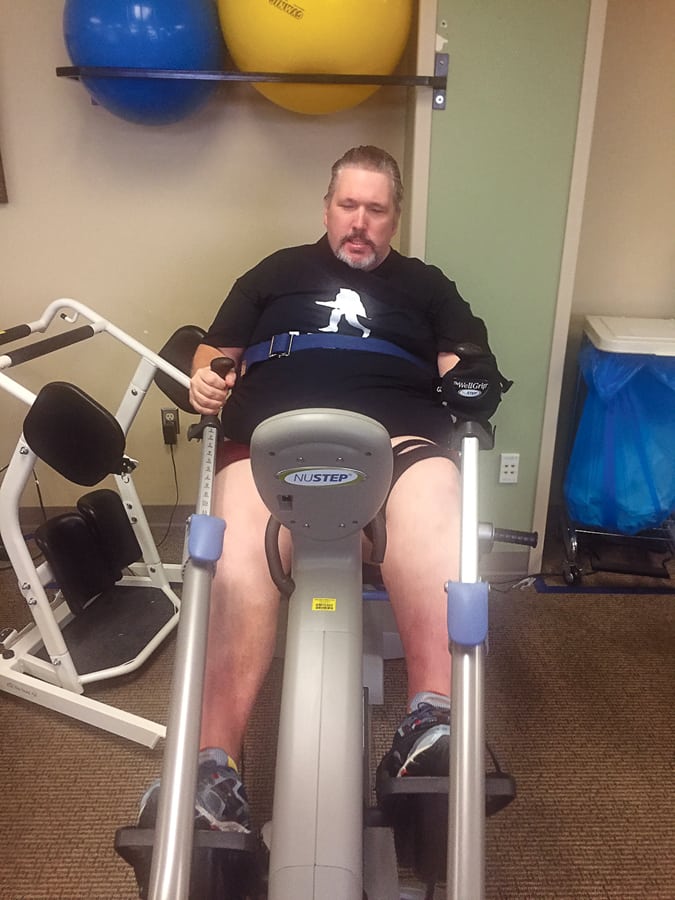
Within days, I was able to walk in a high-platform walker and was in a regular walker by the end of January. Today, I’m using a quad-cane.
Meanwhile, the MCL tear is healing nicely.
The stroke also took away my ability to swallow properly. This is where speech therapy stepped in with electric stimulation. I likened it to laying my throat across an electric fence while eating lunch. Uncomfortable? Yes. Effective? Very. After 24 treatments, my swallowing muscles were back nearly in pre-stroke shape.
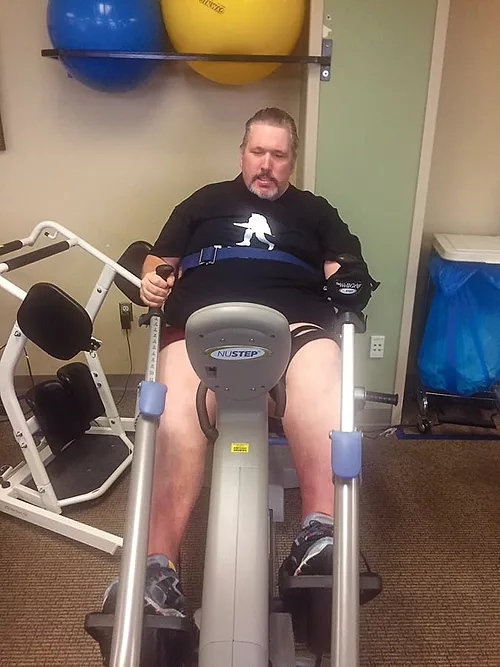
The IPR is fully loaded with all the equipment necessary to get patients back in shape. The most important piece is a therapy gym on site, with equipment such as treadmills, stationary bikes, parallel bars and weight machines.
The nursing staff is specially trained to help those who have had strokes and are typically at a high risk for falls. They work with hundreds per year — 207 people were admitted to IPR last year. And most patients’ stays aren’t as long as mine. The average stay in IPR for stroke patients is 13 days.
While I wished I hadn’t had a stroke and continue to struggle with its aftermath, I feel blessed I landed in IPR. Most communities aren’t fortunate enough to have something like this. I know I am farther along in my post-stroke journey than if I hadn’t been able to take advantage of this invaluable resource.
When I was ready to go home, the IPR staff made sure I was ready. Home inspections, ordering needed equipment (wheelchair, hospital bed, etc.), making sure medications, doctor appointments and out-patient rehab were set up and helping make sure insurance was all in order were truly a blessing when you’re worried about how you’re going to cope with the real world.
The IPR experience was eye-opening. I made a lot of friendships there, and I’m truly grateful to everyone there who took such good care of me.
Tips for getting the most out of therapy
Tips from therapy veteran Andy Perdue of Richland on getting the most from therapy after a stroke:
- Read the book Stronger After Stroke by Peter Levine. I wished I had read this book before therapy. I’d be farther down the road to recovery. It should be required reading by caregivers and spouses, too.
- Rest and nutrition. I learned that eating right and resting were good for my healing brain but also prepared me for the next day’s therapy grind.
- Trust your therapist. Early on, I didn’t always understand why I was doing something. The puzzle piece made more sense weeks later. Trust your therapist to have best intentions.
- Take good notes. After a stroke, your brain isn’t working so well. It’s OK to write things down and ask questions.
- Work hard. I put in the extra work as a way to let my therapists know I was willing to do whatever it took to get better. As a result, they went out of their way to help me. When other patients refused therapy, I happily took their minutes.
- Read. It’s good for brain recovery. I found books impossible because you need two good hands to hold and turn pages. I invested in a Kindle and was very happy.
- Ask for homework. You often have free time in rehab. I didn’t want to waste time, so I asked for homework. Wheelchair laps in the hallway built strength and proficiency so I didn’t have to use therapy time on it.
- Advocate for yourself. You know your body, so don’t be afraid to say you want to work on something specific. In my case, I let my therapist know I wanted to focus on my left arm. As a result, I saw recovery faster.
- Be ready. If you know when therapy starts, be dressed and ready to start. The therapists have limited time so you want to maximize that time. I looked at every minute as priceless.
[panel title="About Andy Perdue:" style="info"]
Andy Perdue is an independent wine journalist who lives in Richland with his wife Melissa and daughter Niranjana. He is the editor and publisher of Great Northwest Wine and writes for several publications, including the Tri-Cities Area Journal of Business and The Seattle Times.