
New Tri-Cities IT firm blends AI, cybersecurity for nuclear renaissance
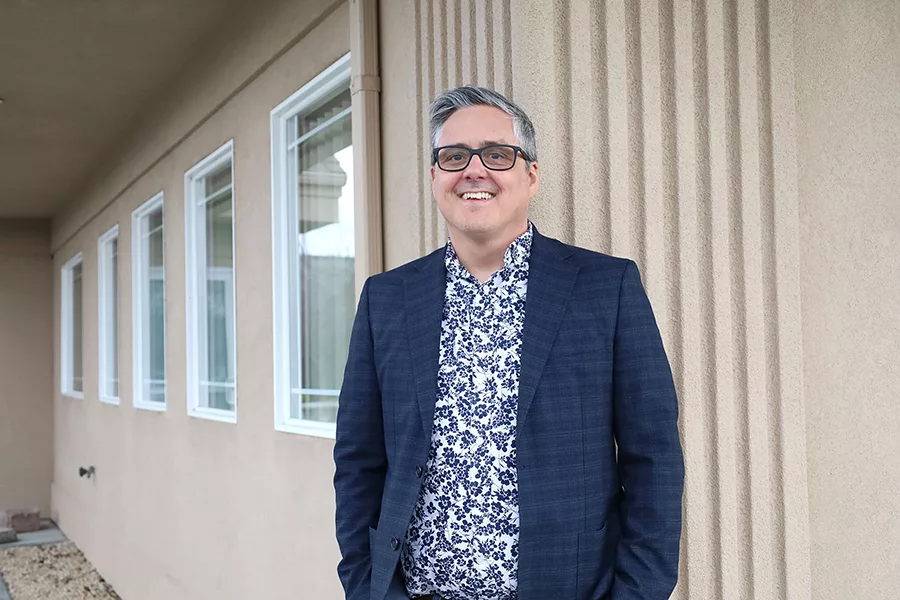
John Roach, senior vice president and general manager, is leading a newly formed information technology company that’s handling a key Hanford contract.
Photo by Rachel VisickA former tech startup founder is now at the helm of a newly formed Tri-City-based information technology company that’s handling a key Hanford contract.
OSC Technical Solutions, which launched in September 2025, plans to expand its role in nuclear cybersecurity and IT as part of what leaders call a growing “nuclear renaissance.”
John Roach is leading the company as its senior vice president and general manager, bringing experience from both the private and public sectors.
The Tri-Citian previously co-founded the startup WholeStory, which sought to change hiring culture using narrative-driven hiring, and later served as Hanford’s director of cybersecurity.
After WholeStory was sold in 2021 following its participation in a national competition, Roach joined North Wind Technical Solutions, a contractor for Hanford Mission Integration Solutions, overseeing IT and cybersecurity work for the past six years.
In 2024, North Wind’s parent company, Cook Inlet Region Inc., or CIRI, created a new holding company, OSC Global, to focus on IT and advanced cybersecurity. It also acquired two cybersecurity companies.
A third company, OSC Technical Solutions, was formed in September 2025 with North Wind’s Hanford team.
The new Tri-Cities-based firm with Roach at the helm has a specialized focus in IT infrastructure, cybersecurity and records management.
OSC Technical Solutions
OSC Technical Solutions, which retains a Richland office at 3240 Richardson Road, employs 387 workers, most based out of the Tri-Cities.
Among the company’s five specialties is a focus on software engineering and development, security and operations. It offers a way of looking at the three different functions together rather than separately, Roach said.
The company also has 100 employees dedicated to records management alone.
It’s a “much bigger deal than a lot of people think,” Roach said, especially at a U.S. Department of Energy cleanup site, where everything must be tracked for a long time.
Cybersecurity systems
The company also does work in industrial control system cybersecurity, a field somewhat different from the company’s other focuses, Roach said.
When looking at electrical utilities, water utilities and nuclear power plants, uptime and availability are prioritized above all else, he said.
“If you have an outage … you’re impacting the physical world,” he said.
Such systems are increasingly targeted by cyberattacks, which can cause costly shutdowns, he said.
“They’re more and more becoming a target of threat actors, of bad guys who want to cause chaos, want to damage the economy, want to hold communities hostage for payment,” he said.
While the company’s core focus is on the ongoing work at the Hanford site, OSC Technical Solutions also is leaning more into industrial control system cybersecurity.
“That’s an area where we’re really focused on expanding our current capabilities and supporting a lot of what you’ll hear called around here the ‘nuclear renaissance,’” Roach said.
This could include work on future small modular reactors or uranium fuel plants, he said. New nuclear plants will all be digital, making their cybersecurity all the more crucial.
AI integration
As regulations change in industrial control systems, OSC Global is positioning itself to help others keep up.
OSC Technical Solutions also has integrated artificial intelligence into its work. Software engineers use AI to improve their efficiency, and they’ve also helped HMIS with the creation of its specialized AI tools, like the Hanford AI Liaison known as HAL.
The company uses AI through tools others have created and through their own tools. “(The technology is) acting as an accelerator for a lot of different elements of the business,” Roach said. It also aligns with the federal government’s goal to dominate in AI.
Local roots, national reach
Roach said that his company has been able to solve a lot of problems at the Hanford site, and hopes to bring its innovative approaches to more DOE sites throughout the country. “Hanford is this incredible testing ground and crucible for mission-focused IT solutions, and it’s been that way for a long time,” he said.
Although OSC Technical Solutions’ work on energy and critical infrastructure lends itself to DOE projects and others outside of the Tri-Cities, its knowledge base is still firmly rooted in the region.
Now that the company is separate from North Wind, it’s energized and more engaged in the community, Roach said.
OSC Technical Solutions partners with Washington State University Tri-Cities on senior capstone projects and provides support for Columbia Basin College’s cybersecurity curriculum. The company also will host a symposium on industrial control system cybersecurity this fall.
Roach is also involved in the community as a board member of the Tri-City Regional Chamber of Commerce. The company is also a member of the Tri-City Development Council, better known as TRIDEC.
Sometimes cybersecurity is treated as an afterthought, Roach said, but it is closely tied to the ongoing work at Pacific Northwest National Laboratory, Energy Northwest, Hanford and other organizations.
“We really as a community have an incredible story to tell in terms of our forward-thinking cybersecurity and IT presence, and so we want to help be a part of that storytelling as well,” he said.
While OSC Technical Solutions has a firm presence in the Tri-Cities, its roots lie in Alaska. The company is an offshoot of CIRI, one of 12 Alaska Native regional corporations created in the 1970s as part of the Alaska Native Claims Settlement Act.
CIRI is owned by nearly 10,000 shareholders in Alaska and throughout the world.
“In terms of creating economic opportunity and freedom for the people of Alaska, they’ve just really been a force for good,” Roach said.
Now that he’s heading up OSC Technical Solutions, “it gives me a chance to tell this story, which I think is really meaningful.”


Stay Informed. It’s Free.
Subscribe to our newsletters and get the latest news and insights delivered to your inbox.
We respect your privacy.
Unsubscribe anytime.
Thank you!
You’re subscribed. Keep an eye on your inbox for the latest updates.