
Airport passenger growth levels off after post-pandemic surge
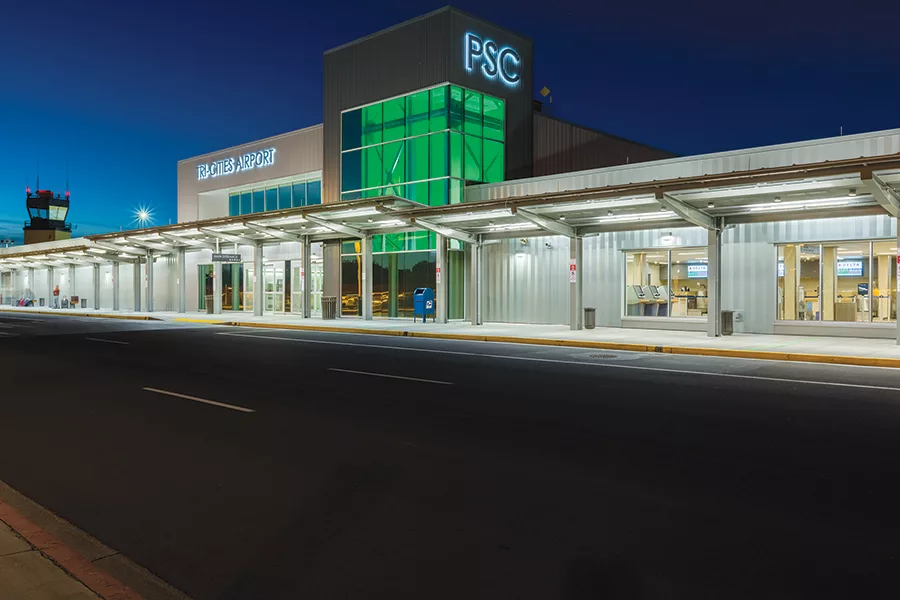
After years of increasing passenger counts since the Covid-19 pandemic, the Tri-Cities Airport has landed on a plateau.
For seven straight months, the airport in Pasco has recorded the number of people boarding planes as being slightly below the number recorded for that same month the prior year. But that didn’t prevent the airport from hitting a new passenger record in 2025.
Yet through the first three months of 2026, boardings are down 4% compared to the same period last year.
Most of the region’s airlines are seeing passenger growth, Airport Director Buck Taft told the Tri-Cities Area Journal of Business, with outside factors affecting two of the airport’s carriers leading to what looks like declining demand.
“It’s never good to be down, but I’m not overly concerned at this very moment,” Taft said.
But this won’t necessarily hold true for the remainder of the year. Taft said overall economic uncertainty and current events could lead to an overall decline in travel. And airlines are beginning to raise fares and other charges as the ongoing U.S. and Israeli military actions against Iran continue to affect fuel prices.
“It’s very hard for the airlines to make predictions in this environment, so they’re going to be conservative, and that’s why it’s likely that their prices will remain elevated for some time until things really stabilize,” Shye Gilad, a former airline captain who now teaches at Georgetown University’s business school, told Travel Weekly, a travel industry publication.
The Tri-Cities Airport first saw its boarding numbers dip in September in the lead-up to the record-long federal government shutdown that started Oct. 1 and lasted through mid-November. The last four months of 2025 saw 5,654 fewer travelers flying out of the airport compared to the same period in 2024.
For the first quarter of 2026, nearly 4,000 fewer passengers boarded planes leaving the Tri-Cities compared to the same quarter in 2025. That was also when a federal budget impasse left TSA workers working without a paycheck, potentially disrupting security checkpoints as some left to find other work.
And yet, during the last four months of 2025, flights for Alaska Airlines, Allegiant, Delta Airlines showed growth, Taft said. American Airlines also saw increased demand last year. And many of those same airlines are also up for the first quarter of 2026.
The seeming decline in passenger traffic may be related to the availability of seats. Avelo Airlines, which dropped the Tri-Cities as a destination last year, is no longer offering flights and United Airlines is facing decreased demand for its San Francisco route due to runway improvements. That decline in available seats is nearly aligned with the decline in passengers.
“Generally, if we have the seats, we have the butts in them,” Taft said, adding that the carriers serving the region have told airport officials they are pleased with the performance of their routes.
Going forward, though, he said he expected the challenges with fuel prices to have a “strong” impact on future travel demand, especially for those who seek the lowest fares.
“The business traveler is going to fly whether the ticket is $800 or $1,200,” he said. “It’s the leisure traveler that’s going to be impacted.”
Travel Weekly reported in mid-April that airlines ranging from U.S. carriers like United and Delta to Air France-KLM, SAS, Philippine Airlines and Cathay Pacific in Europe and Asia, have reduced routes and either increased ticket prices or said they would increase them if the war keeps oil from passing through the Strait of Hormuz.
But travel industry insiders are still holding on to having a good year. With big international events such as the FIFA World Cup expected to bring more international visitors to the U.S. and data showing a new record high for average leisure travel budgets, the industry may still see planes full of passengers.
"Yes, recession expectations have spiked – and TSA disruptions and geopolitical tensions have added a new layer of traveler anxiety that cannot be dismissed,” according to an early April report on travel survey data from travel data analysis firm Future Partners. “But what we see behaviorally continues to tell a different story: Summer is booked, budgets are at record highs, and the majority of American travelers have already demonstrated that travel is one of the last things they cut.”