Tour highlights success stories, brings awareness to fragile industry
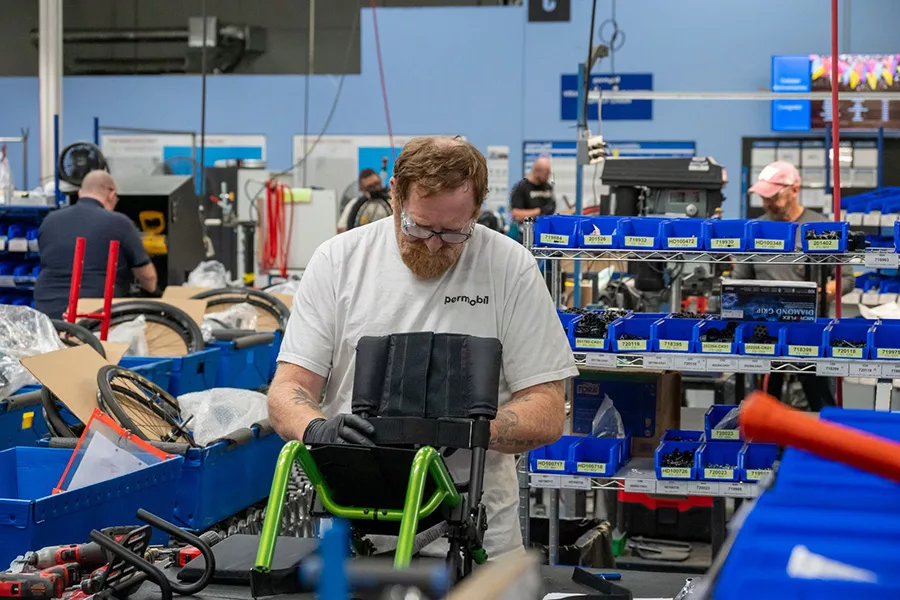
Local manufacturer TiLite, a part of Permobil, makes 60-80 customized wheelchairs each day to keep people moving around the world. Visitors had a chance to tour the operations as part of Association of Washington Business’ ninth annual Manufacturing Week bus tour.
Courtesy Association of Washington BusinessEvery day, a Pasco-based manufacturer creates 60 to 80 custom, lightweight wheelchairs with handmade upholstering and ships them all over the world to keep people moving.
It’s a “great hometown success story” that people drive past every day, and a reminder that amazing careers with great wages exist right here in the Tri-Cities, said Kris Johnson, president of the Association of Washington Business, during a recent visit to TiLite, a part of Permobil.
The visit was a stop on AWB’s ninth annual Manufacturing Week bus tour, where visitors had a chance to tour the facility and watch the manufacturing process. Permobil team members were able to sign their names on the vinyl-wrapped bus.
Permobil’s 127 employees at the plant at 2701 W. Court St., just off of Highway 395, are among Franklin County’s 4,621 manufacturing employees. The county has a total of 56 manufacturers, and Benton County has 187 manufacturers with 4,705 employees.
AWB’s annual tour travels across the state highlighting Washington manufacturers, whose employees make up 7.6% of the state’s workforce. The sector generated $68.3 billion in economic output in 2024.
And thanks to Washington manufacturers, people around the world can have a “Washington state day” every day, drinking Starbucks coffee, using Windows systems on their computer, buying products from Amazon and eating Washington apples, cherries and potatoes, Johnson said during his Oct. 1 State of Manufacturing address in Seattle.
The tour also stopped elsewhere in the Tri-City region, including Framatome in Richland, Tidewater Barge Lines’ Snake River Terminal in Pasco and WIT Cellars in Prosser.
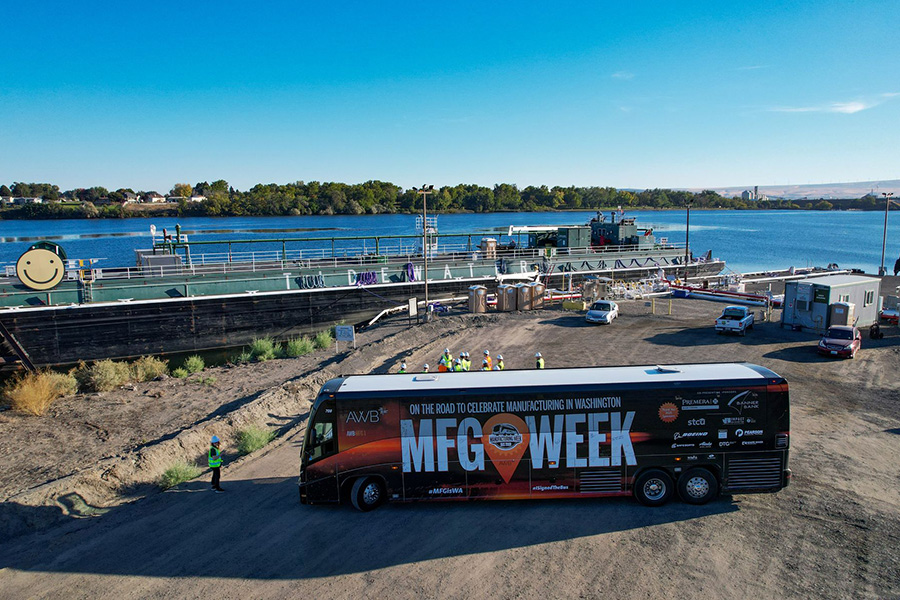
AWB’s Manufacturing Week bus tour highlights manufacturers throughout the state, including several in Benton and Franklin counties. One stop was at Tidewater Barge Lines’ Snake River Terminal in Pasco, where fuels are unloaded from rail cars for transport throughout the Northwest.
| Courtesy Association of Washington BusinessManufacturing at risk
Johnson described the state’s manufacturing environment as “at risk.”
“Between an ever-growing number of taxes, regulations, coming out of our state government with trade uncertainty at the federal level, manufacturers are dealing with unprecedented challenges,” he said in his Oct. 1 address.
Johnson named three challenges to growth for Washington manufacturers: taxes, trade and overregulation.
Taxes remain the top concern of manufacturers, according to AWB’s most recent quarterly survey of Washington employers. This year saw the state Legislature pass the largest tax increase in state history, Johnson said, and small businesses across the state are feeling the effects.
“Once a state gets a reputation as unfavorable to business, that can be hard to shake,” he said.
Trade also presents challenges for manufacturers. Washington is highly dependent on trade – 40% of jobs are tied to international trade, Johnson said, and $58 billion in goods were exported last year.
New tariffs and global uncertainty have made things more difficult for manufacturers, with 72% of Washington employers reporting fears that tariffs or retaliatory tariffs would directly affect them in a negative way, according to AWB’s spring survey.
Tariffs have already affected 58% of manufacturers, Johnson said, resulting in higher costs, lost export markets and delayed investments.
While tariffs aren’t necessarily bad for Washington, constant change makes it almost impossible to plan for the future, he said. “And when employers can’t plan, they don’t invest. They don’t hire, and opportunities disappear.”
Similarly, regulations can be good – they protect workers, communities and the environment, Johnson said. But employers report feeling the burden of complex and costly rules in Washington.
To reach a bipartisan goal of doubling manufacturing jobs by 2030, Johnson said that reforms are needed to streamline permitting and ensuring new regulations have clear cost assessments and timelines.
“Manufacturing can thrive here. But only if Washington creates a regulatory environment that allows employers to build, expand and hire with confidence,” he said.
Despite the “fragile” future of manufacturing, Johnson praised Washington’s strong foundation of innovation and resiliency.
“We will keep proving that Washington is and always will be, a state of builders and innovators, and together, we will write the next great chapter of manufacturing,” he said.