Residents bristle at new lines needed for growing energy needs
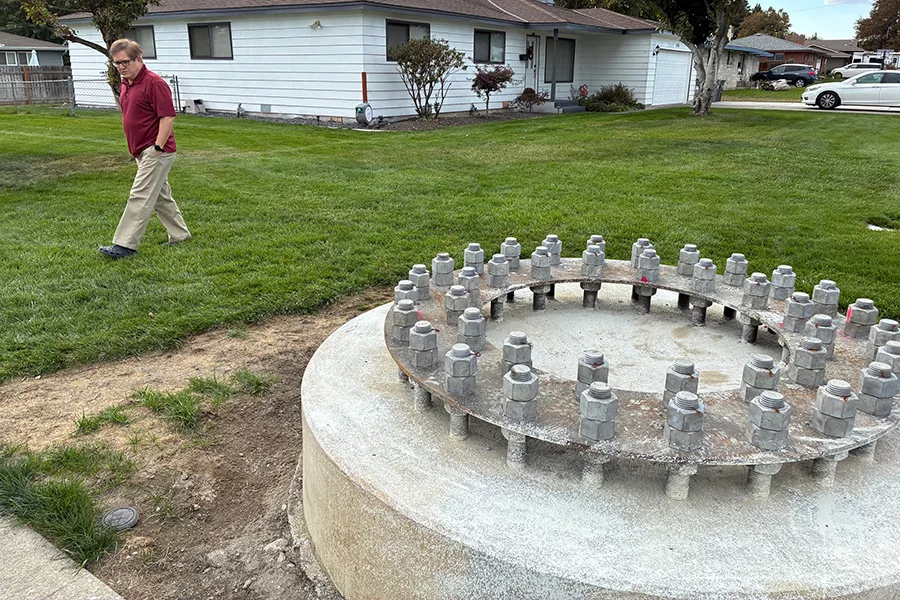
Steve Stallings of Richland walks near the base for a high transmission line installed in his front yard by the Bonneville Power Administration.
Photo by Ty BeaverThirteen cement trucks.
That’s how many Steve Stallings counted stopping outside his home one day in August, dumping the entirety of their loads into a hole 29 feet deep in the corner of his Richland front yard.
By the time they were done, a circular concrete pad about 6 feet in diameter rose 3 feet above the ground, with a circle of 40 bolts set into the top.
Now a monopole 120 feet tall – taller than the Richland Federal Building – stands anchored to it, delivering a 115-kilovolt high-voltage transmission line through the heart of central Richland.
“They just jumped in my yard and started excavating,” Stallings told the Tri-Cities Area Journal of Business. “It’s the ugliest thing ever.” He also said it has taken tens of thousands of dollars off his home’s property value, and he’s currently examining his legal options.
Stallings isn’t the only one who is less than pleased about the 10 transmission poles now towering above Thayer Drive connecting two substations and replacing an older transmission line that was supported by shorter wooden poles.
“I drove down Thayer today and was shocked at the size and intrusiveness of them,” commented one member of the Richland Residents Facebook group about the project. “I feel badly for the property owners there.”
Officials with the Bonneville Power Administration, which is conducting the work, note the project has been in the works for years. The agency scheduled public comment periods, mailed notices to residents and did other outreach to alert residents about the project.
“We haven’t received an influx of complaints,” Andrew Young, BPA’s project manager, told the Journal. “A few people have noted they are bigger than they imagined.”
The project isn’t the only one BPA is conducting in and around the Tri-Cities, nor will it be the last. While the needs and potential impacts of proposed energy-producing facilities is often front and center of public policy discussions and debates, the ability to move around the power those facilities generate is just as crucial.
This could result in more situations like that in Richland, where the demands of a modernizing energy grid potentially clash with the wishes of those living near or under that infrastructure.
“The location of the lines can be inconvenient to locals, can fail to avoid sensitive areas like vital ecosystems, and do not always ensure that the community affected will receive the energy being sourced from that specific line,” researchers wrote in a paper on U.S. electric transmission policy for the Center for Local, State, and Urban Policy. “As such, these concerns have increased public opposition to transmission, leading many communities to file lawsuits and vocalize concerns in hopes to persuade government officials to reject the lines.”
A needed update
Earlier in 2025, BPA officials announced a slew of 23 transmission infrastructure projects estimated at $5 billion planned throughout Washington, Oregon and northern California.
The South of Tri-Cities Reinforcement Project is one of them. Its focus is the installation of a new 18-mile 115-kilovolt transmission line and substation between the agency’s existing Badger Canyon Substation and the Ashe-Marion 500-kilovolt transmission line to the west.
Upgrading the poles that carried the line between the Stevens and Richland substations along and near Thayer Drive is part of that work, Young said, adding that it’s work long overdue.
“Richland was never designed to be a permanent city. Much of the infrastructure was meant to last 10 years and now it’s terribly outdated,” he said. “There have been unplanned outages in the area, and we are trying to limit those. It’s also to make capacity for the future, at least the near future.”
The city has been a close partner on the project, though Clint Whitney, the city’s energy services director, said that BPA did not need approval from the city on the design or size of the new infrastructure. The agency also already had the authority to conduct its work within easements and rights of way for the project.
“We remain supportive of BPA’s overall infrastructure improvements, which are intended to improve transmission system reliability and capacity for the region,” Whitney said in an email to the Journal.
The $12.5 million project is expected to be energized in the winter of 2027, according to a BPA fact sheet.
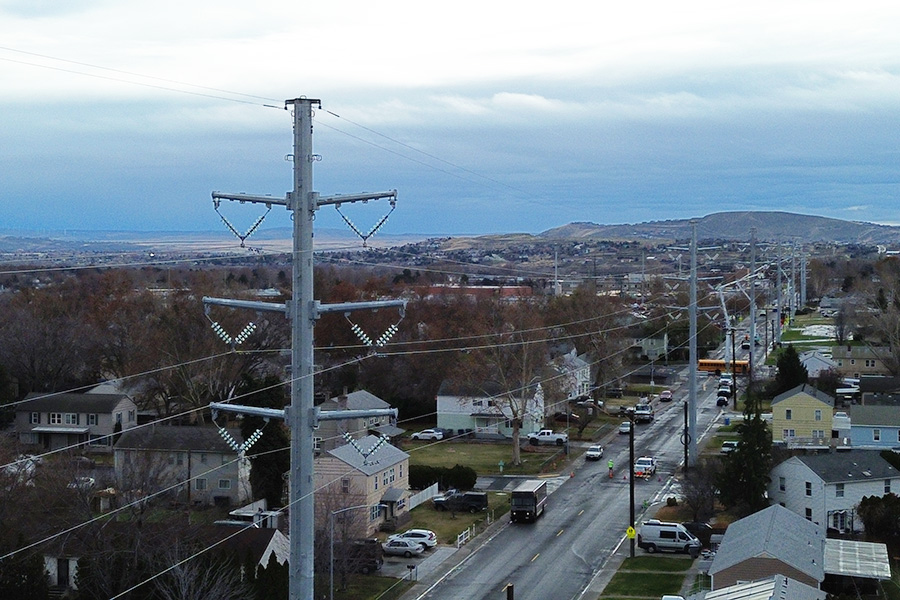
Monopoles taller than Richland’s Federal Building now tower above the residential neighborhoods straddling Thayer Drive.
| Photo by Nathan FinkeGrowing energy demand
Reliability and capacity of the grid have become a focal point for energy producers, utilities and government agencies.
According to data from the Western Energy Coordination Council – the body that oversees the power grid west of Colorado – annual energy demand for the West is forecasted to grow about 20%, from 942 terawatt-hours (TWh) in 2025 to 1,134 TWh in 2034. That’s more than double recent growth forecasts and four times what was seen between 2013-22.
In the Tri-Cities, that demand isn’t just from population growth.
Officials at the Port of Pasco have said that companies have ultimately chosen not to move to its industrial parks due to the limited amount of energy they could secure.
There also are at least three proposals to build data centers in and near the Tri-Cities, which will require extensive power to operate.
The recent annual report of the state’s Clean Energy Siting Coordinating Council put expanding and upgrading the state’s transmission infrastructure at the top of its list of priorities.
“To support the growing demand for electrification and large load energy users, we must take action to rapidly build transmission and generate new renewable energy,” wrote Ecology director Casey Sixkiller and Commerce director Joe Nguyen in a joint letter to Gov. Bob Ferguson. “Without a coordinated state effort, we face a future of unreliable electricity, higher energy costs and climate impacts to our people and environment.”
The state’s Energy Facility Site Evaluation Council recently approved a broad environmental impact statement for transmission projects to guide future developments and mitigate their impacts.
“Transmission facility projects typically take at least a decade to develop and permit. This timing presents challenges for achieving the state’s greenhouse gas emissions reduction mandates, which include ambitious benchmarks starting in 2030,” according to the statement. “There is a need to accelerate the timeline for transmission facility development while still protecting other Washington values, including land use compatibility, environmental protection, and Tribal rights.”
Underground placement
Stallings said he understands the need for energy infrastructure – he works in that field at the Hanford site. And he didn’t mind the prior power pole that was located adjacent to the sidewalk near his property. It was there when he bought the house 30 years ago and even had guylines anchored in his front yard.
While he received mailed notices about the BPA project, Stallings said it wasn’t clear from the map exactly where the new poles would be or how much space they’d require.
In his case, the new pole’s base sits on his side of the sidewalk and extends into his yard about 9 feet, far more than the utility easement should allow, he said. Rather, it appears a former right of way for Thayer Drive – when it was planned to be twice as wide when Richland was first established – was used to provide the space needed, he said.
Stallings has since called on BPA and the city to put the new transmission line underground. He said neither the city nor BPA will give him a straight answer as to why the upgrades were designed as they were, with city officials saying that decision rested entirely with BPA.
Burying transmission lines is feasible per EFSEC’s environmental impact statement on transmission facilities. Such an approach can even offer benefits such as improved reliability and resilience, lower maintenance costs and better mitigation of safety risks.
A request to put the new transmission line underground was among the handful of comments BPA received during the public comment period for the project in April 2023. Others also raised concerns about whether taller poles would be more vulnerable due to the region’s strong winds and potential environmental impacts.
However, Young said that burying transmission lines, particularly higher voltage lines, is not feasible.
The line that will run down Thayer will have a temperature of 212 degrees Fahrenheit and burying it would be expensive, hard to maintain and even more disruptive due to the amount of excavation that would be required.
“Undergrounding … typically doesn’t make it out of brainstorming” during infrastructure planning, Young said. “I’m aware of only six miles out of 15,000 in BPA’s entire network that are underground.”
EFSEC’s transmission infrastructure document affirms those challenges, noting that construction costs can be five to 15 times more expensive than installing overhead lines while only having a service life half as long. The amount of excavation would require pits as deep as 10 feet with dimensions as large as 10-by-30 feet.
EFSEC staff acknowledged in the document that the construction of new overhead transmission infrastructure or upgrading existing facilities can have visual impacts that can negatively affect property values. But those impacts in urban environments are likely less pronounced, and the environmental impact statement offers other possible mitigations, including visual screening via fencing and vegetation.
Young said BPA is mitigating impacts from the larger poles as much as possible. In one case, the agency will replace a fence and do other landscaping for a property owner to address impacts from a new pole. Another pole is being relocated slightly to soften the impact.
“At the end of the day we can’t make everyone happy,” Young said.
Property impacts
Stallings said he has been speaking with Realtors, appraisers and lawyers to determine whether he could seek damages from BPA. He said another property owner along the line was paid several thousand dollars for the impact to their property.
“I don’t want to sue anyone but in this case it has to happen,” he said. “I fear nothing at this point.”
BPA declined to say whether any property owners affected by the work along Thayer Driver were financially compensated.
Young said if the agency builds on private property, the owner is compensated, but if it’s next to their property or within acquired right of way and easements, they only seek to mitigate any impacts.
“We have fielded complaints,” Young said. “It hasn’t been perfect, but for the most part, the people we talk to, even those with poles in front of their house, understand the necessity.”
That same pragmatism can be found alongside residents commenting on the project online, even those who previously voiced unhappiness with the appearance of the new poles.
“I think I will wait to see what it looks like after the lines are strung and the old poles are removed,” one commenter said in the Richland Residents Facebook group. “They are kind of awesome to look at. Maybe it won't be so bad when done.”
12/15/25 9:30 a.m.: Story updated to correct the temperature of high transmission lines and the name of the wires used to anchor larger transmission line poles.