Cantwell, tribal leaders denounce sweeping permitting reform bill in US Senate
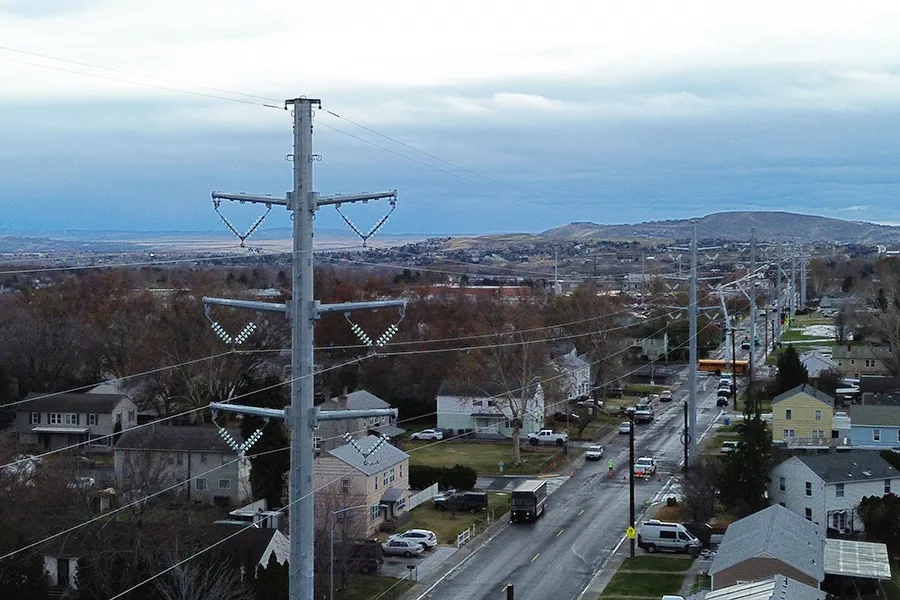
This photo of new larger transmission lines installed by Bonneville Power Administration through the heart of Richland illustrated the story "Residents bristle at new lines needed for growing energy needs," one of several pieces cited by judges in awarding the Tri-Cities Area Journal of Business four awards during the 2026 Editorial Excellence Awards of the Alliance of Area Business Publishers.
Photo by Nathan FinkeU.S. Sen. Maria Cantwell and tribal leaders are sounding alarms related to a comprehensive permitting reform bill that would weaken environmental protections on public land.
“We know the dangers of treating environmental harms as something to fix later,” said John Washines, a tribal councilman of the Yakama Nation. “The Columbia Snake River dams helped power America’s growth, but promised mitigation has never restored the salmon abundance we lost.”
The Bipartisan American Affordability and Jobs Act quietly fast-tracked to the Senate floor following a busy midterm, where it’s slated for a passage vote as early as this week. If the Senate passes the bill, the House of Representatives could take it up by the end of the year.
Though introduced in September, the bill hasn’t gained nationwide traction. Sixty-five percent of likely voters haven’t heard about it, according to a recent poll by Data for Progress.
Despite the bill’s name and a key Democratic sponsor (Sen. Martin Heinrich, D-New Mexico), the measure faces its share of criticism. Tribal opponents say it would weaken protections on public lands for clean water and endangered species, undermine tribal sovereignty by reducing current tribal consultation standards, limit public input and block the ability for courts to halt development.
“Generations of Americans have fought for these rights and their voices deserve to be heard,” said Cantwell (D-Washington) during a Nov. 17 press conference.
Western states, where over 95% of all federal land is concentrated in 11 contiguous states and Alaska will feel the brunt of the legislation.
Tribal leaders are denouncing a provision in the bill that would limit the Historic Preservation Act, which requires that tribes be involved in federal discussions related to developments affecting sacred places, burial sites and other culturally significant lands.
“These are not simply historic landmarks, they are sacred places that connect our people to our history, identity, and ancestors,” said Joseph “Zeke” Rupnick, chairman of the Prairie Band Potawatomi Nation.
In south-central Washington, the Yakama Nation, whose reservation encompasses part of the Columbia River, is concerned about the bill’s implications for salmon and fishing communities.
Of the Yakama Nation’s 16 historic salmon stocks, four are extinct and seven are listed under the Endangered Species Act, said Washines, the tribal councilman.
Developing requirements under the Endangered Species Act would be cut back again, too. The bill would limit the U.S. Fish and Wildlife Service’s ability to consult with developers and ensure projects minimize harm to endangered species. It would give states the option to step in as a consultant.
If the bill passes, it would define what best available science means under Section 3 of the Endangered Species Act. The term would include “all relevant and objective scientific and commercial language,” according to the bill’s text.
Not everyone opposes the sweeping measure. It’s quite popular among those who know about it. After hearing arguments on both sides, 66% of likely voters supported the measure, according to a poll by Third Way.
Last week, the New York Times editorial board endorsed it, telling Democrats to ‘take the deal.’
The bill would allow the rapid buildout of renewable energy and quicken the pace of building transmission lines, which can take ten years or more to complete, a problem that Washington is familiar with.
It could also cut back greenhouse gas emissions and reduce electricity system costs, according to the Climate Leadership Council.
Across the country, including in Washington state, communities are demanding data center moratoriums. Last week, Veterans for Public Lands called on the U.S. Interior Secretary to immediately pause data center development until guardrails are established.
As Washington wrangles with data center regulations, BAAJA’s proposal could sway public support.
While the measure would cut back permitting regulations of federal developments, including data centers, it would also charge data centers for the grid power they use, according to the Bipartisan Policy Center. Theoretically, those funds would shield electric ratepayers from rising costs.
The bill would require new data centers that consume 20 megawatts or more to pay the full cost of the infrastructure that powers them. However, rulemaking with the Federal Energy Regulatory Commission would take years to complete, meaning consumers wouldn’t notice an immediate rate change. Presuming those steps are taken, backers say the measure could decrease rates and improve grid reliability for decades.
This story is republished from the Washington State Standard, a nonprofit, nonpartisan news outlet that provides original reporting, analysis and commentary on Washington state government and politics.

Stay Informed. It’s Free.
Subscribe to our newsletters and get the latest news and insights delivered to your inbox.
We respect your privacy.
Unsubscribe anytime.
Thank you!
You’re subscribed. Keep an eye on your inbox for the latest updates.