Cloud seeding company wants to bring rain to Horse Heaven Hills
Government officials aren’t convinced
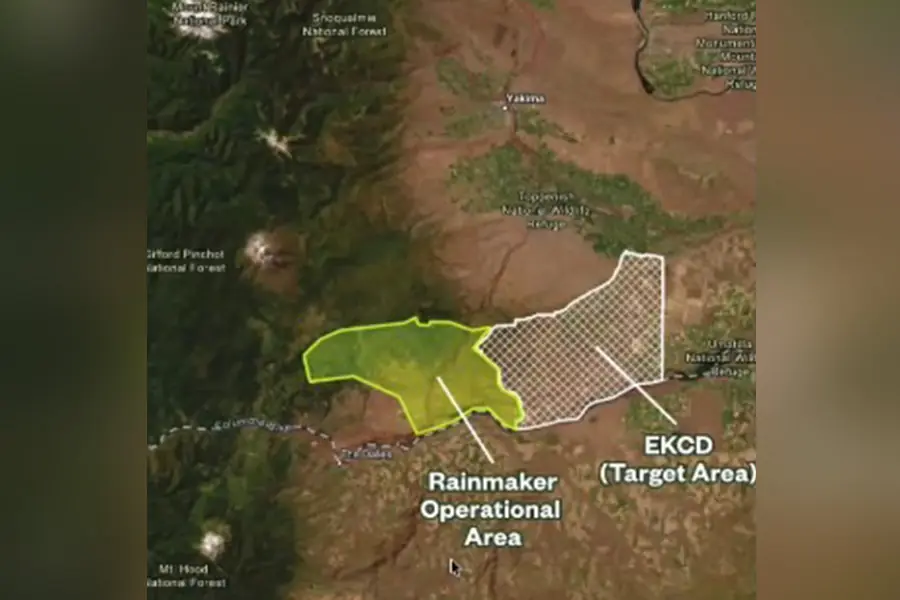
A California-based company is proposing to use cloud seeding to help generate additional rainfall over the Horse Heaven Hills in Benton County.
Courtesy RainmakerA California-based company that says it brought additional rain and snow to places as far as Alaska and as close as Pendleton is proposing to do the same to benefit ranchers and farmers in the drought-stricken Horse Heaven Hills.
But it may need to convince some skeptics in Benton County, including on the county’s Board of Commissioners, before it moves forward.
Representatives from Rainmaker spoke to county commissioners at a recent special meeting about how they seed clouds via drones and how they’ve produced verifiable precipitation for communities they’ve contracted with. The presentation was the only topic discussed at the meeting.
“Every dryland wheat farmer I talk to is excited at the prospect of bringing more precipitation,” said Brandon Monson, Rainmaker’s Washington state director of business development and government affairs, at the Oct. 21 meeting.
The company is currently going through the Washington State Environmental Protection Act, or SEPA, process to cloud seed an 1,100-square-mile area near Goldendale. Its representatives said they don’t require any official permit or approval from Benton County to proceed but community buy-in is important.
“We need the ‘social yes’ to operate in an area or it wouldn’t work,” Monson said.
Commissioner Michael Alvarez was the only commissioner to voice his position of the proposal: “I know I got a lot of phone calls on this project. Folks are very concerned. I don’t want Benton County or the Horse Heaven Hills to be a guinea pig.”
Drought
After four years of drought, Central Washington is one of the hardest hit regions in the state. While Yakima Valley irrigators were expected to receive their full allocation of water in October, last year’s irrigation season ended abruptly because river flows were critically low.
In the Horse Heaven Hills, farmers grow dryland wheat without the aid of irrigation and are solely dependent on the weather.
And conditions aren’t expected to change. A strong El Niño effect this winter is expected to create above-average temperatures which could make it challenging to build snowpack in the mountains, said Karin Bumbaco, a deputy state climatologist.
Less water is expected to be available in summer and early fall by the 2040s, according to a draft forecast from the state Department of Ecology and the state Water Research Center at Washington State University.
What is cloud seeding?
Cloud seeding has been used for more than 80 years to modify weather, often precipitation, by dispersing substances such as silver iodide in the air, according to a 2024 report from the U.S. Government Accountability Office. The dispersion substances can aid in cloud formation by releasing latent heat and attracting moisture.
However, Monson said that until a few years ago, those efforts were often “spray and pray,” with little or no evidence they produced any precipitation. But in 2017, the National Center for Atmospheric Research was able to demonstrate cloud seeding led to measurable snowfall and determined a means to measure its impacts.
Rainmaker’s approach relies upon using radar to identify prospective clouds to target, sending drones flying as high as 15,000 feet to spread silver iodide and then using radar to validate the precipitation created. It typically operates in the winter through spring, when ice- and water-laden clouds are present.
“We don’t want to sell a project or a program and not have confidence in what we’re doing,” said Amie Abramyam, an atmospheric science researcher with Rainmaker, during the commission’s meeting.
The Rainmaker reps said the silver iodide they use is not “bioavailable” and doesn’t harm the environment. They also clarified cloud seeding has its limits. It cannot create clouds, instead boosting the rain- and snow-making ability of those that have already formed. It also can’t cause extreme storms or other weather, only slightly increase the amount of precipitation clouds release.
But every additional drop of water makes a big difference, Monson said. And that’s why organizations such as the Tri-City Development Council, or TRIDEC, the Eastern and Central Klickitat conservation districts, Washington Association of Wheat Growers, as well as individual farmers and cattlemen, are supporting the project.
Karl Dye, TRIDEC’s president and CEO, said his organization signed a letter of support for Rainmaker’s project after visiting with the company’s representatives. Dye said he’s familiar with other entities that have used cloud seeding to support agriculture and even power generation by creating precipitation that fills hydropower reservoirs.
“The technology as they described it seems impressive,” he told the Tri-Cities Area Journal of Business in an interview. “It seems a lot more accurate than traditional cloud seeding.”
Controversial technique
Cloud seeding has a checkered history. The federal GAO report noted that a lack of reliable information on optimal cloud seeding practices, limits on evaluating its effectiveness and public concern pose significant challenges.
Nine U.S. states currently perform cloud seeding, while 10 have banned or have considered banning cloud seeding or weather modification in general, according to GAO. The practice has been attacked as much by skeptics as by conspiracy theorists, who allege it does everything from creating global warming to enforcing population control.
Monson said transparency is important and Rainmaker publishes its data following its seeding activities. And while the impacts are often very localized, Abramyam said cloud seeding is still a viable way to address water shortages in the West.
“Over six to seven months, a little bit more water means a lot to the people who need it,” she said.
But Alvarez said his impression was that Rainmaker is still studying and learning about the impacts of its projects and “I don’t ever like to be first on projects.”
“I’m not closed to the idea but I need to hear from the community before I support it,” he said.


Stay Informed. It’s Free.
Subscribe to our newsletters and get the latest news and insights delivered to your inbox.
We respect your privacy.
Unsubscribe anytime.
Thank you!
You’re subscribed. Keep an eye on your inbox for the latest updates.