
Collections are coming for millions of student loans in default
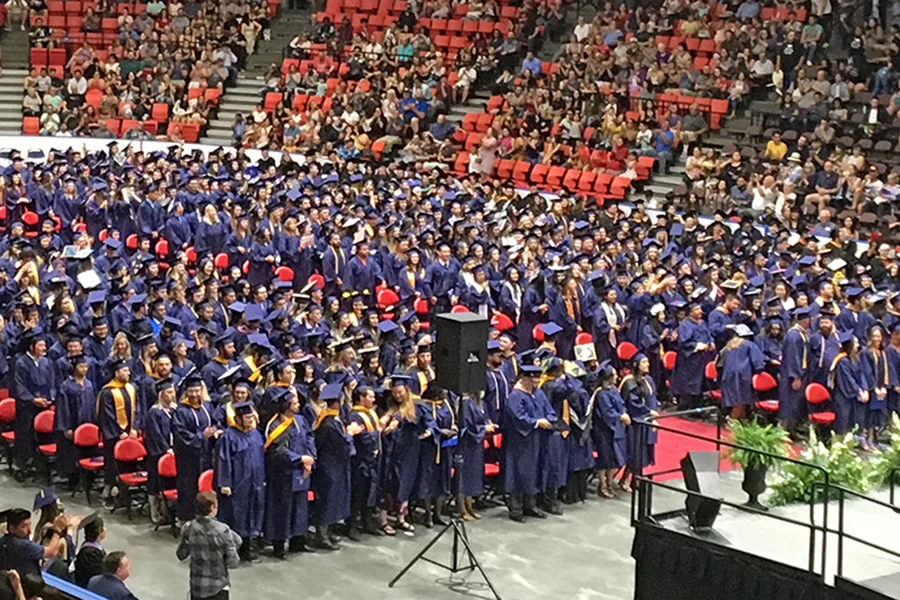
Columbia Basin College graduation
TCJOB File PhotoA long-postponed reckoning could be coming soon for millions of student loan borrowers who are now faced with garnished wages and seized tax refunds as soon as next year.
Since pandemic forbearance finally expired last year, more than 9 million borrowers already are in default, owing a collective $234 billion, and millions more are late in their payments. Those borrowers are likely to face severe collection measures such as wage garnishment and seizure of tax refunds next year. Such collections have been repeatedly paused, most recently this past January.
Betsy Mayotte, president and founder of The Institute of Student Loan Advisors, a nonprofit that advises borrowers, schools and employers, said she expects collections to start next year.
“It’s heartbreaking,” Mayotte said. “People tend to get caught off guard when their tax refund is taken and if they’re struggling financially, a lot of times they’re counting on that refund to catch up.”
The Washington Sun reported in October that collections plans would likely be announced after the midterm elections. The U.S. Department of Education did not respond to a Stateline question.
States with the highest default rate, Mississippi, Louisiana and New Mexico, had more than a quarter of borrowers living there in default, but even the lowest state rates were 15% for Massachusetts, New Hampshire, Utah and Wisconsin. That’s according to a Stateline analysis of Education Department data from the second quarter of this year.
Defaults began to start up again in late 2025 and early 2026. In those two quarters alone, 13% of student loans went into default in Louisiana and Mississippi, and at least 5% went into default in every state, according to data from the Federal Reserve Bank of New York based on credit reports.
Older borrowers seemed to be struggling more than they were before the pandemic, according to the bank’s analysis.
One of them is Timothy Varro, 40, who has made payments for the past 10 years but can’t keep up even with the interest on the roughly $120,000 he borrowed for college in New Jersey and law school in Rhode Island.
Despite a good job as an attorney for a bank in New York City, the balance has ballooned to $375,000, and he can’t make the $2,000 minimum payment. It didn’t help that he graduated in a recession and took low-paying public service jobs at first.
“I don’t have rich parents to pay this off for me,” Varro said in an interview. “This may be my conspiracy theory, but I think this is punishment. They’re trying to send a message that this is what’s going to happen if you’re lower or working class and you strive for upward mobility.”
Varro said he worries about collection efforts because he’s supporting his fiancé in a small apartment in New York City and has been ill at times with epilepsy that requires breaks from work.
“I fear that unless something miraculous happens, I will default and my wages will be garnished for life,” Varro said. “I don’t think it’s asking too much to just give us a payment plan that’s reasonable.”
Even on a smaller scale student debt can be a burden when a college education doesn’t pay off as planned.
Taylor Lewis, 26, owes $29,000 for her time at Kennesaw State University, where she earned a bachelor’s degree in media and entertainment.
“I was young, I was just trying to chase my dreams. I wanted to be a talk show host. I wanted to work in the media world,” Lewis said. “I was just young and stupid, pulling out loans every semester and thinking, ‘Yeah I could pay that back. I don’t care about that.’ They prey on undergraduate students. They know we don’t have anything to lose at the time.”
After graduating in 2023 Lewis found that her degree did not get her into the media world without more experience, and she now works as an assistant manager for United Parcel Service in Atlanta.
After missing a payment by mistake, she said her loan went into default and she wasn’t allowed to rectify it without paying the full $29,000, which she can’t afford. She’s hoping to be offered a repayment plan and planning to go back to school, paying her own way this time, to get a degree in human resources.
Some states, such as Maine, have initiatives to advise students on loans starting in high school. The state suffers too if young people fall into debt, said Mila Tappan, education affordability training manager at the Finance Authority of Maine, known as FAME. Maine is among the states that offer a tax credit for student loan payments to help keep and recruit educated workers. Connecticut has similar credits for employers who help with student loans.
Maine had one of the lowest rates of new defaults at the peak in late 2025 and early 2026, along with other New England states such as New Hampshire and Vermont, but also Kentucky and Wisconsin.
Maine’s finance authority offers student loan counseling through emails, webinars and in-person events. “We like to think that what we do makes a difference. Some of it is as simple as the mentality here in Maine, that you do what it takes to repay your debts,” Tappan said.
Preston Cooper, a senior fellow at the conservative American Enterprise Institute, has written about the student loan crisis and lobbied for changes to benefit taxpayers, he said. He helped craft a process that could deny schools student loans if they can’t prove their degrees raise pay for graduates, for instance.
Some private vocational schools have very high rates of late payment on student loans, as high as two-thirds for some that are mostly in the South, according to a 2025 federal report. Schools of medicine and health, on the other hand, often have little or no default.
The current crisis caught a lot of student borrowers by surprise because they were allowed to stop payments during the pandemic without being classified as delinquent or in default, and the pause was extended many times.
“The government did not do a very good job of communicating the fact that repayment was starting again for real. There were a lot of false starts,” Cooper said. “They would say the student loan payments are about to resume, only to extend the pause.
“You had heartbreaking stories where people only found out they were delinquent on their loans when they suddenly got dinged on their credit.”
This story was originally produced by Stateline, which is part of States Newsroom, a nonprofit news network which includes Washington State Standard, and is supported by grants and a coalition of donors as a 501c(3) public charity.
Stay Informed. It’s Free.
Subscribe to our newsletters and get the latest news and insights delivered to your inbox.
We respect your privacy.
Unsubscribe anytime.
Thank you!
You’re subscribed. Keep an eye on your inbox for the latest updates.