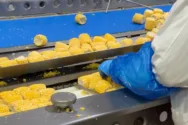
Darigold offers behind-the-scenes look inside new Pasco plant

After three years of construction, Darigold’s 29,000-square-foot Pasco plant opened this summer.
It’s the largest dairy processing plant in the Northwest, and the company launched a video series on its LinkedIn page to show how the plant manufactures butter and powdered milk.
The new plant at 8201 N. Railroad Ave. can process 8 million pounds of milk per day.
Darigold has said the Pasco facility was a $1 billion investment.
“Pasco was chosen because of its proximity both to our farms, and to transportation outlets, both rail, highways and maritime ports,” said former Darigold CEO Allan Huttema in the introductory video. Since the video was published, Darigold has named Amy Humphreys as its new CEO.
Jimco Hrusovszky, the Pasco plant’s site director, starred in the eight-part video miniseries that provides a rare look inside the milk processor’s operations.
Production starts when loads of milk arrive at the plant. There are six bays to receive them, with two extra bays to be added in the future as demand requires. Each tanker truck carries 72,000 pounds, or over 8,000 gallons, of milk.
Darigold also has a “clean in place,” or CIP, system on hand at each bay to wash the insides of the tankers to maintain high milk quality.
After the milk is received, it is transferred to the silo and wet processing rooms. Darigold has 35 silos that can hold 70,000, 50,000, 40,000 or 10,000 gallons of raw milk, with most at the 70,000-gallon size due to the facility’s large production volumes.
The products move through a series of mix-proof valves controlled by a computer system, routing everything where it needs to go.
Once the milk is stored and ready to be processed, it travels through a feed system into four centrifuges. These machines separate the cream from the milk: the cream will be processed for butter manufacturing while the skim milk will be processed into powder.
Once the cream and skim are separated, the cream goes to two heat exchangers, where it’s cooled to a proper storage temperature. Then it heads to a silo where it’s pasteurized and prepared for butter manufacturing.
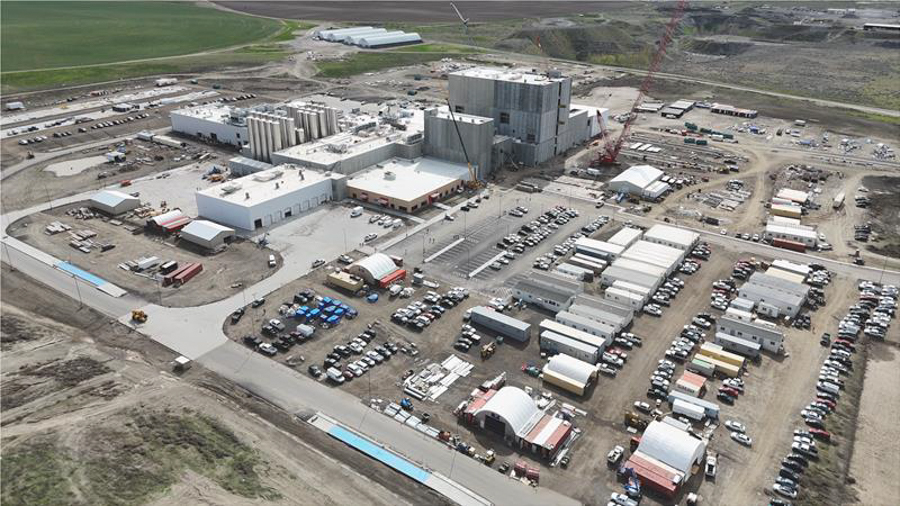
An aerial of the new Darigold plant at 8201 N. Railroad Ave. in Pasco. Darigold said the Pasco project is a $1 billion investment.
| Courtesy DarigoldThe cream must be pasteurized through a high temperature, short-time pasteurizer, which makes the cream safe for human consumption. The cream then ends up in another set of silos to prepare for butter manufacturing.
Meanwhile, the skim milk goes through a reverse osmosis machine, where solids are separated from water. The remaining milk is concentrated from 9% total solids to 18%. It’s then moved into a silo for further processing.
The water that was removed goes through another reverse osmosis machine called a polisher, then is pasteurized in a UV system. The water is cleaned up to nearly potable levels, and can be used again in the facility, reducing the amount of city water needed to operate the plant, Hrusovszky said.
Spore-forming bacteria are spun out of the milk in special centrifuges. Reducing the spore count is a process that’s necessary for milk powders used in infant formulas and other products, Hrusovszky said.
After going through clarifiers, the milk goes to the evaporator room, which transforms the milk from 18% solids to 51% solids. From there, it heads to the concentrate room, where it goes through high-pressure pumps and sprays into the top of driers. The particles fall 100 feet, drying on the way down, turning the particulates of concentrated milk into dry powder.
Like all food manufacturers, Darigold must run several tests and analyses on both its raw and finished products. One test checks for composition, while another ensures that the product is safe for consumption.