Feds greenlight $2B renewable energy project on Yakama Nation sacred site
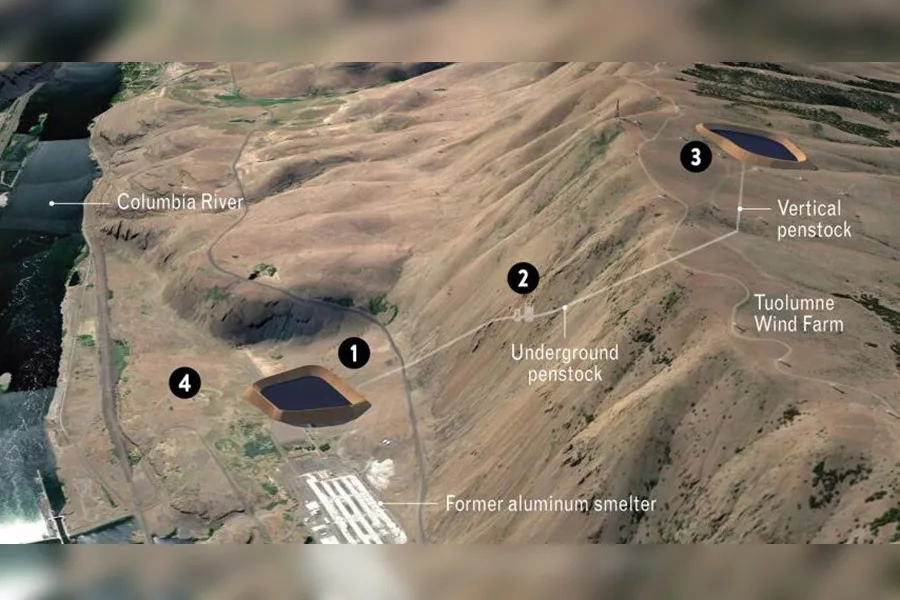
A rendering of the proposed Goldendale Energy Storage Project.
Image courtesy of Rye DevelopmentFederal energy regulators on Jan. 29 greenlit a roughly $2 billion renewable energy megaproject on a Yakama Nation sacred site overlooking the Columbia River in Klickitat County.
The 40-year federal license requires the project to break ground within two years, although it still faces legal challenges, said Erik Steimle, who is leading the project for Rye Development. The new license is the final legal approval needed to move the project into construction, Steimle said.
The site is used for ceremonies as well as treaty-reserved fishing and root gathering, and has been a village location for the Yakama Nation since time immemorial, said Elaine Harvey, who is a conservation scientist and member of the Yakama’s Kamíłpa Band, which is from the area.
But if the Goldendale Energy Storage Project is built, the hillside would become a giant hydropower generator producing enough electricity to power 500,000 homes for 12 hours. It would work by dropping 2.3 billion gallons of water sitting in a man-made reservoir atop the bluff about 2,000 feet down a large tunnel drilled into the rock. After flowing through turbines, water would then be pumped back to the top reservoir to repeat the cycle.
The idea is to release water from the top when electricity is needed, then use wind and solar power to pump it back up at times when electricity from the notoriously unpredictable renewables is abundant. In short: It would be a giant battery.
The federal license ruling comes as the Pacific Northwest heads toward an energy crisis, with growing regional electricity consumption — especially from power-hungry data centers — blowing up old demand projections and threatening Washington and Oregon’s climate goals.
Celebrations, condemnations
“This is a landmark moment for the Pacific Northwest,” said Steimle in a press release. “With electricity demand and energy costs on the rise, this license represents a huge step toward a more reliable grid and affordable energy prices for the region.”
The license follows another win against Native nations and environmental groups last year, when the project earned a water-quality certification.
Construction on the nearly 700-acre project will take four to five years, according to Becky Brun, who is a consultant for the project.
Steimle said he expected construction to start in 2027. Underground tunneling machines will hollow out thousands of feet of tunnels to a diameter of 29 feet.
The project would be the first major pumped storage hydropower project in Washington, as well as the first new major U.S. pumped storage project in about 30 years, he said.
The company is currently working on two other pumped storage projects, including one in Oregon that won federal approval in 2019 but is only a little ahead of the Goldendale project, Brun said.
“There’s an urgent need for this type of energy storage,” Steimle told The Columbian, “and the Goldendale project will help Washington meet its clean energy goals with minimal environmental impact.”
The potential project’s harms to Yakama sacred sites were the subject of an award-winning 2024 documentary titled “These Sacred Hills.”
Yakama Tribal Council Chairman Gerald Lewis blasted the permit approval in a press release as “rewarding bad actors who have spent years finding loopholes to target a new wave of industrial development on top of Indigenous sites that have religious and legendary significance.”
“They know it’s wrong,” he added, “if a small Christian shrine sat on this site the decision-makers would understand what ‘sacred’ means.”
A state review of the project found it would have “significant and unavoidable adverse impacts” on the Nations’ historic sites and culturally important plants.
In addition to the Yakama, 17 tribal governments, the National Congress of American Indians and Affiliated Tribes of Northwest Indians all have come out against the project, according to Columbia Riverkeeper, which is currently fighting the project in state appeals court alongside the Yakama Nation.
History repeating
“The potential consequences, if this project does proceed, would include, No. 1, a total desecration of our sacred site, Pushpum,” Harvey said. “And it’s irreversible.”
Pushpum means “Mother of all roots,” a name bestowed on the area because it functions as a seed bank for almost three dozen different kinds of roots, flowers and shrubs. Some can only be found there, according to Columbia Riverkeeper.
Because of Pushpum’s current use as a site for gathering, fishing and ceremonies, and because it contains archaeological sites, Harvey said the project put the Yakama Nation between a rock and a hard place: reveal a sacred site, opening it up to looting or keep the information secret but lose it all together.
Harvey’s family has been displaced by hydropower development twice.
First, The Dalles Dam flooded the Willa-wy-tis Band’s village in Maryhill in the 1950s. Then in the late 1960s, the Army Corps of Engineers removed Harvey’s family from lower Rock Creek Canyon as John Day Dam flooded the area, pushing them to Goldendale where Harvey lives today.
“We had to bear the burden of the hydro systems, we had to be removed from our village site along the Columbia River. My grandmothers and grandfathers were pretty much just told to leave, and they were left homeless,” Harvey said. “That’s the type of tragedies that our people have endured for ‘green energy.’ ”
Why there?
The area is part of about 12 million acres ceded to the U.S. in an 1855 treaty that enshrined ongoing fishing, hunting and gathering rights at traditional sites like Pushpum into U.S. law.
Critics have long asked why 40 years of hydropower is worth destroying a sacred site in an area with some of the oldest and most well-documented Native history in North America. Nearby Celilo Falls, for example, was the longest continually inhabited site in North America before it was drowned by The Dalles Dam hydropower project.
Steimle said the company understands the importance of protecting Native cultural sites and has moved some components of the project around the site to address concerns.
“We do not propose projects on lands where we’re not invited to do so,” Steimle said. “This piece of private land that’s been industrialized for quite some time is owned by a landowner who has requested this type of development.”
The bottom half of the site was an aluminum smelter until regional power prices jumped in 2003.
“There are very specific things that are required for this type of site: geology, geography, a sustainable source of water,” Steimle said.
In this case, local and state officials have targeted the site for redevelopment, he said.
Simone Anter, a senior staff attorney at Columbia Riverkeeper, said project opponents still have 30 days from when regulators published the license to challenge it — a process that could lead to more legal battles.
And Harvey has no plans to give up on the prized home of early-season Indian celery, which is an important part of longhouse ceremonies.
“That’s why it attracts people of different longhouses to come and gather,” she said. “We still dig Indian celery there — we’ll be there next month, in February, digging it.”
Henry Brannan, reporting for The Columbian in Vancouver, is with the Washington State Murrow Fellowships, a local news program supported by the state.
This story is republished from the Washington State Standard, a nonprofit, nonpartisan news outlet that provides original reporting, analysis and commentary on Washington state government and politics.