
Now in 25th year
Student-run branches give teens real-world financial edge, experience
20 former high school credit union students have been hired, still have full-time careers with Gesa
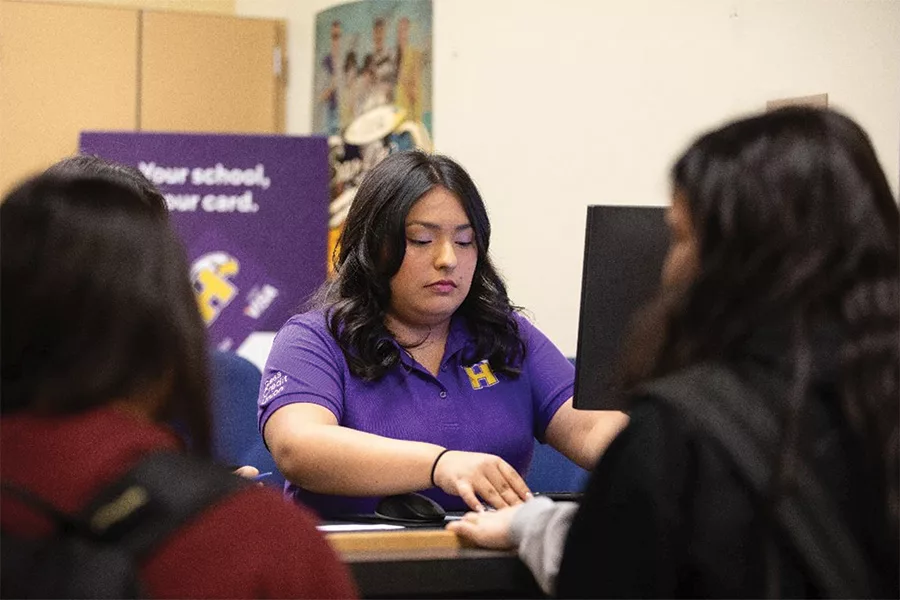
Students participating in Gesa’s high school credit union program have the chance to learn hands-on about financial literacy and checking accounts. Pictured is the student-run credit union at Hanford High School in Richland.
Courtesy Gesa Credit UnionRuth Plaza was in Chiawana High School’s DECA club, interested in pursuing a business-related field, when she heard about Gesa Credit Union’s student intern position.

Ruth Plaza
She took on that role as a high school senior, learning more about financial literacy and how to make learning fun for the other students around her.
“It has helped me so much,” she said, explaining that’s she’s been able to educate her own family about finances.
Plaza is continuing her work as an intern with Gesa at Washington State University in Pullman. “I’m learning so much more, which I’m so thankful for,” she said.
High school students like Plaza locally and across the state have the opportunity to get hands-on financial experience, thanks to the Richland-based credit union’s student program, now in its 25th year.
Gesa’s high school branches are fully student-run operations that equip students with money management skills and real work experience.
First launched at Richland High School in 2000, the program has since expanded to 18 high schools across the state and 200 participating students, with six more branches set to open by the end of the school year.
One of the six branches that will open this year is in Pasco School District’s newly completed Sageview High School, where the branch was specifically built into the school’s designs.
Each high school credit union is branded to feel like part of the school, even though they are Gesa-operated.
“These high school credit union programs are meant to be a complement to and embedded into a school’s curriculum,” said Brandon Allison, assistant vice president of community impact at Gesa.
How it works
Gesa’s high school credit union program connects with DECA, Future Business Leaders of America (FBLA) and accounting or financial services classes offered by the school district.
Students in those courses can volunteer as student tellers at their high school branch. They aren’t paid by Gesa, but they can earn credits for their class and gain hands-on experience.
Each branch is led by a campus branch program manager, a paid student intern for Gesa. That’s a position that students have to apply for at the end of the school year. Often, students who have already participated in the program as a volunteer are selected.
Applicants go through an interview process both with Gesa’s education team and their branch team, then begin training in the summer.
Once the school year starts up again, the student interns are ready, with two and a half months of experience already under their belts. They open the campus branch during lunch, then work after school and on weekends at Gesa’s actual branches.
All of the students working at the campus credit union do two hours of training with Gesa’s education team in the weeks leading up to the branch opening. Typically, the branches open by the end of September or early October.
Branch operations
Students in the credit union program learn how to handle deposits and withdrawals, cash checks, speak about the benefits of student accounts, open those accounts, and complete some marketing training.
The campus branch can essentially handle everything that a typical credit union branch can do. Students are only able to use the branch with a student checking account, which they can start signing up for at the high school branch. The process needs to be completed by Gesa’s traditional branches.
Students can open a student checking account with parent permission at age 14. The accounts are specifically designed for students, offering full functionality with safeguards in place. There are no fees for these accounts, and students cannot overdraft.
“We want these accounts and this program to be a learning experience, and we feel like placing those guardrails on these accounts, we’re letting them have relevant real-world experience (that) sets them up for success when they enter adulthood,” Allison said.
Year-round opportunities
In addition to gaining day-to-day transaction experience, the students running the campus branch build other skills throughout the year.
Students are given a budget to host a grand opening event to create awareness about the campus branch. They can use advertising, giveaways and vendors to put on a fun event, Allison said, while also giving students project management experience.
In the spring, students participate in designing Gesa’s annual financial literacy challenge, which encourages students to complete online financial literacy courses. Students in the campus branch program get to decide how to promote the challenge as well as how to reward students who complete the challenge.
Gesa’s team also helps students to polish their resumes, listing out all of the functions they perform as part of their credit union work.
Students in the program also are eligible for scholarships.
Gesa dedicates $100,000 in scholarships for its campus branch students, and all students who are a part of the program are guaranteed a scholarship. A $2,000 scholarship is set aside for student interns, while student tellers are guaranteed a minimum of $500.
Program success
Now in its 25th year, the program has proved successful.
More than 20 former high school credit union students have been hired and still have full-time careers with Gesa, including Amber Merrill, Gesa’s community relations manager.
But the program is meant to launch students in any career they choose, teaching both hard and soft skills to build their experience.
Gesa’s high school branches are a part of its commitment to its financial education.
“It’s our honor to support the schools in creating a generation of students who are not only workforce-ready, but have the ability to create a lifetime of financial freedom,” Allison said.
In 2019, the program was recognized by the Credit Union National Association as the top youth financial education program in the nation. And in 2022, it became the first financial sector Career Launch-endorsed program in Washington through Career Connect Washington.
When Allison is asked why Gesa runs a program like this, he said Gesa’s goal is to make a positive impact in the communities the credit union serves.
“There’s no larger impact than being able to offer a realistic credit union in schools across the state for students to be able to gain that financial experience, to truly set themselves up for adulthood,” he said.