Higher education
Colleges see strong enrollment gains as campus projects move forward
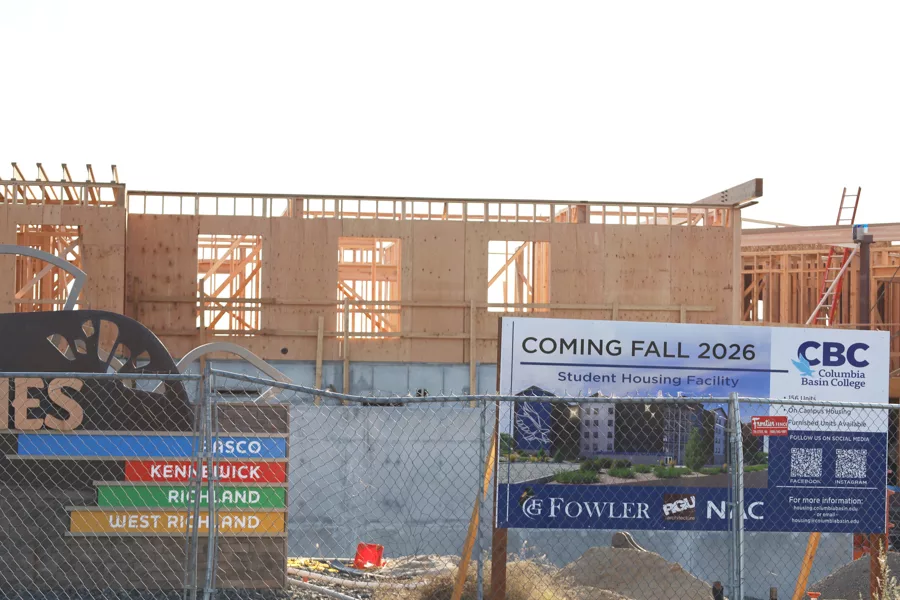
A new student housing facility is under construction at Columbia Basin College in Pasco.
Photo by Nathan FinkeColumbia Basin College and Washington State University Tri-Cities both reported significant student enrollment increases this fall, marking consecutive growth at both schools.
CBC has two big building projects on the horizon – a second student housing facility currently under construction and replacing a 54-year-old arts building.
WSU Tri-Cities has no major capital projects in the works but does plan nearly $2 million in campus improvements and repairs.
Columbia Basin College
Columbia Basin College fall enrollment has continued its upward trend.
The Pasco community college welcomed 8,243 students in fall 2025, up from 7,778 during the same period last year, or about 6% more, according to preliminary headcount data.
Preliminary full-time equivalent enrollment was 6,577 versus 6,053 in fall last year, an increase of 8.7%.
CBC officials noted this means there’s been a slight uptick in the average courseload per student, with students taking more classes on average this year.
“It’s great to see the campus filled with students. This year we added a new Bachelor of Science in computer science. Continuing to expand our program and degree offerings to meet industry needs is the key to continuing CBC’s strong enrollment numbers,” said Rebekah Woods, president of Columbia Basin College, in a statement.
In 2024, CBC had a total student enrollment of 12,283 students, a high-water mark over the last 15 years.
CBC manages an operating budget of $72.4 million and employs 932 people.
Several areas of the Columbia Basin College campus in Pasco will be seeing improvement in the coming year.
Replacement of the college’s Arts Center received the green light for funding from the State Board for Community and Technical Colleges as part of the fiscal year 2026-27 capital budget.
Identified as the P Building on campus maps, the building is made up of connected structures that appear as nearly fitted together pieces of an unadorned concrete block. Designed by Spokane architect Ken Brooks, it took 4,000 cubic yards of concrete to build for $1.8 million in 1971.
CBC’s Brian Dexter, assistant vice president for campus operations, said the college is in the process of selecting an architect for predesign for the roughly $40 million project.
Another major construction project remains in the future state capital budget pipeline: a $49 million Center for Applied Science and Agriculture building. It currently sits at No. 30 on the list of state capital budget request priorities for 2025-27.
Meanwhile, construction continues on a student housing facility – CBC’s second - at the corner of 20th Avenue and Argent Road across the street from the main Pasco campus. It will feature 156 rooms and is on track for completion in the summer of 2026.
A substantial three-phase project to renovate lab and classroom spaces in the T Building science wing was completed earlier this year at a cost of $2.5 million.
Dexter said updates included the renovation of a chemistry lab, conversion of a general lecture classroom into a physics lab, combining two smaller classrooms and renovating halls and common spaces of the science wing.
Replacement of some aging water and sewer line infrastructure on campus also was completed at a cost of $2.8 million. More is scheduled to be replaced in the next funding biennium.
A $250,000 roof recoating project wrapped up in January with more roof repair and replacement projects planned for the future.
Predesign work for updates to Saraceno Way – the road that serves as the north entrance to CBC’s campus – is complete and the $2 million project is now in the design phase and projected to be completed in the summer of 2026.
Dexter said that it is a locally-funded project and will include pedestrian and bicycle path improvements, lighting and crosswalk upgrades, as well as new signage and landscaping.
Other projects for the next biennium include additional updates to Saraceno Way as well as replacement of mechanical and electrical equipment including pumps, chillers and air handler units.
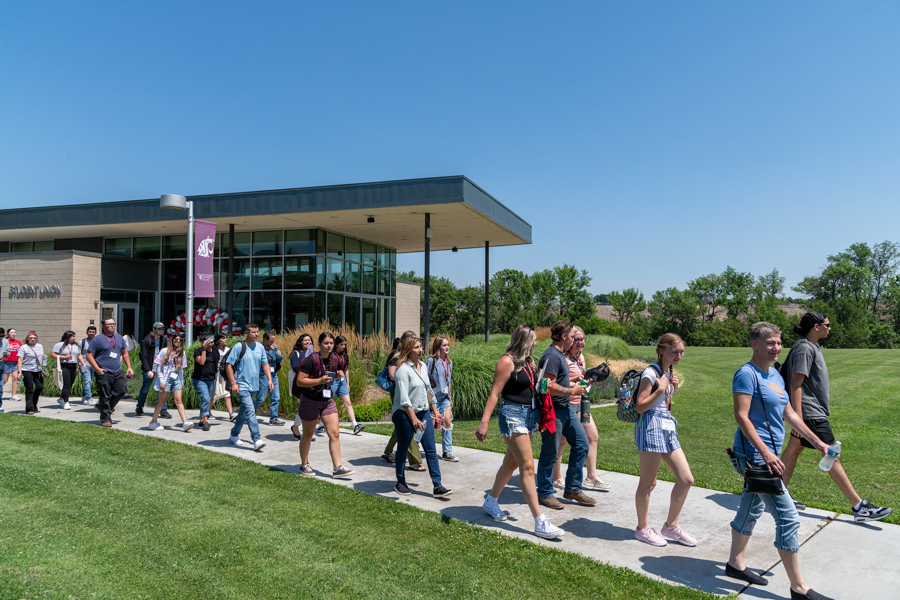
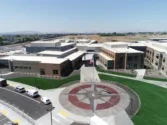
Enrollment is on the rise at the Washington State University Tri-Cities campus, though no major capital projects are in the works.
| Courtesy WSU Tri-CitiesWSU Tri-Cities
Washington State University’s Tri-Cities campus in north Richland saw an 8.1% increase in student enrollment in fall 2025 over the previous year, welcoming 1,489 students, and marking a third consecutive year of growth.
First-year enrollment grew by 11.1%, marking the third consecutive year of double-digit growth in this category. First-time graduate student enrollment more than doubled compared to last fall.
“An 8.1% increase in overall enrollment and another record-breaking number of first-year students indicates that students and families understand the benefits of a WSU Tri-Cities education,” said Sandra Haynes, chancellor of WSU Tri-Cities, in a statement. “We are proud to be a campus where students can pursue excellent academic programs in a supportive, close-knit community.”
Jamie Owens, campus director of admissions, attributed the growth in part to her team’s efforts to strengthen outreach to local high schools and transfer students.
“These results are achieved by spending time in high schools, welcoming prospective students at on-campus events, and sending countless emails, text messages and phone calls. We genuinely care that our students and their families feel confident in their college decision and work to ensure they understand how to maximize financial aid,” Owens said.
Owens said initiatives such as application workshops and “Instant Decision Days” at regional high schools and community colleges helped boost WSU Tri-Cities’ number of first-year students.
Overall enrollment across the entire WSU system remained nearly flat year over year, declining less than 1% from 25,685 students in fall 2024 to 25,477 this fall.
Leslie Streeter, director of marketing and communication for WSU Tri-Cities, said while there are currently no major capital projects in the works at WSU Tri-Cities, he university is working on some campus improvement and repair projects all costing under $2 million.
The Bioproducts Science and Engineering Laboratory, or BSEL, is undergoing roof repair, as are the concrete steps leading to the East Building.
The most exciting development is remodeling of laboratory space at the Institute for Northwest Energy Futures building to house the small modular reactor, or SMR, simulator in partnership with Energy Northwest.
Housing this simulator at WSU Tri-Cities will not only support the SMR industry as it comes online at Energy Northwest in the coming years, but also will provide necessary training for the next generation of engineers and other personnel needed to operate SMRs here and abroad.
WSU Tri-Cities has a core operating budget of $27.6 million and employs over 326 people per 2024 figures.