
How WA lawmakers are trying to regulate data centers
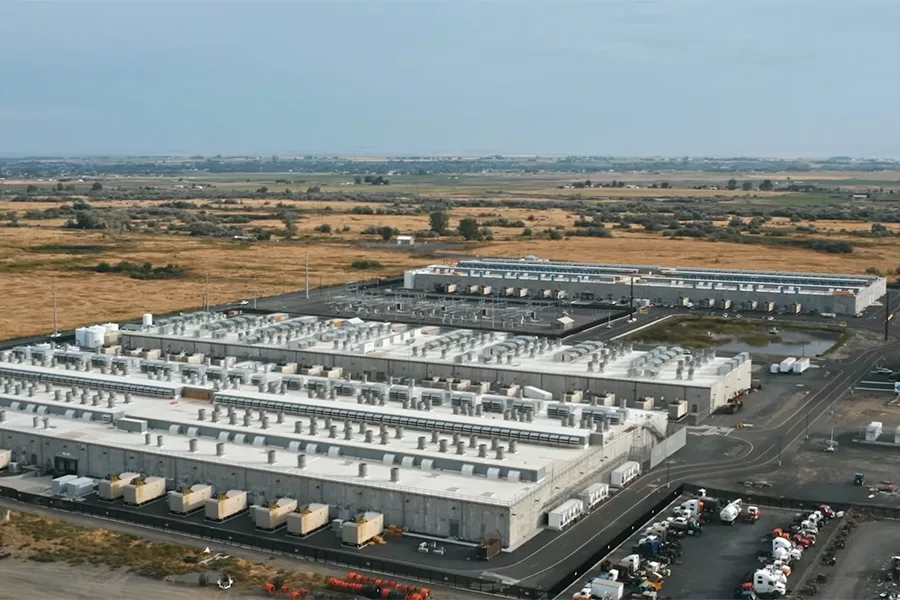
Amazon Web Services maintains multiple data center campuses in Boardman, Hermiston and Umatilla.
Courtesy AmazonWith data centers expected to become the largest source of electricity demand in the Pacific Northwest, Washington legislators are pressing ahead with a bill aimed at protecting the grid and offsetting potential hikes for utility ratepayers.
House Bill 2515 passed out of the Appropriations Committee on Feb.9, with two Democrats and all of the Republicans on the panel opposed. Reps. April Berg, D-Mill Creek, and Larry Springer, D-Kirkland, cast the two Democratic “no” votes. The bill next awaits a floor vote in the House and still needs Senate approval.
“These policies seek to protect ratepayers by ensuring new data centers are picking up the whole tab for new growth,” said Rep. Beth Doglio, D-Olympia, who is the bill’s lead sponsor and chair of the House Environment and Energy Committee. She also said the bill would help grid reliability and improve transparency on water and energy usage.
Before the Appropriations Committee passed the bill, it made two significant changes. Lawmakers adopted a Republican-backed amendment, which eliminated an annual state fee for data center operators. And they loosened clean energy requirements for the facilities that were in the original bill draft.
Money from the eliminated fee would have gone to help low-income families weatherize their homes and to support higher education programs.
Data center backers say those moves are a step in the right direction, but that the bill will still stifle innovation and hurt the economy.
Washington is already among the top 10 states with the highest number of data centers. That’s partially thanks to tax incentives for the centers that the Legislature approved in recent years.
The centers provide the computing power for vast amounts of internet-connected technology that people have come to rely on. And they are expected to grow rapidly to support artificial intelligence.
What changed?
As written, the bill requires utilities to establish a tariff or policy for data centers by 2027, to ensure the centers cover the costs utilities face in supplying them with enough power. The idea is that those added costs aren’t passed on to other ratepayers.
The legislation also calls for data centers to curtail electricity use — possibly turning on generator power — when the grid is strained, and to take other steps to manage the demand they put on the grid.
Additionally, data center operators would be required to share a sustainability report, information on server cooling technology and data on water and energy use and emissions.
Opponents argue that, despite the bill targeting “emerging large energy use facilities,” it unfairly singles out data centers. Some manufacturing facilities like semiconductor plants and food and beverage processors use just as much electricity, said Dan Diorio, vice president of state policy for the Data Center Coalition.
Before the changes, the bill required data centers to also pay the state an annual fee based on energy usage, levied at half a penny per kilowatt hour. Projected to bring in over $30 million a year, that fee was cut following passage of an amendment from Rep. Mary Dye, R-Pomeroy, the top Republican on the Environment and Energy Committee.
“We know that data centers really improve the economic conditions of communities that really have not had much opportunity,” Dye told the Standard. “By putting a tax on data centers, you make our state unattractive for that opportunity.”
Supporters of data centers specifically highlight local tax revenue and jobs they’ve created in more rural parts of the state, in places such as Quincy, Washington.
The bill also originally mandated data centers switch to using emissions-free energy by 2035, but that date moved to 2045 under changes backed by Doglio. This change aligns with the state’s timeline in existing law to eliminate greenhouse gas emissions from the grid.
Diorio said the timeline puts everyone — data centers, utilities and other large electricity users — on the same page, but that the bill still falls short.
An average household has 21 Wi-Fi-connected devices, according to the Data Center Coalition.
Those devices are backed by cloud services, one of the primary functions of a data center, and “the backbone of the internet and modern economy,” Diorio said. When the grid is strained, “data centers can’t just turn the internet off,” he added.
The Data Center Coalition also contends that cooling systems for the facilities are trade secrets that companies shouldn’t have to disclose.
“The type of cooling technology you’re using is very much a competitive edge because it allows you to be more efficient,” Diorio said.
‘Considerable complexity’
Puget Sound Energy, Washington’s largest investor-owned utility, is already racing to find enough renewable energy to meet state mandates. Last week, Amazon outbid PSE for a large solar energy farm in Oregon.
While the utility supports the intent of the data center legislation, it finds the bill does not address challenges related to this increased competition, said Andrew Padula, a spokesperson for Puget Sound Energy.
“We have been attempting to help policymakers understand the considerable complexity of this issue,” Padula added.
Berg, one of the two Democrats who opposed the bill in the Appropriations Committee vote, said tax incentive legislation for data centers that she sponsored in 2022 also established the state’s first labor and environment standards for facilities.
“I think we absolutely need to keep having conversations that protect ratepayers, that protect our climate and that protect our communities,” Berg said in an interview. “I really want to sit down and be collaborative because I do know of communities like in Quincy where their property taxes have been cut in half.”
Berg also sponsored an amendment to remove the fee that data center operators would pay to the state, but withdrew it, clearing the way for Dye’s identical amendment to pass.

Stay Informed. It’s Free.
Subscribe to our newsletters and get the latest news and insights delivered to your inbox.
We respect your privacy.
Unsubscribe anytime.
Thank you!
You’re subscribed. Keep an eye on your inbox for the latest updates.