Pasco emerges as ideal site for industrial symbiosis park
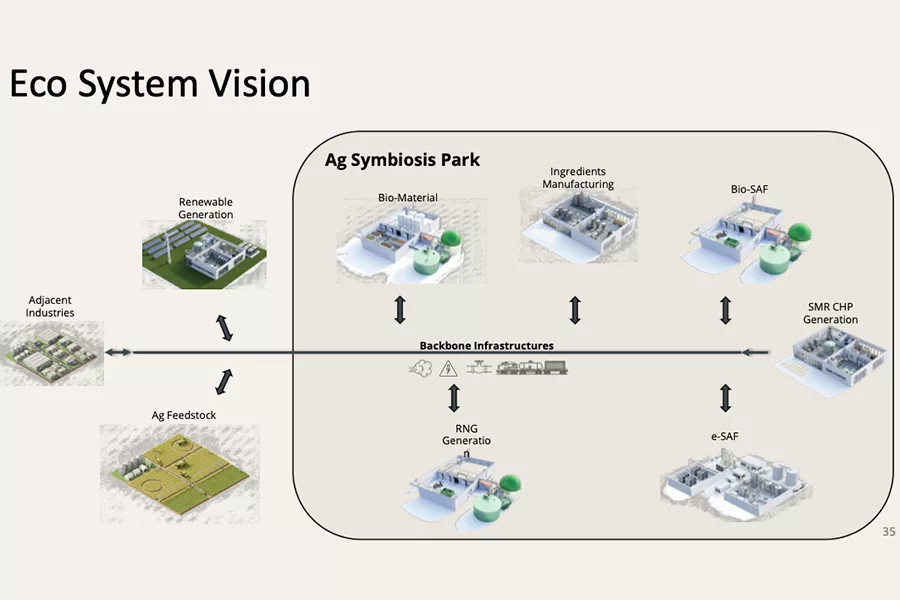
Port of Pasco commissioners recently accepted the results of a feasibility study looking at the possibility of establishing an industrial symbiosis park in Pasco. Such facilities use technologies that convert biowaste to renewable gas or reuse waste heat from manufacturing to support other processes.
Courtesy Port of PascoPasco already has a key advantage for developing an industrial park centered on reusing manufacturers’ waste byproducts, according to consultants who studied the concept.
Consultants Jakob Hebsgaard and Anders Larsen recently presented findings to Port of Pasco commissioners, saying many communities struggle to find an organization capable of leading such efforts.
“That’s why it’s a pleasure to talk to a port operator because that’s what a port does,” said Larsen, of Denmark-based Hebsgaard | Larsen.
The consultants worked with the Center for Sustainable Infrastructure (CSI) on a feasibility study that identified Pasco as an ideal location for an industrial symbiosis park.
Port commissioners unanimously accepted the study.
It’s a concept the port has pursued for years with a vision to recruit new economic development, support existing agricultural and industrial partners, and venture into environmentally-sustainable infrastructure.
“This is such a forward thinking and much needed project,” said Commissioner Vicki Gordon. “We’re very excited about this.”
There’s still a lot of hurdles to jump – and not just finding land for the project. The state recently allocated about $250,000 to the port to conduct a manufacturing market analysis, identify waste-to-energy technologies that could be used by park tenants and determine local feedstocks, such as agricultural waste, that could be used to power the park.
And finding the right tenants also will need to be a thoughtful process, port officials said.
“The first business in really sets the groundwork,” said Stephen McFadden, the port’s deputy executive director. “We can’t just take any company we have to take the right companies to establish that waste-to-energy pipeline.”
The port began looking at the concept of an industrial symbiosis park under former executive director Randy Hayden. Hayden took part in a study tour in 2023 to look at such facilities in Denmark, which has invested deeply in the reuse of waste to power its manufacturing sector and meet environmental goals.
Similar parks in Denmark use technologies that convert biowaste to renewable gas or reuse waste heat from manufacturing to support other processes.
That kicked off a growing movement to bring the concept to Washington state, with the port and the Cowlitz County Economic Development Council in the southwestern part of the state identified as pilot locations.
“The notion that one person’s waste is another person’s energy source is an intriguing concept,” said Commissioner Matt Watkins. “Our energy outlook in our community needs some out-of-the-box thinking.”
The port’s ability to support an industrial symbiosis park was not the only factor in identifying the region as a strong candidate, Hebsgaard | Larsen and CSI said. The study also pointed to strong energy infrastructure, a variety of locally available bio-waste, and broad stakeholder support from industry, utilities and local governments.
Along with exploring funding options and fine-tuning outreach to potential stakeholders, the port’s next steps should be narrowing down the list of appropriate sites for an industrial symbiosis park.
Hebsgaard | Larsen and CSI indicate in the study that land currently held by the state Department of Natural Resources could be the best option, with a parcel in the range of 120-150 acres.
McFadden stressed to port commissioners that they are entering “a marathon of a thousand sprints” given the many pieces of developing an industrial symbiosis park. The current timelines are built to take the next 10 to 15 years for the project to reach fruition.
However, the port has recent experience in dealing with projects where its leaders initially underestimated the appetite for new development opportunities.
“When I first got here, there was a project for Darigold,” McFadden said. “Everyone thought Reimann (Industrial Center) wouldn’t develop for decades and now look at us.”
Port commissioners agreed last year to spend $20.8 million to more than double the size of its quickly filling Reimann Industrial Center.