
Benton, Franklin counties shift to a majority-minority population

Over the past dozen years, the greater Tri-Cities has won the sweepstakes for fastest-growing metro in the state. Between 2010-22, the population here grew at a clip of 1.8% per year, compounded. People of color in the two counties had much to do with this, as they expanded their numbers even faster, at a compounded annual rate of 3.8%
These bare facts of population provide the backdrop for a March 21 talk I gave to the Columbia Basin Badger Club on key measures of progress of people of color here.
As of 2022, the estimated population in the two counties was nearly 312,000. And for people of color? Over 153,000. That’s 44% of the total. (2023 estimates for people of color are not yet available.) With such tailwinds, the base forecast by state demographers at the Office of Financial Management (OFM) calls for a two-county population of over 350,000 in 2030.
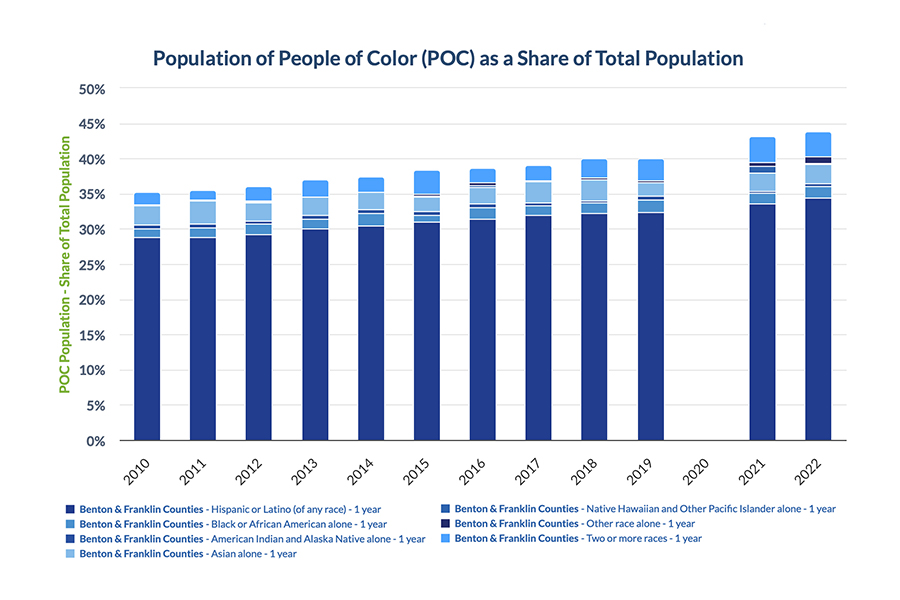 Courtesy Benton-Franklin Trends
Majority minority
And people of color in 2030? OFM doesn’t issue forecasts by race and ethnicity. Were the growth rate of the last dozen years to prevail through 2030, we expect the numbers of people of color to exceed 200,000. This would make the entire two county area “majority minority.”
To understand, then, a future Tri-Cities, it is critical to understand the trends now visible in this large and expanding group of residents.
Currently, an overall assessment of economic and educational progress is mixed. One of the most fundamental measures of economic well-being, median household income, shows the recent (2018-22) average for all people of color populations to be lower than the level of non-Hispanic whites.
But the growth rates of two of the three largest groups – Hispanic/Latinos and “two or more races,” have been considerably faster than that of non-Hispanic whites. Since these two groups amount to the bulk of people of color here, it’s fair to say that this segment is catching up.
Yet not all are. The other groups – Asian-Americans, American Indian, Black, Native Hawaiian/Pacific Islander – all experienced slower income growth over the past dozen years than non-Hispanic whites. The differentiated outcome by race or ethnicity is true of so many measures.
Highest paid sectors
Consider the makeup of the area’s highest-paying sectors.
For example, Hispanic/Latinos now account for nearly one out of every five jobs in waste remediation, yet the share of Asian-Americans has actually grown faster. In finance and insurance, the share of Hispanic/Latinos is not only large, at 28% compared to the next people of color group, Asian-Americans (4%), but has grown more rapidly than the other racial and ethnic groups.
Since education sets occupational choices, and since occupations determine salaries and ultimately incomes, the educational progress of students of color can be predictive. Consider high school on-time graduation rates. Overall, there’s not much to celebrate among the three largest school districts over the past decade. Total shares remain in the high 70% to mid-80% range, below the state average. Students of color have typically shown lower graduation rates. Yet, Hispanic/Latinos have demonstrated faster progress than all other groups.
College-going behavior
And then there’s college-going behavior – whether to a two- or four-year nonprofit institution. Overall rates for the most recent two years, covering the classes of 2020 and 2021, have plummeted. The experience has not been too different for Hispanic/Latino students, but considerably worse for other groups.
If the greater Tri-Cities is to enjoy an economy filled with well-paying jobs and if residents want the area’s future workforce to come largely from today’s youth, the economic progress of the past decade could well be in jeopardy with these educational outcomes.
Editor's note: Jones was joined in the Badger Forum by two distinguished people of color community leaders, Othene Haywood and Martin Valadez.
The entire forum is available for viewing on the Badger club’s website: columbiabasinbadgers.com.
D. Patrick Jones, Ph.D. is the executive director of the Institute for Public Policy & Economic Analysis at Eastern Washington University. The Institute has co-created and maintained Benton Franklin Trends since 2015.