
Medicaid cuts will bite area health care providers

Next year will usher in a brave new world for Medicaid patients and the health care systems that care for them. The Washington Healthcare Authority (HCA), administrator of Medicaid in the state, predicted in July that 200,000 to 320,000 state residents will lose Medicaid coverage in the wake of recently passed federal legislation.
Caitlin Safford, senior policy advisor to the governor, has told the Washington Legislature that “at least 250,000” state residents will lose coverage. In addition, her office is predicting that 150,000 will no longer be able to afford individual coverage on the health insurance exchange or marketplace.
The predictions are largely based on the new federal work requirement for Medicaid recipients. The work rule applies to individuals 19-65 and requires 80 hours per month. There are exemptions, such as pregnant women, foster youth, disabled veterans, tribal members and the medically frail, among others. The concern among Medicaid advocates revolves around the ability of some (many?) patients to perform the work. Another concern is the reporting requirement – recipients must confirm their working status every six months with the HCA.
A loss of coverage will bring well-researched declines in health to those affected. Care is typically delayed or even foregone. Chronic disease management suffers. Mortality rates likely will rise among those with insurance denials. These health concerns may not be immediate, but will likely occur here over time, if the research is even modestly predictive.
Since this column covers the regional economy, the remainder of this one will look at the impact of these changes on the fiscal health of the largest health provider type in the greater Tri-Cities – hospitals. Ideally, we would include ambulatory care providers but their data is scarce.
 Courtesy Benton-Franklin Trends
Hit to hospitals
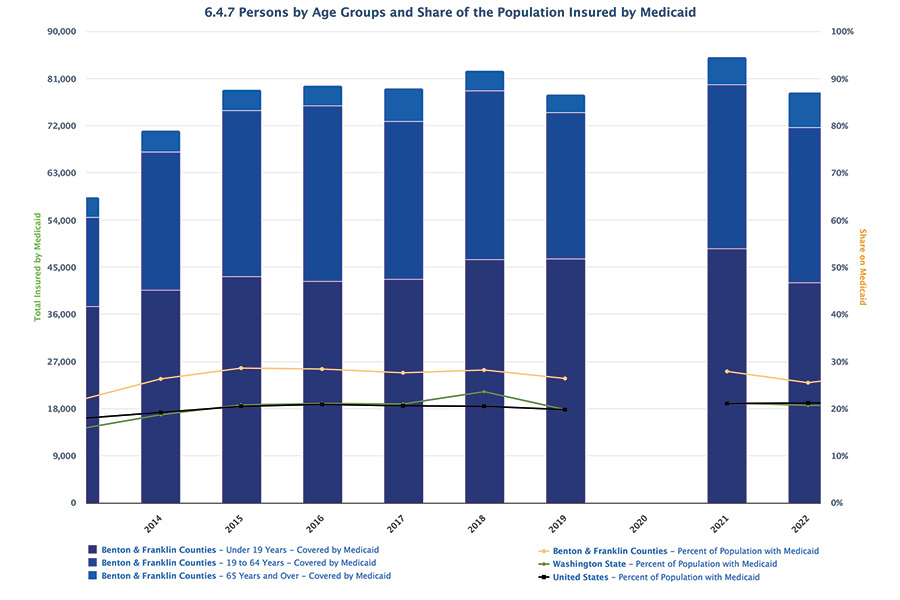
The accompanying graph from Benton-Franklin Trends clearly displays how large Medicaid looms among the payors for health care in the two counties.
In 2023, the most recent year for Census estimates, total Medicaid enrollment here was about 85,500. That represents 5.4% of the state’s Medicaid population. The total population of the two counties represents a lower share, 4.0%.
In other words, the Medicaid population is disproportionately large here. This is observable from the graph, where the share of the total population on Medicaid in the greater Tri-Cities was about 28% in 2023. The share statewide was 21%.
Now apply the Medicaid enrollment share in the two counties of the state’s enrollment to the HCA’s estimates of the total losing coverage. At the low end (200,000), this implies a drop of 10,800 from local rolls. At the high end of the estimate (320,000), this implies a drop of 17,280 current Medicaid enrollees. In percentage terms, this yields a range of roll “drops” of 13%-21% of current recipients.
These are significant numbers, with profound implications for the area’s four hospitals. In 2024 for three hospitals and 2023 for Trios, the total revenue flow to the hospitals from Medicaid, adjusted for contractual deductions, was $244 million. Using a mid-point estimate of roster losses of 17%, one might expect an aggregate loss of $41.5 million in net Medicaid reimbursements.
How significant is that sum? Consider that in 2024 (and 2023 for Trios), the aggregate total net revenue from all sources was a mere $40 million.
And the fiscal impact doesn’t stop there. Not-for-profit hospitals are expected, under state law, to offer care to anyone who appears at the door of the emergency department. Often those encounters become cases of charity care. This is different than bad debt, a category that begins with patients who were not categorized as recipients of free care at the outset of their encounter with the hospital.
In 2024 (and 2023 for Trios), the aggregate number of charity care patients among the four was 20,900. If all the projected Medicaid disenrollees were to show up at the emergency department, that would usher in an increase of nearly two-thirds (using the mean of the state’s estimates). Charity care, in the aggregate, was valued at $99 million for the four hospitals. Imagine that sum climbing by $65 million. That would wipe out the aggregate bottom line from the area’s hospitals and then some.
Of course, not every dropped patient from Medicaid will show up at the emergency department. The evidence shows that care will be delayed or not sought out at all for many. And some disenrolled patients might find their way to Medicare or even employee-sponsored coverage.
But the general direction of the impact of the new federal policy seems clear – more financial pain for the health care sector, the second largest in the area by head count.
D. Patrick Jones is the executive director for Eastern Washington University’s Institute for Public Policy & Economic Analysis. Benton-Franklin Trends, the institute’s project, uses local, state and federal data to measure the local economic, educational and civic life of Benton and Franklin counties.