How Pasco beat the odds – and two cities – to land a college

A one-time military post may have tipped the scales favoring Pasco for placing Washington state’s newest junior college 70 years ago.
Each of the Tri-Cities all vied to make Columbia Basin College part of their community, but the nod went to Pasco.
It was the shuttered doors of the Pasco Naval Air Station that seemingly influenced the state Board of Education in its decision in choosing Pasco on May 14, 1955.
Why? It could immediately serve as a college. Building a new one would take time.
First day
On Sept. 19, 1955, the first footsteps of students at Columbia Basin Junior College echoed in the hallways of the old Navy base that had been used to train Navy aviators in World War II.
Comprising the new campus were the main navy base administrative building and four smaller buildings.
Pasco had another selling point.
The community had bought 157 acres for building a new campus while classes were already underway at the old Navy base. Its first structure was completed in 1957 on the site CBC now occupies.
Pasco’s successful lobby came from the likes of Pasco Mayor Harry Custer, Pasco School Board Superintendent Herman Jaeger, Pasco School board members Lyle Neff and Tom Bishop, and the Pasco City Council.
Columbia Basin Junior College became the state’s 10th. Today there are 34 community colleges in the state.
Major campus players when the school was founded included George Askegaard, who served in multiple roles, including registrar and financial administrator.
Walter Oberst taught political science and history as a professor at the new school. He began teaching in the Pasco School District in 1928 and was part of the Pasco education scene for the next 40 years. He would author the definitive history book on Pasco, “Railroads, Reclamation and the River: A History of Pasco.”
Jack Cooney, who had been director of a vocational technical school in Pasco training Hanford workers before CBC existed, brought his skills to the new campus.
Mildred Partch was CBC’s first librarian, while Wayne Rodgers and Harold K. Severeid headed up the automotive technology programs.
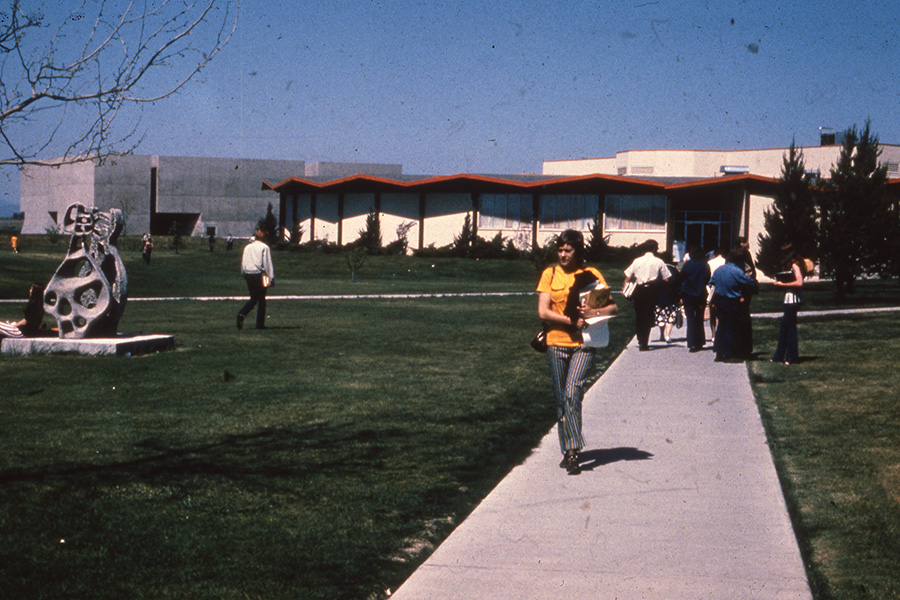
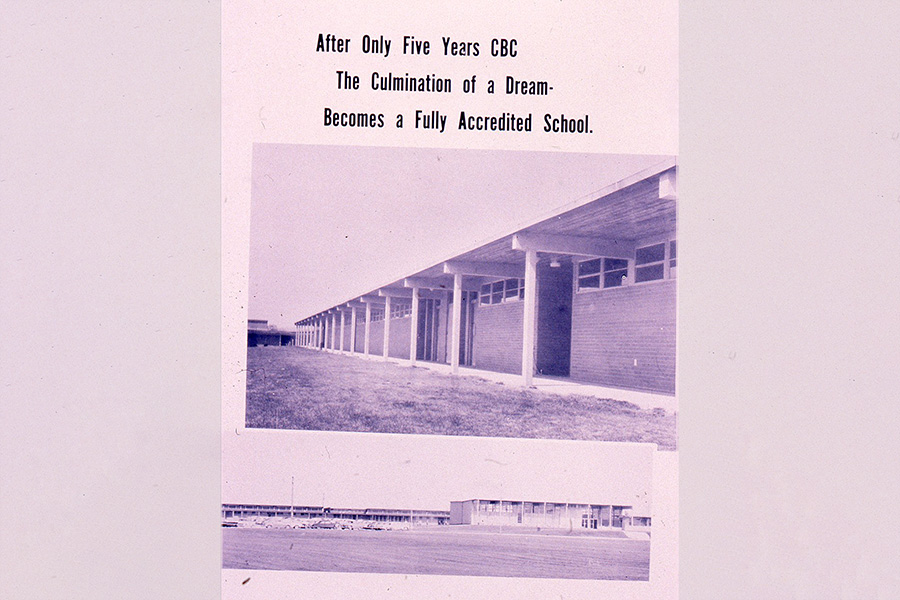
An undated photo of Columbia Basin College.
| Columbia Basin CollegeFrom junior to community
The identity of junior colleges in the state was changed in 1961 to community colleges by an act of the state Legislature, and it was further solidified in 1967 when the Community College Act was passed.
For several years, CBC was both administered and funded by the Pasco School District with bonds and levies paying most of the bills. In 1963, funding of community colleges was separated by the state from local school districts, with the full transfer of administration occurring with the act passing four years later.
Today, state appropriations, tuition, grants, fees and contracts combine to finance community colleges in Washington.
CBC opened its doors for the first time to 238 male and 34 female students, half of whom were taking vocational programs.
The other half were enrolled in general education courses then being offered by CBC that included mathematics, English, science, music, practical nursing, agriculture, business education, speech, drama, foreign languages, social science, chemistry and physical education.
Today, some 7,500 students per quarter attend.
CBC’s initial faculty included two dozen full-time instructors, complemented by 35 to 40 instructors of night courses.
Associate degrees offered by CBC include the arts and variations of science and applied science, plus bachelor degrees in nursing and applied science. One-year certificates and short-term certificates also can be earned.
The Northwest Association of Colleges and Universities, which accredits colleges and universities, visited after CBC’s curricula was established, and with some of its permanent structures in place on the 157 acres.
On Dec. 5, 1960, “the association expressed satisfaction with the college’s curricula, faculty, facilities and operations, and accredited the institution.”
The state’s first junior college was Everett in 1915 with 42 students enrolled in a one-year program. Classes were on the top floor of Everett High School. It closed in 1923 for lack of enrollment.
The state’s oldest community college, Centralia, celebrates its 100th birthday this year. It opened in 1925. Skagit Valley came a year later, Yakima Valley in 1928, and Grays Harbor College in 1930.
Eight junior colleges were operating by 1943, and all were financed and administered locally while serving a combined enrollment of about 1,000 students.
 Courtesy Columbia Basin College
Athletic achievements
The rich tradition of CBC’s academic programs is further complemented by its athletic achievements in both women’s and men’s sports.
On Dec. 15, 1962, CBC’s football team played in the famed Junior Rose Bowl game in Pasadena before 41,000 fans.
The crowning achievement of CBC’s rich football history was winning the 1978 national junior college football championship with a 10-0-0 record. The entire team was inducted into the CBC Athletic Hall of Fame.
Another CBC Athletic Hall of Fame team was its 1963-64 basketball squad which completed a perfect 27-0 record
That season was the fourth consecutive of five straight Washington Junior College Association basketball championships won by CBC.
Other Hawk teams awarded the honor include 1994 women’s soccer, 2005 women’s basketball, 1979 golf and 1972 men’s wrestling.
The wrestlers that year are considered as having produced the most dominant athletic performance ever in the Northwest athletic conference history, qualifying nine for the finals in 10 weight classes. Of the nine, seven won individual wrestling titles, and the other two placed second.
CBC athletes have played Major League baseball, were starters in the National Football League, and competed in the National Basketball Association. One even scored a touchdown in the Super Bowl.
Gale Metcalf of Kennewick is a lifelong Tri-Citian, retired Tri-City Herald employee and volunteer for the East Benton County Historical Museum. He writes the monthly history column.