New bus line to link Tri-Cities and Spokane
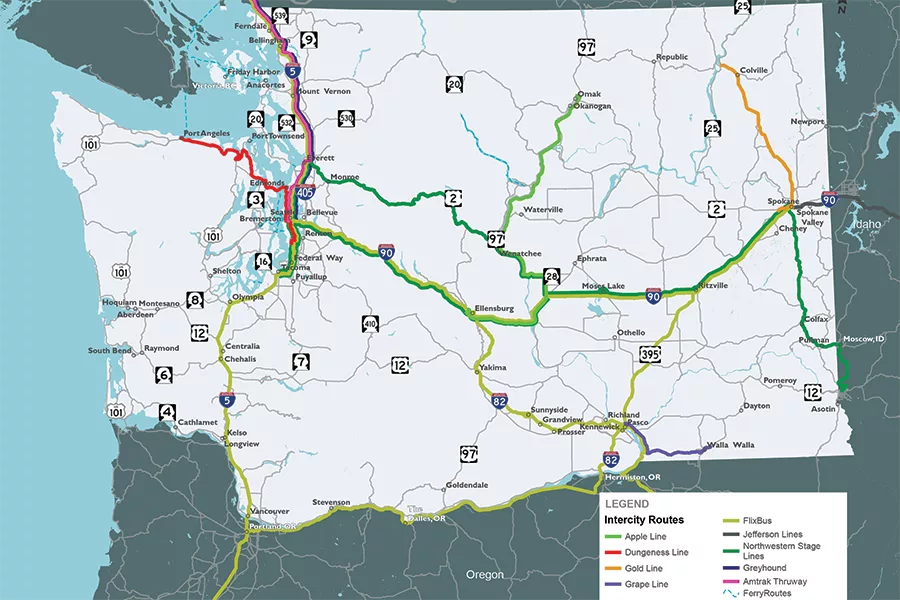
A fifth route called the Wheat Line will launch in the second quarter of 2026, running between Spokane, Moses Lake and Pasco.
Courtesy Washington Department of TransportationIf you’re tired of getting behind the wheel to get up to and back from the greater Spokane region, you now have an option to kick back and let someone else do the driving for you.
The newest Travel Washington Intercity bus route, the Wheat Line, begins service May 1 between the Tri-Cities and Spokane, according to a release. It will be operated by Central Washington Airporter, joining the state’s four other intercity bus lines – Dungeness, Gold, Apple and Grape.
A full route map with stops has not yet been published as of April 30, but available details indicate the Wheat Line will offer two daily trips, northbound and southbound, with the intention of providing connections between other transportation hubs, such as the Tri-Cities and Spokane airports; multimodal transit centers in Pasco, Moses Lake and Spokane; and Eastern Washington University’s Cheney campus.
“With the Wheat Line, people in central and eastern Washington cities and rural communities now have a vital link to connect them to essential services like education, healthcare, employment and other transportation options,” said Travel Washington Intercity Bus Program Manager Nina Stocker in a statement. “Our partnership with Belair Charters and CWA will deliver dependability, adaptable scheduling and a reliable customer experience that truly reflects the needs of the communities we serve.”
This is the first new Travel Washington bus route in nearly 20 years and is the second to serve the Tri-Cities.
The Grape Line currently offers three trips daily between Pasco and Walla Walla, with connectors to other outlying areas and as far away as Yakima. Tickets typically start at $40 roundtrip.
The state Department of Transportation identified the Wheat Line’s service area as a “priority corridor” in its 2024 Connecting Communities study. The study used extensive public input to find areas where potential service expansion would be most cost-effective. It also focused on linking rural areas to the existing intercity network, transportation hubs and urban centers.
Along with fares, the intercity bus lines are funded by The Federal Transit Administration and WSDOT.