New rail hub set to boost freight capacity with Puget Sound ports
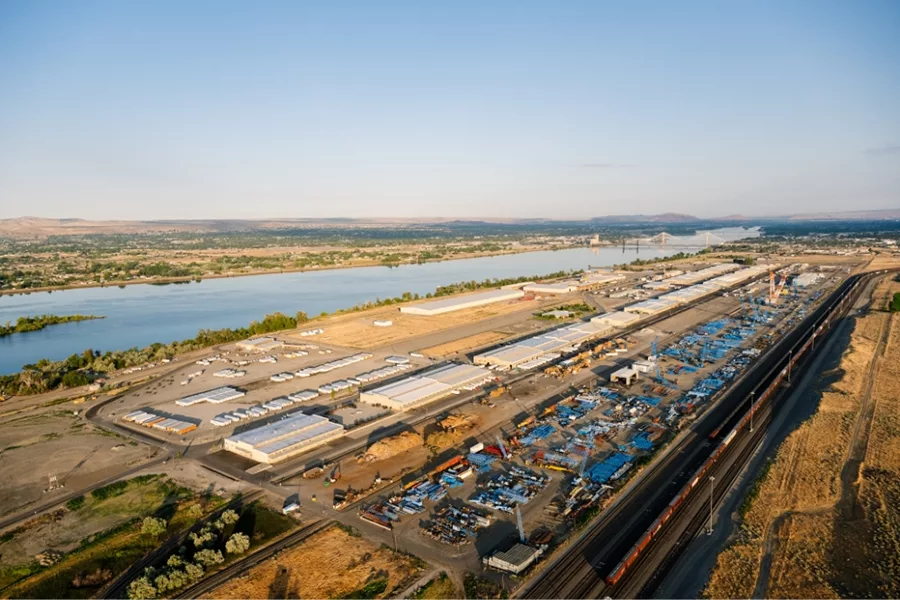
Savage Transload Network LLC is close to finalizing a lease for 12.5 acres and 9,900 feet of industrial rail track at the Port of Pasco’s Big Pasco Industrial Center to establish a transmodal facility, with operations starting in August.
Courtesy Port of PascoThe volume of trains and trucks coming and going from the Tri-Cities is about to see a sharp spike.
Savage Transload Network LLC is close to finalizing a lease for 12.5 acres and 9,900 feet of industrial rail track at the Port of Pasco’s Big Pasco Industrial Center to establish a transmodal facility, with operations starting in August.
At peak volume it plans to use that track to move up to 880 containers of goods every month.
“You’ll see mile-long trains pulling in and being broken in half on those rails,” Stephen McFadden, the port’s deputy executive director, told port commissioners in April.
And with Savage’s rail business recently being acquired by Canada-based Cando Rail & Terminals, the new Pasco facility will be part of the largest first mile and last mile rail operating services and terminal company on the continent.
“... We are operating a broader, more connected platform across North America that strengthens how we serve our customers, positions us to deliver even greater reliability, efficiency and value, and provides opportunities for employees to grow within a dedicated, rail-focused organization,” said Brian Cornick, president and CEO of Cando Rail & Terminals, in a statement.
The transmodal facility will be where containers are transferred between trucks and trains, with trains bringing containers from and to ports in Puget Sound. Port officials said the deal with Savage would have been done a year ago if not for the uncertainty generated by unstable global tariffs.
The deal predates the recent arrangement struck with the Northwest Seaport Alliance and the ports of Pasco, Benton and Walla Walla to establish the Inland Logistics Hub. That partnership aims to ease shipping of imports and exports between the inland parts of the Pacific Northwest and marine terminals connecting with global markets.
Establishing transmodal links such as those with Savage/Cando and the Puget Sound ports will make it easier for agricultural producers and other Mid-Columbia enterprises to get their products to market. It also will decrease reliance on truck traffic crossing Snoqualimie Pass.
“This marks a significant increase in what the port can do,” said port Commissioner Matt Watkins.
The value of Savage/Cando’s lease has not been disclosed as it was still being negotiated. The company also will invest $175,000 in rehabilitating some of the rail line it plans to use.
Additionally, along with an annual rail maintenance fee, rail usage charges and taxes, Savage/Cando will pay the port for each container it receives. That scale starts at $14 per container for the first 220 containers and maxes out at $40 for each container after 660.
“Even at 220 containers a month, Savage will become the largest rail user at (Big Pasco Industrial Center),” according to a port memo.
And Savage/Cando may not stop there. Port documents indicate the company has interest in possibly expanding its operations to the port’s Reimann Industrial Center north of Pasco. That industrial park is the first BNSF certified rail site in the state.
As for those who frequently commute or drive over the rail lines in east Pasco, you may start to learn alternative routes.
“There will be days when you see the crossing arm where you’ll want to go around,” McFadden said.