City of Pasco
Explosive growth cools but more is coming

Framing for the lazy river is taking shape at the Pasco Aquatics Facility
Photo by Scott Butner PhotographyTo say Pasco has grown in recent years is an understatement.
Housing developments with thousands of homes have spread across former agricultural fields to the north and west.
New industrial partners have moved into town, including the massive Amazon warehouses and Darigold’s milk processing facility that came online this summer.
Civic and commercial projects that can build community, such as the Pasco Aquatics Facility, Summer’s Hub food truck park near Gesa Stadium and two new high schools, are under construction or recently completed.
And the Broadmoor area, the 1,200-acre swath of land east of Broadmoor Boulevard and north of Interstate 182, is positioned to be the next epicenter for development with homes, businesses and other amenities planned.
“Pasco is at a truly transformative moment,” said Haylie Miller, director of the city’s community and economic development department, in an email to the Tri-Cities Area Journal of Business. “From new schools and homes to thriving businesses and innovative infrastructure, we’re building not just for today, but for generations to come.”
But Pasco’s momentum slowed in 2025, as construction labor shortages, supply chain disruptions and increasing costs from inflation and tariffs took their toll.
The value of residential and commercial building permits issued by the city through the end of August 2025 was just over half of the value of the $387 million in permits issued during the same period in 2024, according to data collected by Home Builders Association of the Tri-Cities.
Residential
Residential construction continues to be a primary source of growth in Pasco.
The city has led the Tri-Cities in growth by sheer numbers for years. More than 770 people moved to the city over the past year, the largest increase by numbers among the Tri-Cities. According to the state Office of Financial Management, Pasco is projected to have more than 120,000 residents by 2046, a roughly 45% increase from its current population of 82,990.
Developers continue to diversify the types of housing they are building in the city. Since city leaders updated housing density limits in various areas more than a year ago, builders have requested more permits for townhomes, duplexes and accessory dwelling units, or ADUs, also known as “mother-in-law units.”
The four residential projects near Burns Road – which will add an estimated 1,500 homes – demonstrate the variety of homes being brought to Pasco. Madison Park North, Raven Place, Glacier Park and The Grove at Broadmoor will have six different types of properties, from detached or attached single-family and factory-assembled homes to duplexes and cottage housing.
A variety of housing options are coming to Pasco’s core, too. The Rio Vida Apartments are planned near the intersection of Marie Street and Fourth and Third avenues, which will add 82 apartments across three three-story buildings.
Overall, though, housing construction slowed compared to the prior year. While developers sought to build dozens more duplexes and townhomes by the end of August 2025, there was a steeper decline in single-family homes during the same period: 182 permits issued compared to 278 during the same period last year.
No new permit applications for multifamily projects were being pursued at all, a potential effect of the state’s recently enacted rent stabilization bill that housing and real estate experts said chilled the rental housing market.
“That bill is very troublesome,” said state Rep. April Connors of Kennewick, who is also a Tri-City Realtor, during a September panel discussion on the housing market. “Rent control has never panned out in any community. We had developers tell us they’re done in the state if the bill is passed.”
Further east and on the Columbia River shore, developer James Sexton has a vision for a mixed-used development that includes 962 homes as either apartments or detached condos. However, that project at the Port of Pasco’s Osprey Pointe has faced delays for years and there is currently no timeline yet for when it will break ground.
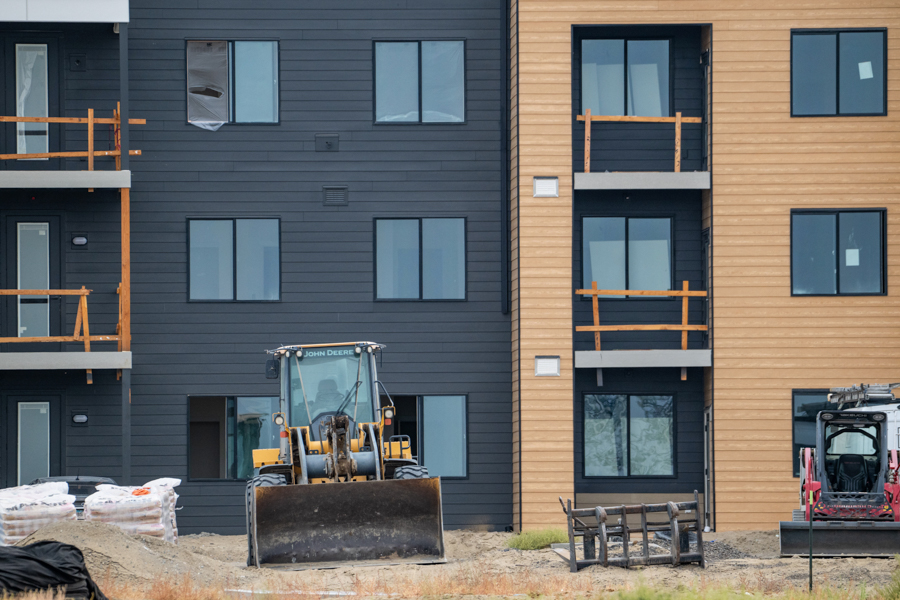
Earth-moving equipment and temporary balcony railings signal ongoing construction at the Brisa Heights apartments at 10181 Burns Road in Pasco.
| Photo by Scott Butner PhotographyLive, work, play
More housing brings the need for more services and amenities, and Miller said a slew of permits have been approved for commercial and civic projects in west Pasco:
- The Pasco location of the popular Summer’s Hub restaurant and food truck park at 6120 Burden Blvd. plans to celebrate its grand opening on Nov. 1. It’s modeled after the original location in Kennewick and will have room for 24 food trucks with a restaurant inside.
- Columbia Basin Heath Association is building a health clinic at 7405 Three Rivers Drive.
- Idaho Central Credit Union is establishing a bank branch at 7406 Three Rivers Drive.
- Goodwill Industries of the Columbia recently announced plans for its second thrift store and employment center in Pasco. Located at 7511 Wrigley Drive, it’s expected to be completed in the next one to three years.
- Sun Ridge Storage Solutions has plans to build a warehouse at 9707 Saint Thomas Drive.
West Pasco is also home to many of the city’s newest civic facilities. The long-awaited Pasco Aquatics Facility is currently under construction in the Broadmoor development and set to open in 2026.
Downtown core
Meanwhile, the Rio Vida apartments aren’t the only development going on in downtown and east Pasco.
Industrial and commercial projects on deck in and around the railyards include a distribution facility for Old Dominion Freight Line, a commercial park and a new warehouse for hose distributor ARG Industrial.
The area isn’t without its own improved civic amenities.
The city’s Martin Luther King Jr. Community Center is undergoing $12 million in improvements over the coming years, aimed at supporting educational and recreational programs as well as providing technological access and meeting space.
Airport
Miller said the Tri-Cities Airport, owned and operated by the Port of Pasco, is a focal point for the city in the coming years. The airport has seen steadily increasing passenger traffic since the Covid-19 pandemic, bringing dollars into the region.
A-1 Hospitality Group, which already owns and operates the Courtyard Marriott near the airport, broke ground on an extended stay Home2Suites hotel in November 2024 at 2101 Argent Road.
Taran Patel, the hospitality group’s managing principal, said during the hotel’s groundbreaking that the firm pursued the project to address “the growing demand for premium extended-stay accommodations in Pasco.”
A-1 also recently completed Flight Path Plaza, a four-unit strip mall nearby at 2915 N. 20th Ave.
Miller said the port’s Aerospace Innovation & Manufacturing Center, a business park on 460 acres on the airport’s perimeter, is what the city is currently preparing for. The first phase is anticipated to cost $118 million and would begin providing necessary infrastructure as well as improvements to Road 36 and a new air traffic control tower.
Broadmoor
It’s the Broadmoor development, however, that is where the city expects to innovate its version of a walkable mixed-use development.
While a projected number of homes and business for the area hasn’t been released, planning documents show a swath of commercial zoning along Broadmoor Boulevard with residential areas of varying densities stretching toward the Columbia River, where a strip of open space is planned.
The development is expected to take years to complete and includes extending Sandifur Parkway, the establishment of Road 108 and an expansion of Broadmoor Boulevard. Work to upgrade the I-182 and Road 100 interchange was completed this past spring.
“Broadmoor is gearing up to redefine the urban lifestyle for the Tri-Cities,” according to city materials for the project.
Potential challenges, impacts
All these projects will require substantial financial resources, Miller said, and that could be a limiting factor. Projects in the Broadmoor area will require developers to make significant investments, as will the city via a tax increment funding, or TIF, framework. The same applies to development at the airport business park, which will cost an estimated $215 million to fully build out.
“With no major constraints identified, continued coordination on utilities and funding will be key to moving the project forward,” Miller said in an email.
City officials are also working to streamline the permitting process for projects, particularly for new commercial construction.
But some things are outside the city’s control. A combination of cost increases from inflation and tariffs, a shortage of skilled workers and fears of uncertainty resulting from disruptions at the federal level, such as funding reductions and policy changes, have contributed to this year’s slowdown
But Miller is confident the city will continue to grow and remain a desired destination.
“I don’t get concerned until we see something happen,” she told the Journal. “For the last three or four years I’ve been hearing from applicants that the market is slowing down, but we haven’t seen it yet.”