Q&A with Lindsey Myhre
President and CEO of STCU
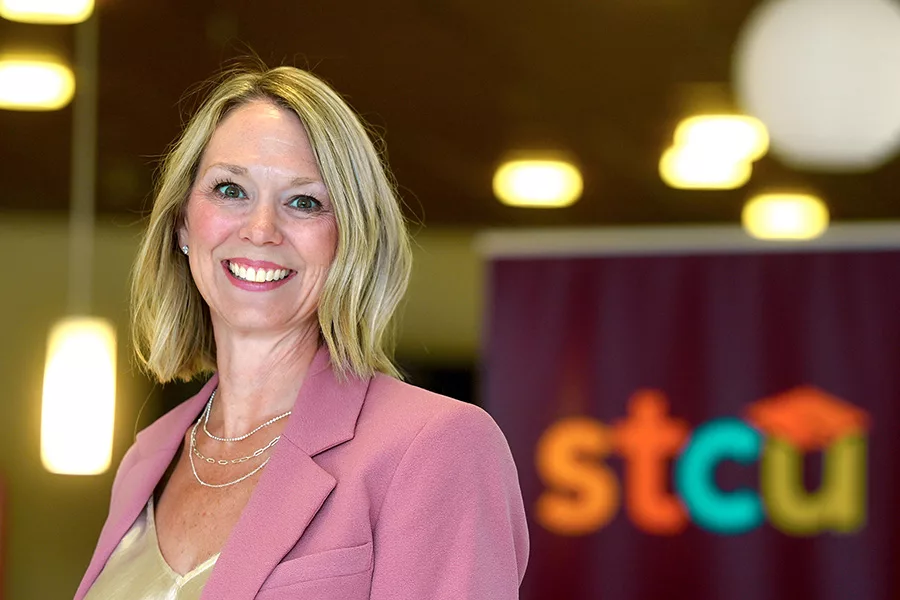
Lindsey Myhre
Courtesy Kathy Plonka / The Spokesman-ReviewNumber of employees you oversee: 1,050
Brief background of your business:
STCU was founded by Spokane school teachers in 1934. For the first 30 years, the credit union operated out of Spokane’s Lewis & Clark High School. We now have more than 300,000 members of all walks of life, more than $6 billion in total assets. We currently have 49 branch locations across Central and Eastern Washington, Eastern Oregon and North Idaho. (That will grow to 50 when our Columbia Center branch opens in October!)
How did you land your current role? How long have you been in it?
Started in 2000 as an accounting assistant, with a plan to work at STCU a few years and then move to Seattle, Portland or Chicago. I stayed because I love the STCU culture and was able to step forward for a variety of challenging roles, in accounting and finance, human resources and other areas. I was to director of accounting and finance in 2012, joined the executive leadership team as vice president of finance in 2015, and was promoted to chief financial officer in 2017. My title was executive vice president and CFO when the board appointed me president and CEO in June of this year.
How has the credit union industry evolved since you first started working in it?
It’s evolved in all ways: technology, sophistication, consolidation, regulatory burden and more. What hasn’t changed is credit unions’ not-for-profit structure, and our deep commitment to members and the communities where they live.
Can you talk about STCU’s presence and growth in the Tri-Cities, and why this is an important market for you?
Prior to opening our first Tri-Cities location (Southridge branch) in 2017, there were already about 2,300 Tri-Cities residents who were STCU members – the largest concentration outside the Spokane/Coeur d’Alene area. Many of those members had joined STCU while living in Spokane for college or other reasons, and remained with us after moving. Those members were anxious to have their credit union come to Tri-Cities, and became our biggest advocates in the community.
We now have nearly 11,000 STCU members living in Benton and Franklin counties, served by three Tri-Cities branch locations, with our fourth opening in October. As an organization that strives to be “here for good,” we have sought to serve the community. For instance, we sponsor the STCU Over the River Air Show and the Art in the Park Festival.
You are STCU’s first female CEO in its 91‑year history. What does that milestone mean to you, and how do you hope it paves the way for future women leaders?
This milestone is meaningful to me, not just as STCU’s first female CEO, but because women have been part of our story since the beginning. Our articles of incorporation in 1934 were signed by nine women and one man. As a mom of two daughters, I hope my leadership shows that you can be both a parent and a leader, and that women can lead authentically while making a lasting impact. My goal is to keep that door open even wider for the next generation of women leaders.
What legacy do you hope to build and what changes or innovations do you aim to champion for STCU’s future under your leadership?
I hope my legacy at STCU is one of balancing innovation with the heart of who we are. I see a lot of opportunities to bring AI into both the employee and member experience in ways that make things easier and more personalized. But it’s just as important that we never lose the human connection – that people always feel seen and valued.
I also want us to be deeply and authentically involved in our community – not just present but truly showing up for each other in positive ways. If, down the road, people say STCU led with innovation, stayed true to its people, and made our communities stronger, I would be proud of that.
What advice do you offer women entering finance or the C-suite today?
My advice to women entering finance or aiming for the C-suite is to own your voice. Don’t wait to have all the answers before you speak up – your perspective matters. Build confidence by being prepared but also trust that your experiences and insights bring value.
I’d also say surround yourself with people who challenge and support you, and don’t be afraid to take risks or step into opportunities that feel a little bigger than you. Leadership isn’t about fitting a mold – it’s about bringing your authentic self to the table.
You’ve said that STCU’s culture supported your advancement. What specific organizational practices – like leadership development or mentorship – made the biggest impact?
STCU’s culture has been such a big part of my journey. I was fortunate to have numerous mentors, both within and outside of my discipline, and that gave me tremendous perspective and helped me grow as a leader.
What also stands out is our culture of curiosity and courage – we’re encouraged to try new things and not be afraid of failing. That kind of environment allows people to stretch, learn and discover strengths they might not have known they had. For me, those two things – mentorship and the freedom to experiment – made the biggest impact.
What is one characteristic that you believe every leader should possess?
I believe every leader should possess courage – courage that’s grounded in integrity. Integrity is what keeps you true to your values, and courage is what allows you to act on them. To me, great leadership means making hard decisions with honesty, standing firm when it matters, and lifting others up along the way.
What is the biggest challenge facing business leaders today?
I think the biggest challenge facing business leaders today is navigating change – and not letting fear of change hold us back. The pace of technology and shifting workforce expectations to name a few. But the real danger is clinging to what’s familiar instead of adapting. Leaders must be willing to embrace change with courage and clarity, while still keeping people connected to the purpose and values that ground us.
If you had a magic wand, what would you change about your industry?
If I had a magic wand, I would make our industry even more seamless and human at the same time. I’d want technology, like AI, to handle the routine and repetitive tasks, so employees and members could focus on meaningful connections, guidance, and support. My dream would be an industry where efficiency and empathy go hand in hand, and where every person feels truly valued.
Who are your role models or mentors?
Two well-known leaders who inspire me are Indra Nooyi and Howard Schultz. Both exemplify leadership with vision, integrity, values-driven leadership and a focus on people.
Closer to home, I’ve been fortunate to have mentors at STCU who shaped my perspective and growth, including Bill Before and Ev Hopkins. They not only guided me as leaders but also deepened my appreciation for the credit union movement; its emphasis on community, service and supporting each other has strongly influenced how I lead today.
How do you keep your employees motivated?
I keep employees motivated by creating an environment where people feel informed, valued and supported. Transparent and clear communication is key – when employees understand the “why” behind decisions and the bigger picture, it builds trust and engagement.
I also focus on recognizing contributions, giving employees opportunities to grow and encouraging them to take on challenges. When employees feel empowered, heard and connected, motivation naturally follows.
How did you decide to pursue the career that you are working in today?
My path to this career really came together when a professor introduced me to careers in credit unions. It clicked immediately because it combined so many things I care about: my love of math, my desire to help people, and my strong sense of community and volunteerism. From that moment, I knew I wanted to be part of an organization that not only makes a difference financially but also supports and uplifts the community it serves.
How do you measure success in your workplace?
I measure success by looking at a combination of outcomes and culture. First, I evaluate how well we’re executing our strategic plan and initiatives – are we making progress toward our goals and driving impact? Financial health is also a key indicator, ensuring the organization is strong and sustainable. But equally important is employee engagement – when our people feel motivated, supported and connected to our mission, it shows we’re creating a healthy, high-performing culture.
What do you consider your leadership style to be?
I would describe my leadership style as direct, collaborative and values-driven. I believe in setting clear expectations and holding myself and others accountable, while also taking the time to listen, mentor and support growth. I focus on empowering people, building confidence, and creating an environment where innovation and human connection can thrive together.
How do you balance work and family life?
I balance work and family by being fully present in everything I do. At home, that means showing up for my daughters’ games or activities – even if it means adjusting my schedule and catching up on emails later. At work, it means being fully engaged and present when I’m there. Communication is key.
What do you like to do when you are not at work?
When I’m not at work, I love spending time outdoors and with my family. That includes boating, huckleberry picking and cheering on my kids at their activities. I also enjoy cooking and staying involved in the community through volunteering – anything that lets me connect with people.
What’s your best time management strategy?
My best time management strategy is being intentional and fully present with whatever I’m focused on at the moment. I prioritize tasks based on impact and deadlines, plan my day to allow flexibility for unexpected needs, and use clear communication to set expectations. That way, I can give my best both to my work and my family without spreading myself too thin.
Best tip to relieve stress?
My best tip for relieving stress is to be self-aware and recognize when it’s time to recharge. Taking a step back, even for a short moment, helps me reset, gain perspective and come back more focused and energized.
What’s your favorite book? Podcast?
My favorite book is “Grit” by Angela Duckworth. It really resonates with me about perseverance, passion and pushing through challenges.
As for podcasts, I enjoy “SmartLess” for its humor and insights, and “Breaking Points” for its thoughtful take on current events and leadership perspectives.
Do you have a personal mantra, phrase or quote you like to use?
“Lead with your head and your heart, empower others, and stay grounded in your values.”