
Ag-tech incubator wants to bring AI, robotics to Yakima Valley
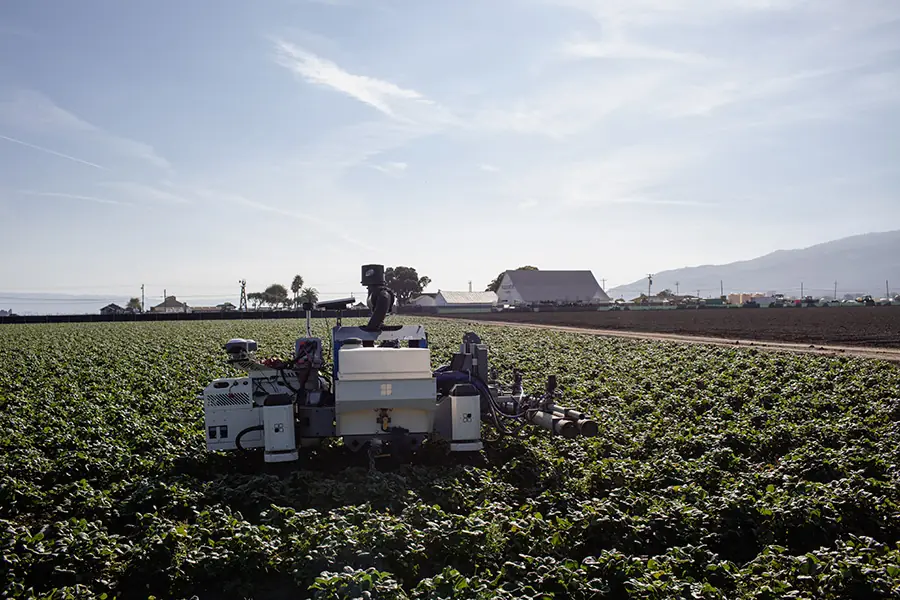
An autonomous robot developed by startup Bonsai Robotics works in a test field at the Salinas site of agtech incubator Reservoir Farms. Reservoir recently announced it will establish its fourth incubator site in the Yakima Valley, potentially in coordination with Washington State University’s Irrigated Agriculture Research & Extension Center in Prosser.
Courtesy Reservoir FarmsYakima Valley is poised to become a new hub for agricultural innovation as a California-based agricultural technology company focused on robotics and artificial intelligence prepares to open a location in the region.
Reservoir provides startups with an incubator to test new technologies on working farms, with local growers and researchers, and access venture capital to help develop and grow their businesses.
The company announced plans to establish its latest on-farm technical community in the area at the 2026 FIRA Pacific Northwest Conference in October at the Yakima Sundome.
The Yakima Valley will be Reservoir’s fourth location after others in California and Arizona.
“Our expansion into Washington state was a very natural next step for us,” said Christy Birdsong, Reservoir’s head of external affairs.
Reservoir’s on-farm communities bring together more than 30 startups working on “physical AI,” technology that allows robots and machines to perform real-world agricultural tasks. Its expansion into the region will broaden that work to include tree fruit and blueberry production – and its first Pacific Northwest site is set to open in spring 2027.
The new location – which hasn’t been announced yet – will give companies a chance to develop and test technology in real farming conditions, including potential applications such as fruit harvesting, tree pruning and other orchard operations.
As labor challenges and the demand for greater efficiency continue to shape agriculture, the expansion brings another opportunity to explore how robotics and AI could play a role in the future of farming across the Yakima Valley.
It’s an important industry for the state, with agriculture production reaching $12.9 billion in 2024. Ag producers exported $7.81 billion worth of products in 2025, a nearly 2% increase over the previous year. The state’s top crops include apples ($1.9 billion), potatoes ($825.7 million), wheat ($716.3 million), cherries ($431.7 million), hops ($329 million) and grapes ($274 million).
The industry employs 164,000 workers statewide, not just in fields and orchards but in processing facilities.
Reservoir CEO and founder Danny Bernstein said the firm has not solidified where it will base operations, though it is working with Washington State University’s Irrigated Agriculture Research and Extension Center, or IAREC, in Prosser.
“Washington growers need innovative technologies tested under real-world farming conditions,” said Naidu Rayapati, director of WSU Prosser IAREC, in a statement. “Opportunities to bring ag-tech startups together with our faculty to evaluate emerging technologies across diverse cropping systems, including orchards and vineyards, could give growers valuable insights within a single growing season and rigorous validation over multiple seasons, helping them make informed decisions, reduce risks, and improve productivity and profitability.”
Tri-City Development Council, or TRIDEC, will provide financial support for the venture, but president and CEO Karl Dye told the Tri-Cities Area Journal of Business a dollar figure has not yet been set. He noted it will be a fraction of the cost to establish Reservoir’s local operations.
But he and others in the ag industry lauded Reservoir’s entry into Washington, saying its efforts have the potential to not only stabilize an industry facing numerous pressures but to reinvigorate it.
“Ag-tech has the opportunity to draw farm families back in and presents an opportunity for the next generation,” Dye said.
Reservoir launched two years ago and has since established operations in Salinas and Sonoma in California and Yuma, Arizona.
Among its backers are farm equipment manufacturer John Deere, which committed $10 million to Reservoir in August, and Western Growers, which announced it would provide $1.5 million earlier in the year.
Bernstein, a former Silicon Valley executive, said startups have historically fared poorly in agriculture as so many are based in urban environments and don’t have access to real farm conditions or experiences. But as labor shortages, runaway costs and other factors bear down, farmers will need tech “if we want to maintain this way of life, maintain what we hold dear.”
TRIDEC and Prosser’s IAREC won’t be Reservoir’s only partners in the region. The Washington Tree Fruit Research Commission, North American Blueberry Council and other national and local organizations have signed on to support it.
“We felt this was one of the missing pieces of the puzzle,” said Ines Hanrahan, the research commission’s executive director, of Reservoir’s ability to support innovation for the region’s growers.
And Bernstein acknowledged that local buy-in is critical for the project’s success, as that will provide the real expertise innovators need and establish the trust needed for any innovations to be adopted within the industry.
“We didn’t just want to show up as big, clumsy Californians. We wanted to show up and help,” he said.
From Dye’s perspective, Reservoir’s efforts are also a means to recruit those innovators to the region not just to test their ideas, but to fully set up shop.
“Our goal is once startups graduate, they stay here,” he said. “We want to keep them here. Not only are they close to their customers but they’re close to our workforce and our logistics hub we’re known for.”
And that could also be how farm families stay on the farm: by providing tech careers that give youth another means to engage in the industry, Dye said.


Stay Informed. It’s Free.
Subscribe to our newsletters and get the latest news and insights delivered to your inbox.
We respect your privacy.
Unsubscribe anytime.
Thank you!
You’re subscribed. Keep an eye on your inbox for the latest updates.