Pivotal moment
Tight margins, rising costs challenge Washington farms
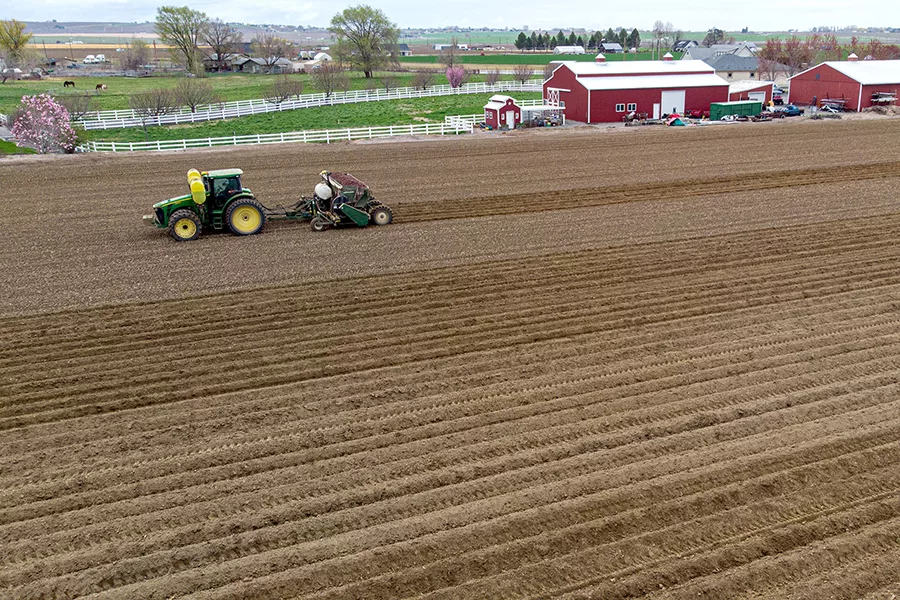
An industry worth $12.9 billion is losing competitiveness in a state that depends on it.
Consumers are paying more for food while those who produce it are earning less.
Growers and producers are under pressure from rising inputs – seed, fertilizer and other production materials – and labor costs, water scarcity and increasing regulatory burdens.
“Washington is losing its competitive advantage,” according to a state-commissioned report, Agriculture Viability Study, released in February 2026. “It is critical to explore ways in which to retain Washington’s competitive advantage and through that advantage, enhance economic resilience.”
A volatile industry
Volatility and uncertainty have always been part of farming, and producers have learned to navigate strong years and difficult ones.
Franklin County farmer Jim Alford said 2025 was a decent year for his operation but can’t say the same for the year ahead.
Several factors went his way last year: All the crops he planted were under contract, production levels were stable, and the diversity of his operations – potatoes for processing and turning into vodka, row and cover crops and specialty pollen and seed crops for a pharmaceutical raw supply company – protected him from market volatility.
Alford said 2026 is full of challenges, from soaring fuel and fertilizer prices, cuts in contracts, and rising labor costs paired with a growing shortage of workers.
“Currently, outside of beef production, there are very few bright spots,” said Alford, who is president of the Franklin County Farm Bureau. “Our area is extremely diversified, and all crops are suffering poor returns.”
Just across the Columbia River from Franklin County, Benton County growers are facing a fourth year in a row of drought, along with all the other pressures facing the industry. And while some may see slightly more water availability compared to the previous year, it doesn’t alter the underlying reality: For many, costs are still outpacing revenue.
At a Roza Irrigation District meeting in late March, some growers questioned whether it was worth securing additional water supplies at all this year, with Prosser area farmer Jim Willard noting concerns that some crops may not be earning enough to cover costs.
“The discussion this year was why should we go out and get water for crops that aren’t even paying for the cost of production,” he told the Tri-Cities Area Journal of Business.
Despite all the challenges, the industry’s proponents argue that agriculture not only has a future in the state but also must be part of the state’s future. But, they say, it’s imperative that everyone work to ensure that farmers, ranchers and everyone producing food can thrive and not just survive.
Billion-dollar industry
Washington state’s agricultural industry had an estimated value of $12.9 billion in 2024, the most recent year data is available, according to the Washington State Department of Agriculture, or WSDA. Agriculture makes up 10% to 13% of the state’s annual total gross domestic product, or GDP.
Farmers and ranchers manage nearly 7.7 million acres, about 17% of the state’s land area. The state’s varied geography and climates make it a producer of many specialty crops. Many are grown in the Mid-Columbia – tree fruits, hops, grapes, potatoes and wheat.
Producers exported $7.81 billion worth of products in 2025, a nearly 2% increase over the prior year. Those goods ranged from frozen french fries and fresh apples to hay and dairy. More than half of the state’s top 10 exports can be found at Mid-Columbia farms and food processing plants.
The industry employs 164,000 workers statewide, not just in fields and orchards but in processing facilities across the state.
But it’s an industry struggling to hold on. Of six major crops produced in the Mid-Columbia, all but hops saw declines in the value of their harvest in 2025 compared to the prior year, according to the National Agricultural Statistics Service of the U.S. Department of Agriculture, or USDA.
The potato industry was hit particularly hard, with harvested acreage declining by 20,000 acres, production down more than 1.2 billion pounds and the value of the crop dropping about 20% to $825.7 million.
And despite lower returns, rising production costs are squeezing food producers who supply the nation’s essential food networks.
Fuel prices in Washington are among the highest in the nation, second only to California, according to Derek Sandison, the state’s agriculture director, in this edition of Focus. Fertilizer costs also are up, partly in response to the blockade of the Strait of Hormuz resulting from U.S. military operations against Iran.
“At the same time, while consumers are seeing higher prices at the grocery store, those increases are not reaching the farm,” Sandison said in his Focus column. “In 2024, farmers received less than 12 cents of every dollar spent on food. The result is a widening gap between what consumers pay and what producers earn – placing farmers in an increasingly difficult position.”
Farm labor currently accounts for roughly a third of the cost of agricultural production and continues to climb and become more scarce each day as the workforce ages and immigration is restricted, according to the state’s report on agriculture viability.
Local growers also are facing mounting financial pressure as new state labor mandates take effect, including higher minimum wages and expanded overtime requirements.
Washington’s agricultural overtime rule requires most farmworkers receive time-and-a-half pay for hours worked beyond 40 in a week, a threshold phased in starting in 2022 and fully implemented in 2024.
“We have experienced soaring costs for labor, while prices have stayed the same or dropped on our produce sales,” Alford said.
Future of ag
WSDA said it is working with producers and other partners to find a path to the future for agriculture in the state, with the Agriculture Viability Study being the first phase of an initiative to identify the threats facing farmers but also opportunities to help them thrive.
Gathering input from those in the industry on how to move forward is the next step.
“Our hope is that by candidly sharing these challenges and highlighting the work already underway to address them, Washington can advance solutions that preserve local food production, protect environmental resources and create conditions in which farmers and ranchers can not only persist but genuinely thrive,” according to the report.
For his part, Willard planned to cut his workforce down as much as 20% and was prepared to not manage up to a quarter of his acreage, much of it in wine grapes.
“We’re basically going to go into maintenance mode and keep the vines alive with limited water,” he said in March.
Despite the industry’s challenges, Alford said he is optimistic about the future of ag in the Mid-Columbia, as long as state lawmakers don’t continue to throw up roadblocks in the form of bills detrimental to farming.
“Our area is one that includes abundant water, power, land, great weather, a large labor pool, a diversification of over 300 commercially grown crops with significant investment in the processing sector,” he said. “Combine this with our proximity to the ports for export, increasing water and power supply issues throughout the United States, I believe you will see a continued investment in our area from out of state processors looking to take advantage of our high skilled farmers, high quality land, and large labor supply.”