Washington agriculture faces shared challenges and a shared future
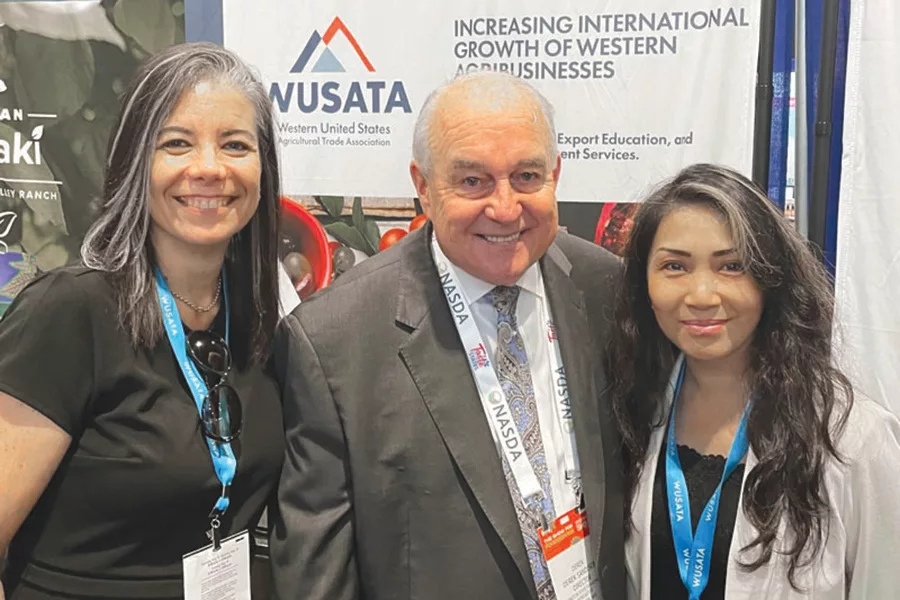
From left: Renata Dalton, deputy executive director of the Western U.S. Agricultural Trade Association, Derek Sandison, Washington State Director of Agriculture (WSDA), and Elisa Daun, WSDA international trade specialist, at the National Restaurant Association Show in Chicago in May 2026.
Courtesy Washington State Department of AgricultureWashington agriculture is at a pivotal moment – one that calls for both a clear understanding of current realities and a thoughtful approach to the future. Across the state, farmers and ranchers are navigating a complex set of economic, environmental and structural challenges that are reshaping what it means to sustain a viable agricultural operation.
While these pressures may show up differently depending on the crop or region, the underlying story is consistent: This is not a challenge isolated to eastern or western Washington. It is a statewide issue that touches every community, every consumer, and every corner of our economy.
An economic cornerstone
Agriculture remains one of Washington’s most important industries. In 2024, the value of agricultural production reached $12.9 billion, with more than 32,000 farms operating across the state. Notably, as many as 94% of those farms are family-owned, reflecting a deeply rooted tradition of stewardship and generational commitment.
The industry contributes an estimated 10% to 13% of Washington’s gross domestic product, underscoring its significance not only in rural communities but across the entire state. From the food on our tables to the strength of our export economy, agriculture plays a central role in our shared prosperity.
Challenging financial reality
Despite its economic importance, the financial outlook for many producers is increasingly strained. Data from the U.S. Department of Agriculture Economic Research Service shows that Washington currently ranks last in the nation for returns to operators, with net returns at negative $300 million. In practical terms, this means that after covering expenses, many farmers are not bringing home income.
This is not a short-term fluctuation – it signals deeper challenges within the system. Producers are facing persistently high costs while often receiving prices that do not reflect those increases. As the saying goes, farmers are price takers, not price makers.
One of the most pressing issues is the rising cost of inputs. Fuel prices in Washington are among the highest in the nation, second only to California. Fertilizer costs have also climbed sharply in recent months, adding to an already high-cost environment.
Labor, the single largest expense for many operations, accounts for roughly 32% of total production costs in the state.
At the same time, while consumers are seeing higher prices at the grocery store, those increases are not reaching the farm. In 2024, farmers received less than 12 cents of every dollar spent on food. The result is a widening gap between what consumers pay and what producers earn – placing farmers in an increasingly difficult position.
Weather, water, uncertainty
Environmental conditions continue to add pressure to an already challenging landscape. The Yakima Basin is entering its fourth consecutive year of drought, with irrigation districts preparing for reduced water availability. Early forecasts suggest another hot, dry summer across much of central and eastern Washington, though it remains too soon to determine the full impact on the 2026 harvest.
For producers, water is not just a seasonal concern – it is a fundamental factor in long-term planning and investment. Continued drought conditions raise difficult questions about crop choices, yields and the sustainability of certain operations.
These challenges are felt statewide, reinforcing the reality that agriculture in Washington is interconnected. What happens in one region can have ripple effects across supply chains, markets and communities.
Shifting global markets
Washington agriculture is deeply tied to international trade, and recent shifts in global markets are creating both opportunities and uncertainty. Export patterns are evolving, with notable declines in shipments to China alongside growth in markets such as South Korea, Japan and Mexico.
Some commodities have seen gains in new markets, while others have faced setbacks. These fluctuations require producers to remain adaptable, often making significant adjustments in response to forces beyond their control.
Trade remains a critical component of Washington agriculture’s success, while also underscoring the importance of stable market access. Through Washington State Department of Agriculture’s International Marketing Program and partnership with the Western U.S. Agricultural Trade Association, we continue working to expand export opportunities, strengthen existing markets and support Washington producers in a rapidly shifting global landscape.
Long-term pressures
Beyond immediate challenges, broader trends are shaping the future of agriculture in Washington. Fewer than 1% of residents are directly involved in farming today, contributing to a growing disconnect between consumers and the realities of agricultural production.
At the same time, the agricultural workforce is aging. Two-thirds of farmers are over the age of 55, and the average age of farmworkers has steadily increased. These trends raise important questions about succession, workforce development and the next generation of producers.
Additional pressures – including land costs, development, infrastructure needs and declining research investment – further complicate the landscape. Together, these factors point to the need for a comprehensive, forward-looking approach to supporting agriculture in our state.
Statewide approach to viability
In response to these challenges, we launched the Washington State Agriculture Viability Assessment to better understand the conditions facing producers and identify practical, long-term solutions.
We recently released Phase 1, with Phase 2 to follow later this year. I want to thank the producers and partners who shared their time and insights – your input helps ensure this work reflects real-world conditions across the state.
This assessment is intended to be a living resource, with updates and addendums as new information becomes available. At its core, it reflects a simple but important truth: the future of agriculture in Washington is a shared responsibility.
Looking ahead
Agriculture connects every Washingtonian. It provides the food we rely on, supports jobs and local economies, and helps define the character of our state. The challenges facing the industry are real, but they are not insurmountable.
By taking a thoughtful, coordinated approach – one that brings together producers, policymakers, and the public – we can ensure that Washington agriculture remains resilient and viable for generations to come.
The path forward will require collaboration, innovation, agricultural technology improvements, and a clear understanding of the realities facing those who produce our food. Just as importantly, it requires recognizing that this is not someone else’s issue to solve – it is a Washington issue, one that affects us all.
Derek Sandison is the director of the Washington State Department of Agriculture.