
Pasco Aviation Museum plans to expand into former Navy hangar
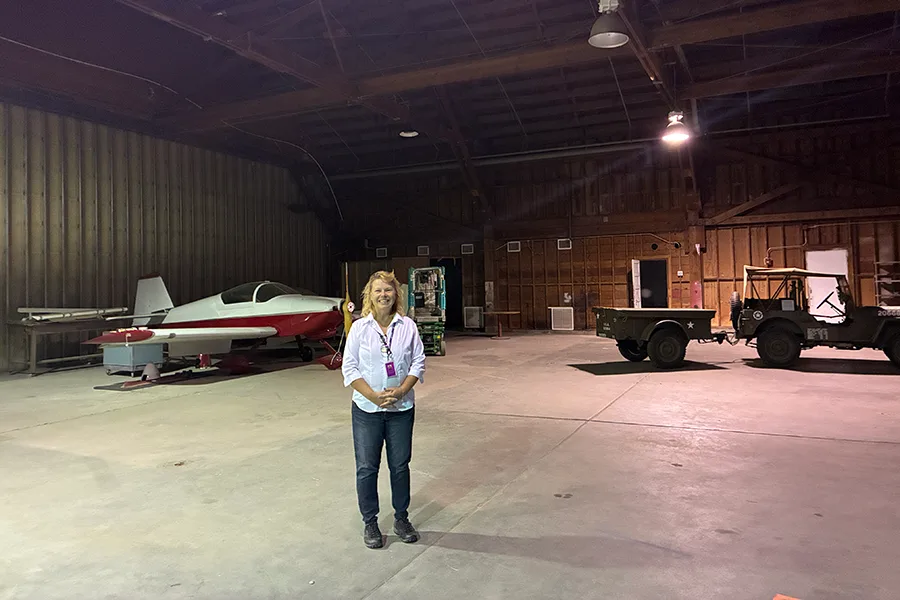
Nonprofit leader Malin Bergstrom said about $500,000 worth of upgrades and improvements are needed to prepare the former naval hangar for the public.
Photo by Ty BeaverIt took close to six years and $600,000 to transform the former control tower of Naval Air Station Pasco into the Pasco Aviation Museum before it opened in 2018.
Now, less than a decade later, its supporters are looking to once again bring a part of the former military base’s legacy under its wings.
The museum recently took possession of the 12,000-square-foot hangar attached to the back of the control tower, which is located east of the runways of what has since become the Tri-Cities Airport. The hangar is one of three built and used by the U.S. Navy that remain standing.
It will be some time before the hangar, which will more than double the square footage already occupied by the museum, will be open to the public.
Malin Bergstrom, who was among the founders of the nonprofit that established the museum, said roughly $500,000 in improvements are needed to bring the building up to fire and electrical codes.
But Bergstrom said she is excited for the possibilities the additional space will provide alongside preserving its history.
“The goal has always been to have the entire building – to save the entire building,” she recently told the Tri-Cities Area Journal of Business. “I was always upfront that someday we’re going to be able to save the hangar.”
Air station history
The Navy established the air station in 1942 to serve as a pilot training facility and to repair aircraft damaged in the Pacific theater of World War II. It was sold to the city of Pasco after the war and some of the facilities, including the control tower, saw continued use as part of commercial airport operations.
Bergstrom herself grew up in the control tower. Her father, Karl Bergstrom, operated his aircraft services company out of the ground floor of the control tower for decades and that included the attached hangar.
“I remember sweeping its floor many times,” she said.
After convincing the Port of Pasco to leave the building standing in 2011, volunteers with the museum’s nonprofit rehabilitated it and filled it with artifacts documenting the facility’s role in local aviation history, as well as its impact on the community as a whole. Visitors can now visit all four stories of the building and see exhibits demonstrating how the air station operated and what it was like in those days when aviation was still relatively new.
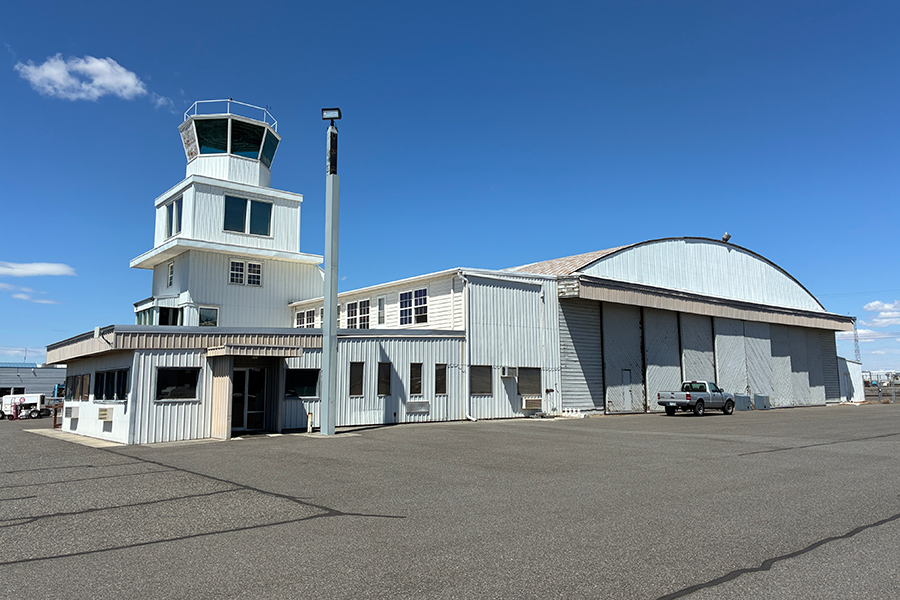
The nonprofit that operates the Pasco Aviation Museum has acquired the 12,000-square-foot hangar attached to the former control tower of Naval Air Station Pasco which has housed the museum since it opened in 2018.
| Photo by Ty BeaverMuseum expansion plans
Along with the hangar, the museum will acquire an additional 1,900 square feet in the control tower’s ground floor that was previously being used by contractor Apollo Inc. Port commissioners unanimously signed off on providing the space at the lease rate already paid for the rest of the building.
The public can’t step inside just yet. Bergstrom said that while the hangar has a fire suppression system in place, it is not functional and one must be installed before the space can be used. Smoke detectors are needed as are electrical upgrades and new lighting.
Volunteers with the museum nonprofit haven’t wasted any time in starting to use the space. Several larger pieces of the museum’s collection – including two aircraft donated by a former flying enthusiast who built them himself – and a military jeep have already been moved in. It’s also being used as a space to sort and organize airplane model kits that have been donated; the museum wants to get them back in the hands of kids and kids-at-heart.
The goal is to open the museum’s 2027 season with the hangar open to visitors. And Bergstrom said she and her husband, Michel Pelletier, are already envisioning what the hangar could be, from offering a permanent display of aircraft to potentially serving as an event venue.
“It’s well worth the wait but it was a long time coming,” Bergstrom said.
Go to: pascoaviationmuseum.org.