
Global stakes
Washington agriculture navigates export gains, China losses, tariff uncertainty
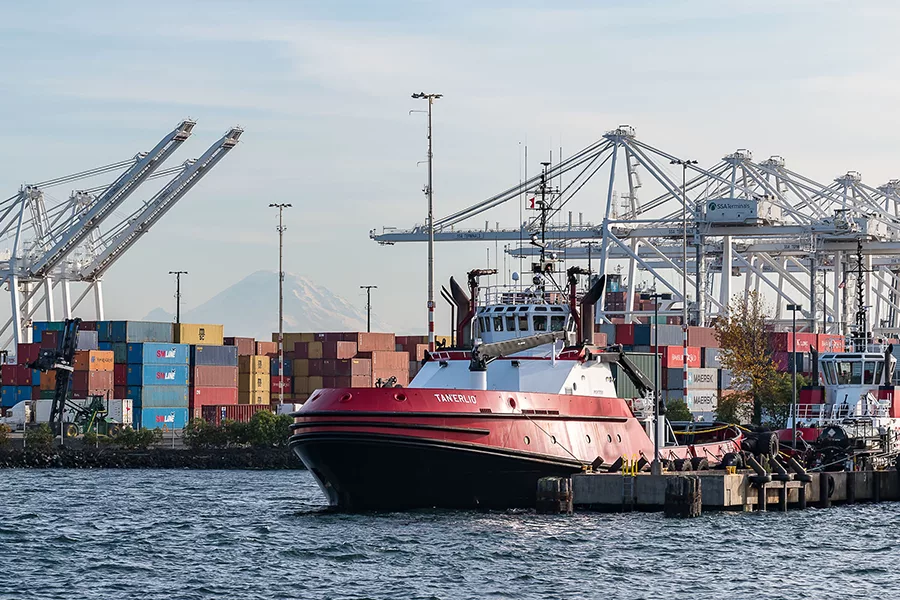
Containers sit stacked on docks at the Port of Seattle. Recent data shows Washington agriculture remains highly export dependent, heavily tied to Asian markets and vulnerable to trade disruptions and shifting international demand.
Courtesy Washington State Department of AgricultureWashington agriculture officials braced for disruption last spring after the federal government announced sweeping new tariffs on major trading partners.
“There was an expectation in the beginning we’d see a big decline because of the tariffs,” said Rebecca Weber, acting program manager on exports with the Washington State Department of Agriculture, who works out of a Kennewick office. “Often in the past that’s been the case.”
The state’s most recent export report shows that the state did see lower agricultural exports overall from its ports in 2025, a nearly 11% decline to $16.86 billion. However, products that originated in the state inched upward, growing nearly 2% to $7.81 billion.
The report shows Washington agriculture remains highly export-dependent, heavily tied to Asian markets and vulnerable to trade disruptions and shifting international demand.
At the same time, it also shows exporters successfully diversified into markets like Mexico, Vietnam and parts of Southeast Asia while some China-related trade weakened.
China remained a top destination for the state’s ag products, but it saw a sharp decline in exports, largely because of retaliatory tariffs. The value of all exports to China in 2025 was $453.9 million, a more than 34% decline over the prior year.
Some individual goods made gains, especially dairy commodities, which saw a 23% increase in 2025 compared to the previous year. Mexico remained the state’s third biggest export market, with $1.15 billion worth of apples, dairy and poultry products, among others, heading south, a 26% increase over the previous year.
“Cooler heads prevailed,” Weber said, citing strong trade relationships and good faith efforts on the part of trade representatives to maintain networks.
But there’s no doubt the tariffs had an impact, particularly on crops grown or processed in the Mid-Columbia. And while the tariffs have been overturned by the courts, it’s too early to say if that will reverse any of the impacts from the past year.
Destined for export market
Roughly 30% of food grown and processed in Washington state is destined for export markets. Frozen french fries, a major product of the region, remained the state’s top agriculture export in 2025, but saw the total value of those shipments drop just over 2% to $1.09 billion.
It was a year of mixed performance for other products in the Mid-Columbia. Apples were the third most exported product for the state, but their value dropped more than 3% to $819.3 million. Hay also fell 10% to $443.9 million.
Wheat exports grew 5% to $684.8 million while hops inched up just over 2% to $332.2 million. Cherries climbed just over 9% to $319.9 million.
Canada remained the state’s top export market, with apples and cherries among the top three products it imports. However, the value of those exports dropped more than 2% in 2025, down to $1.37 billion.
Mixed feelings on tariffs
When it comes to tariffs, Weber said that the agriculture industry has mixed feelings about them. Some growers see them as a means to protect their market share, in the case of blueberries and asparagus. The Washington State Potato Commission lauded the federal government’s tariff strategy last year, as its officials saw it as a way gain entry to new export markets.
While the tariff situation last year did not prove as damaging as some initially feared, it still added uncertainty and challenges for growers.
“The federal tariff strategy was so over the board that I do not know of one instance where it helped us, and I am not really sure how to quantify the negative impact, but they did cause issues to a varying degree depending what crop you grow,” said Jim Alford of JC Agriculture, Alford Farms and Block One Distillery.
And the impact isn’t just on what farmers were able to get packed onto barges heading overseas. Tariffs also have made crop inputs such as fertilizer more expensive, putting an additional squeeze on farmers.
“We can’t control global markets or supply disruptions, but we can take a hard look at policies here at home that are making it more expensive to grow the food Americans rely on,” the Washington Association of Wheat Growers said in a statement this spring. “Countervailing duties on fertilizer have added real costs for wheat growers ... across the country. Rolling those back is a practical, immediate step to help farmers stay competitive and keep growing the highest quality wheat in the world.”
Stable start to year
As far as 2026 goes, Weber said it’s too soon to tell how the state’s ag exports will fare. Data from the first two months of the year showed stability but that was prior to the start of U.S. military operations against Iran, which crippled international shipping out of the Strait of Hormuz.
And the war has done more than disrupt shipping. Weber said there are still some pending trade agreements that could impact the state’s agricultural exports, including one with Vietnam and the joint agreement with Canada and Mexico, the nation’s largest export markets, along with Japan.
“Now there’s other things going on that have paused negotiations,” Weber said, referring to the war in Iran.