When seconds matter
Richland first responders to launch life-saving ‘blood on board’ program
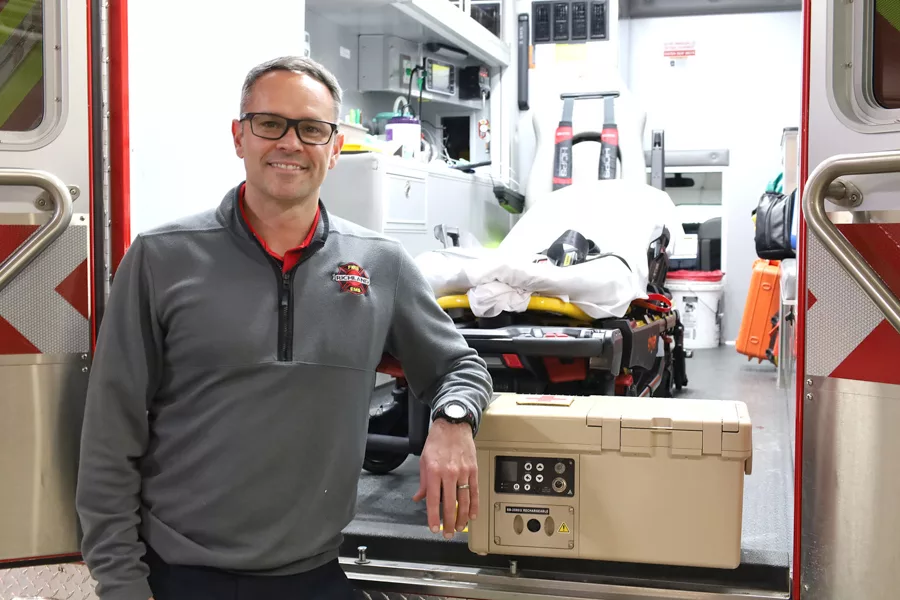
Andy Sabin, battalion chief and fire marshal with Richland’s Fire & Emergency Services department, stands with a mobile blood cooler that will help get blood to people in need before they arrive at a hospital.
Photo by Rachel VisickRichland’s Fire and Emergency Services department is getting ready to deploy a new program to help save lives, and is hosting a community blood drive to help power up the service.
Its new Blood on Board pre-hospital blood transfusion program aims to help those suffering from a critical illness or traumatic injury by getting them the blood they need in the field.
Each minute of delay in access to blood can increase the odds of mortality by as much as 5%, the department said in a release. That means that if an injured person can get blood once an ambulance is on site rather than later at a hospital, they might stand a better chance of surviving.
That’s why the department is working to get blood stored on one of its vehicles. When the program gets up and running, officials say it will be the first fire-based EMS agency in Eastern Washington to bring blood into the field.
The idea was first brought up in 2020 by Capt. Tim Estell, who had served in the military and understood the importance of delivering blood fast. But the Covid-19 pandemic shifted priorities, and the idea sat on the back burner for several years.
Now, the idea is much closer to implementation. Andy Sabin, battalion chief and fire marshal with Richland Fire and Emergency Services, said that they hope to get the program up and running by this summer.
Launching the program
In late 2025, the department bought a special blood cooler, a small container that keeps blood at a specific temperature range. Though it will be hardwired into a vehicle, it also has a backup battery that can last 96 hours, Sabin said. It’s also connected to an app that allows staff to monitor its status from their phones.
The plan is to have one cooler for now – at more than $20,000, it was a hefty purchase.
The cooler will be placed in the battalion chief’s vehicle, Sabin said. One battalion chief is on duty every day, and their vehicle could get dispatched to any emergency where blood is needed.
“We’ll work with the 911 dispatch center to add them to any call that could need blood, so any hemorrhages, any motor vehicle collisions with a report of bleeding … any medical call where it’s anything linked to bleeding,” Sabin said.
Though the cooler has been bought and is ready to go, the department is waiting on a go-ahead from Kadlec, where they will get the blood. They’ve been having conversations, Sabin said, and those they have talked to are supportive, but they still need to finalize the logistics.
The department aims to carry three units of O negative, or universal, blood. A unit of blood is about a pint.
The blood will last about 28 days. Sabin said that the department hopes to come up with a plan with Kadlec to return the blood to the hospital if it isn’t used within a set amount of time. That way, the blood can still be used at the hospital, and the Fire and Emergency Services department can restock.
Each unit of blood the department uses would cost around $700 to $800, but Sabin said it’s worth it because it’s hopefully going to save someone’s life.
Community blood drives
Since the department will be using blood, Sabin said it’s important that they put blood back in the system.
They launched a blood drive to promote their Blood on Board program in November. While the Red Cross initially recommended about 26 appointment slots, 53 donors participated.
That got the Richland department thinking. What would be a big blood drive? The Red Cross said that would be 60 to 80 donations. And the record for the state? The Red Cross looked into it and said they would consider over 110 donations the state record for the largest single-day blood drive turnout.
That’s been the Fire and Emergency Services department’s goal for their March blood drive. As of the Tri-Cities Area Journal of Business’ press deadline, only one slot of 146 was available for the March 31 blood drive.
They’re confident they’ll hit the goal: Sabin said the department already has commemorative coins to give away. Participants also will get a $15 Amazon gift card, a free commemorative T-shirt, and a complimentary A1C test to help screen for diabetes.
Going forward, Sabin said the department hopes to host two blood drives a year to help contribute to the blood supply. Since the donations are hosted at Fire Station 74 at 2710 Duportail St., Richland, they can only be hosted in the spring and fall, when the weather is mild, to keep the station at the right temperature.
Beneficial blood
The Blood on Board program can help trauma patients, like those in a car accident or with a bad cut, but that’s not the only group that can benefit from pre-hospital blood transfusions. Those suffering from internal bleeding or women who are bleeding after giving birth could receive blood.
Sabin relayed the story of a 6-year-old girl who was bleeding a few days after having her tonsils removed and was saved by receiving blood on the way to the hospital.
“There’s definitely a need for it,” he said.
Richland Fire and Emergency Services has 97 total staff across six stations. About 81 are operations staff, and 41 or 42 are paramedics, Sabin said. Paramedics are the ones who would have to initiate the transfusion, and there are usually multiple on an ambulance.
Though the idea of bringing blood to the field has been slow to catch on throughout the country, Sabin said that it’s beginning to spread as EMS agencies initiate it and see the benefits.
“This feels like one of those win-win-win situations for everybody,” he said. The Red Cross benefits from regular blood drives, while patients coming to Kadlec are in a more stable condition.
“It’s community involvement, we’re doing what’s right for the patients, and then we’re able to schedule these donations that we know the blood that we’re donating isn’t just for the Tri-Cities, but it’s going to help everybody in the region.”
Go to: richlandwa.gov/BloodOnBoard


Stay Informed. It’s Free.
Subscribe to our newsletters and get the latest news and insights delivered to your inbox.
We respect your privacy.
Unsubscribe anytime.
Thank you!
You’re subscribed. Keep an eye on your inbox for the latest updates.