
Rising bankruptcies signal ongoing financial strain in Tri-Cities
Bankruptcies have been on the rise in Benton and Franklin counties and across Eastern Washington since a low point in 2022, and the rate doesn’t look like it will come down just yet.
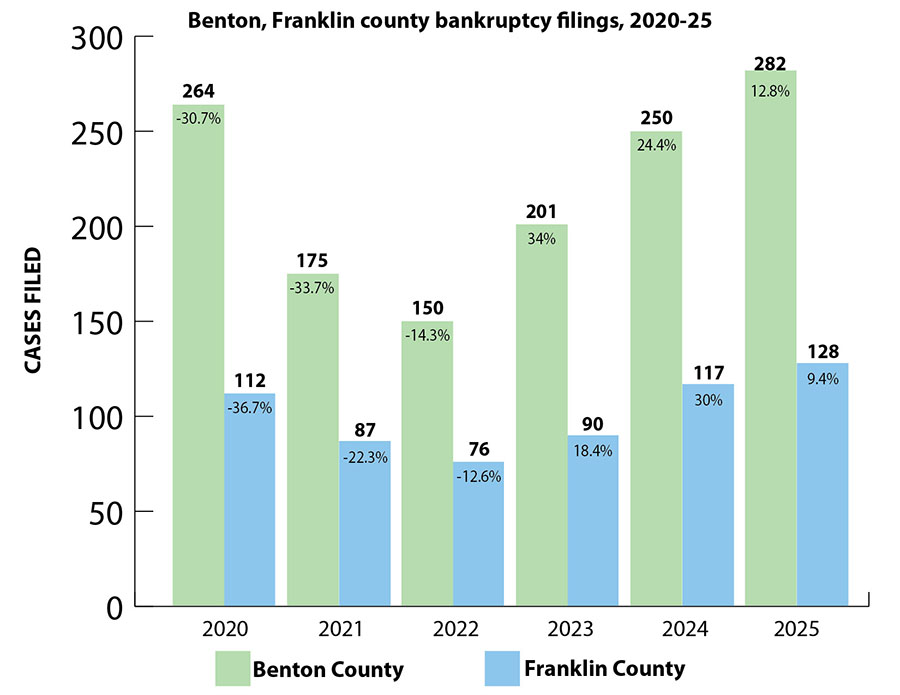
In the U.S. Bankruptcy Court’s Eastern District of Washington, bankruptcies reached 2,295 total filings in 2025, an 8.2% increase over 2024, and an 82% increase over 2022, when there were 1,261 bankruptcies recorded.

Dalton Cannon
Benton and Franklin counties reflected the same trend. Benton County saw 282 bankruptcy cases in 2025, up from its low of 150 in 2022, and Franklin County had 128 bankruptcy cases in 2025, up from 76 in 2022.
Dalton Cannon, an associate attorney with Gravis Law in Richland who focuses on bankruptcies, said that the majority of the increase comes from Chapter 7 cases, which are tailored for people who make below median income.
“An uptick in that chapter of bankruptcy is really just an indicator that wages aren’t accelerating at the same rate as cost of living,” Cannon said.
While Benton and Franklin counties aren’t much different from the region covered by the Bankruptcy Court, the Tri-Cities in particular might be feeling the effects of job insecurity at Hanford and the Pacific Northwest National Laboratory, causing additional financial strain on some families, he said.
Other bankruptcy types
Other types of bankruptcies aren’t seeing the same growth though.
Chapter 13 bankruptcies, another type of consumer bankruptcy, saw only minor growth in the last few years, and in 2025, those cases were lower, “which means that individuals who will make above median income that are able to make their payment obligations just aren’t filing bankruptcy as much as the people who are on the lower half of the income spectrum,” Cannon said.
Business bankruptcies are all over the place from year to year, but they’ve been high since 2021 and 2022.
Covide-19-era assistance, including Small Business Administration loans, is coming due and driving some businesses into bankruptcy, Cannon said.
Some owners facing those loan payments have lost their business and now must meet their debt obligations as individuals working regular jobs, he said.
 Source: U.S. Bankruptcy Court, Eastern Washington District
Bankruptcy process
Typically, Cannon’s clients are regular people who have a life event that becomes a catalyst for bankruptcy. This can be the addition of a child to the family, being injured or ill and out of work, or growing credit card debt.
“The second a family begins to rely on things like unemployment or paid family medical leave, we see a dip in income, and it doesn’t take very long for that dip in income to get out of control,” Cannon said.
Families might use credit cards to pay their bills while they are out of work, which then becomes another ongoing payment when they do land a job.
“Their net income in a month is still lower because they have additional things that they’re paying because of these debts that they had to incur just to make ends meet,” he said.
Not everyone who comes to Cannon’s office needs to file for bankruptcy.
“I would say just under half of the people I meet with, I end up recommending that they don’t file for bankruptcy for one reason or another,” he said. “If people have other options, we want to explore those options. Bankruptcy is kind of a last resort for a lot of people.”
Others, however, come in set on bankruptcy, and he helps them through the process, which involves plenty of paperwork and then a long waiting period once a case has been filed.
Bankruptcy effects
There are many different classifications of debt, Cannon said, and while people often wonder if they’re able to keep their home or their car, the answer is generally yes.
He explained that the bankruptcy process has exemptions, but with price limits. Bankruptcy courts generally want people to stay in their homes, but an expensive, recently-acquired house likely wouldn’t be eligible.
Those who go through the bankruptcy process will see a dip in their credit scores, and the bankruptcy is listed on their credit reports for 10 years after filing, Cannon said. But those who have gone through the process can work to improve their credit score in the same way credit is always built: Making payments on cars, mortgages and credit cards.
Buying a house might be more difficult in the wake of a bankruptcy. Cannon said that while there are no hard rules, mortgage lenders in the area likely want to wait two to four years before approving a loan to someone who’s filed for Chapter 7.
Employers are not allowed to fire employees for bankruptcy, but Cannon said that those working in the financial sector who have filed may face difficulties.
No slowdown
Another category of bankruptcies that has been on the rise is pro se cases, or cases where those filing do so on their own, without an attorney. Cannon said they’re rising at a higher rate than total bankruptcies.
The increase could be due to people feeling more comfortable filing on their own, thanks to online tools and the availability of information, or it could be that more people are unable to afford legal representation, Cannon said.
It could also simply be the lack of accessibility to bankruptcy attorneys.
“Every time I’m on a hearing, I’m seeing the same six familiar faces for other attorneys representing clients,” he said.
Cannon has plenty of clients, too, and said that he could meet with more people if he had time. But he has to limit his consults to ensure he has time for everything else he needs to do.
Even though it’s just the beginning of 2026, Cannon doesn’t see bankruptcy cases slowing down in the near future. There are still plenty of cases to work through that were initiated at the end of 2025, and with the median income raising slightly this year, even more people may qualify for Chapter 7 bankruptcies.


Stay Informed. It’s Free.
Subscribe to our newsletters and get the latest news and insights delivered to your inbox.
We respect your privacy.
Unsubscribe anytime.
Thank you!
You’re subscribed. Keep an eye on your inbox for the latest updates.