
State of regional economy is a mixed bag at start of year

Giving a real-time update on the state of a regional economy is always a challenge. At the Eastern Washington University Institute, we depend on public data, which is released with understandable lags. These can be anywhere from five to 10 months. Toss in the recent federal government shutdown and delays lengthen.
This month’s column summarizes many of the latest high level economic data releases, with the notion that they give a sense of where the economy of the greater Tri-Cities has been in 2025 and could help signal where it’s going. Some of the data is from 2024 and some is from this year.
Population
Population is formally a demographic indicator, but it has much to do with a regional economy. It’s hard to envision the economy without population growth. That has certainly been true here for many years, as the metro area of Benton and Franklin counties has shown the fastest growth rate of all Washington state metro areas for several years and its economy has prospered.
That isn’t currently the case. Between April 1 of this year and the same date last year, the Office of Financial Management estimates that the metro area picked up 2,275 new residents. That is half the average of the prior decade. In percentage terms, it represents a year-over-year rate of 0.9%, the first time area population growth has slipped below 1% since before the turn of the century. The prior decade’s average rate was 1.6%.
Further, for the first time in a decade, the population here grew at a rate below the state rate. Is the area’s population bloom off the rose? Time will tell. But there will certainly be economic implications if that’s the case.
Not surprisingly, net in-migration between early 2024 and early 2025 was low, the lowest in a decade. Local area population grows largely from people moving in from somewhere else, not a surfeit of births over deaths. The annual average for the greater Tri-Cities before 2025 was 2,636. This year, about a third of that number, 879, represents the second lowest in-migration of the new century.
 Courtesy Benton-Franklin Trends
Income
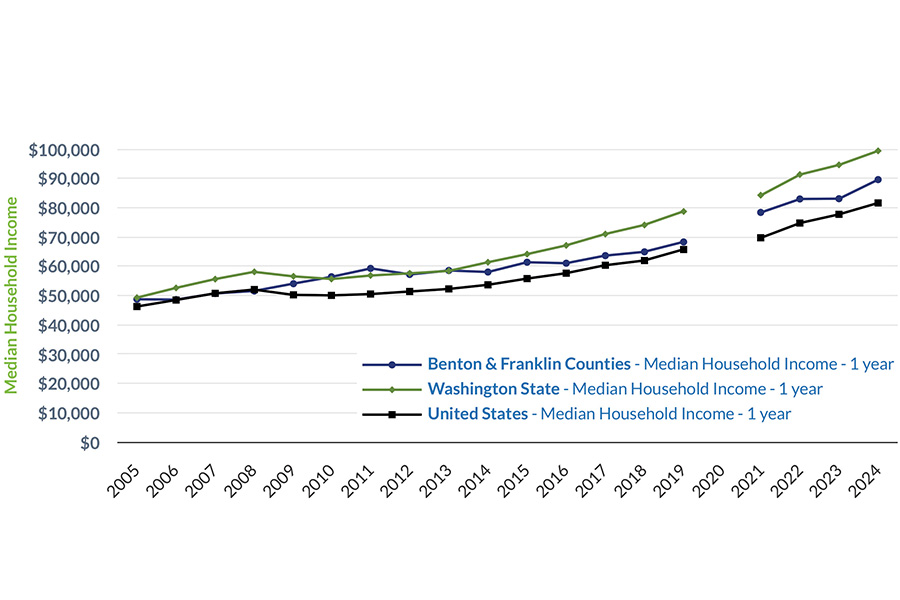
Even though personal income data stemmed from last year, it was recently released and deserves some attention. The measure is median household income, or MHI. The median gives a better idea of the middle of an income distribution than the average, and the unit of the household reflects how so many of us live and receive income.
In a word, 2024 was another strong year for MHI in the greater Tri-Cities. The Census estimated it to be $89,573. That’s a gain of about $6,500, or 7.9%, over the prior year. This growth easily surpassed the increases in the state and U.S. medians, both at 5%. And although the area’s MHI still lies below the state’s level, it continues to be the highest among all Eastern Washington metros.
Similarly, we don’t have much current data on the largest source of median household income, annual earnings from work. But it’s worth examining for last year and for some of this year, as it’s the largest component of MHI.
In 2024, average worker earnings at organizations based in the two counties were a bit over $67,000, representing a gain of 5.2%. That was well over the 10-year average annual gain of 3.5% prior to 2024, but still less than overall gain in the state last year, at 6.1%.
And for this year? Data for only the first quarter is available, in part due to government shutdown. If the changes hold for the rest of 2025, they augur for a softer year than 2024. In the first three months, average quarterly earnings of workers at local organizations grew by 3.2% in Benton County and a mere 1.5% in Franklin County.
Employment growth
Last year was another year of employment growth in the greater Tri-Cities. The estimated number of residents with a job, here or outside of the two counties, was 139,950. This represents a gain of 3,000 since 2019. Several Eastern Washington counties had yet to show any gain from 2019.
The 2024 local unemployment rate, not surprisingly, was 5.1%, the third lowest year since the turn of the century and only slightly higher than the two preceding years.
For the first eight months of 2025, however, average employment hardly budged over the same months a year ago. Unless fourth quarter data comes in very strongly, there will be little gain in employment in the two counties this year.
Taxable retail sales
Despite these headwinds, total taxable retail sales in the two counties are showing their highest growth rates since 2021 and early 2022. For the first quarter, these sales grew by 7.4% over the same quarter a year ago; for the second quarter, by 7.1%. Contrast the local, quarterly results to the state’s gains, at 1.5% and 3.4%, respectively.
Third quarter sales data are available only for the entire state. But state numbers represent slightly stronger gains from the first half. It seems likely that growth here will continue to outperform that state average for the rest of the year.
Yet, a significant driver of economic activity – residential construction – as measured by single-family building permits, is flashing a slowdown. For the first half of the year, they are off by 172 permits, or 13%, compared to last year.
Summarizing these results is a bit like the parable about the blind men feeling the different parts of an elephant and reporting out contradictory and limited findings about the giant animal because they had never encountered one before.
This column’s summary of the region’s key economic factors is a mixed bag. My hunch is that a read of the 2026 greater Tri-Cities economy is likely to retain this ambivalence.
D. Patrick Jones is the executive director for Eastern Washington University’s Institute for Public Policy & Economic Analysis. Benton-Franklin Trends, the institute’s project, uses local, state and federal data to measure the local economic, educational and civic life of Benton and Franklin counties.


Stay Informed. It’s Free.
Subscribe to our newsletters and get the latest news and insights delivered to your inbox.
We respect your privacy.
Unsubscribe anytime.
Thank you!
You’re subscribed. Keep an eye on your inbox for the latest updates.