
Tri-City job market hasn’t shifted much toward degree-heavy work

It may surprise the casual observer of the greater Tri-Cities economy that the share of jobs requiring at least a bachelor’s degree hasn’t budged much in the past decade.
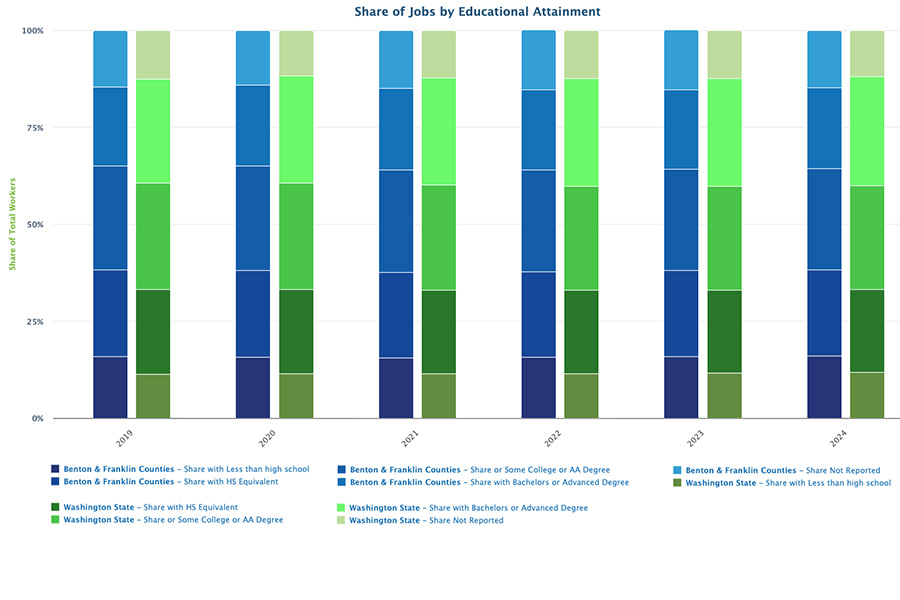
According to the U.S. Census, it stood at 20.7% in 2024. In 2015, the share was 20.9%. The accompanying graph displays the last five years, with the full time series available on the Benton-Franklin Trends website.
Compared to the Washington state average, the local share of the workforce requiring a bachelor’s degree is far lower.
In 2024, the comparison was 20.7% vs. 28%. And the relative standing has been like this since the pre-pandemic years, as the Trend graph shows.
The indicator tracks the share of jobs at four levels of formal education: less than a high school degree, high school diploma, some college or an associate (AA) degree, and a bachelor’s degree or higher. (Plus an “unknown” category.)
In 2024, the sum of the shares of jobs requiring less than a high school degree and those requiring a high school diploma was the largest, at 38%. The state average was 33.2%. Upon reflection and review of the Trends data, this result makes sense.
Low degree workforce
Among the top five employing sectors, several seem to fit the profile of a “low” degree workforce. (See Trends indicator 3.3.4.)
Agriculture represents a significant part of the regional economy. Last year, it claimed 8.6% of the total bicounty workforce. Retail represented 10.4% of the total workforce in 2024. And the waste services sector (better known as Hanford) came in at 9% of the workforce. Certainly, there are some Hanford workers with post-secondary education, but the bulk likely do not fall into this category.
Outside of retail employment, the local profile is not shared throughout the state.
Agricultural employment was 2.7% of the statewide workforce in 2024. Administrative and waste services was 5.1%. And most of jobs statewide in this sector fell into administrative, and not waste industries, by a factor of at least seven to one. This underlines the uniqueness of this significant part of the bicounty economy.
Jobs requiring some college
If there is a job category that more or less matches share size with the state, it covers those jobs requiring some college or an AA degrees.
In 2024, the local share was slightly over 26%. Statewide, the size of the same share was 27%. This relatively strong standing likely reflects the needs of the booming construction sector, some Hanford cleanup activities, the burgeoning health care sector, and, to some degree, government.
Consider how the sector breakdown of employment supports this result. The health care and social assistance category has shown the most rapidly growing share over the past decade. It currently sits at 14% and was at 11% a decade ago.
Similarly, construction employment has shot up over the past 10 years, now claiming 8.2% of the workforce versus 5.5% in 2015.
This view of the composition of the bicounty labor force goes a long way to explain the distribution of the adult population by educational attainment. The local educational profile is captured in three Trends indicators.
The first covers high school as the highest level achieved. (Due to the federal shutdown, 2023 represents the most recent data year.) In that year, the share of adult population with a high school degree or less was nearly 39%. This share has remained constant over the past decade, as it stood at 39% in 2014.
Note how well the educational attainment shares match the job shares covered earlier in the column.
Local adult residents with at least a bachelor’s degree amounted to 30%. This is a considerably higher share than the one describing job requirements, most recently at about 21%. The discrepancy could be due to the educational profile of retirees in the Tri-Cities. Or, it might signify some degree of underemployment.
A better match between job requirements is found in the “some college or an AA degree” category. For 2023, the latter share stood at about 31%. The share of jobs requiring this level of formal education was 27% in 2024. Again, the discrepancy might be due to retirees and perhaps some underemployment.
Generally, then, it appears that at the degree level, the supply of and demand for talent is evenly matched for two of the three large categories for the two counties.
This analysis, however, does not examine the distribution of degrees by major compared to the distribution of occupations. It is never easy to arrive at close matches in this look at workforce, and for sure there are some occupations in deficit and likely a few in surplus in the greater Tri-Cities.
D. Patrick Jones is the executive director for Eastern Washington University’s Institute for Public Policy & Economic Analysis. Benton-Franklin Trends, the institute’s project, uses local, state and federal data to measure the local economic, educational and civic life of Benton and Franklin counties.