Officials praise more balanced salmon report, urge broader recovery plan
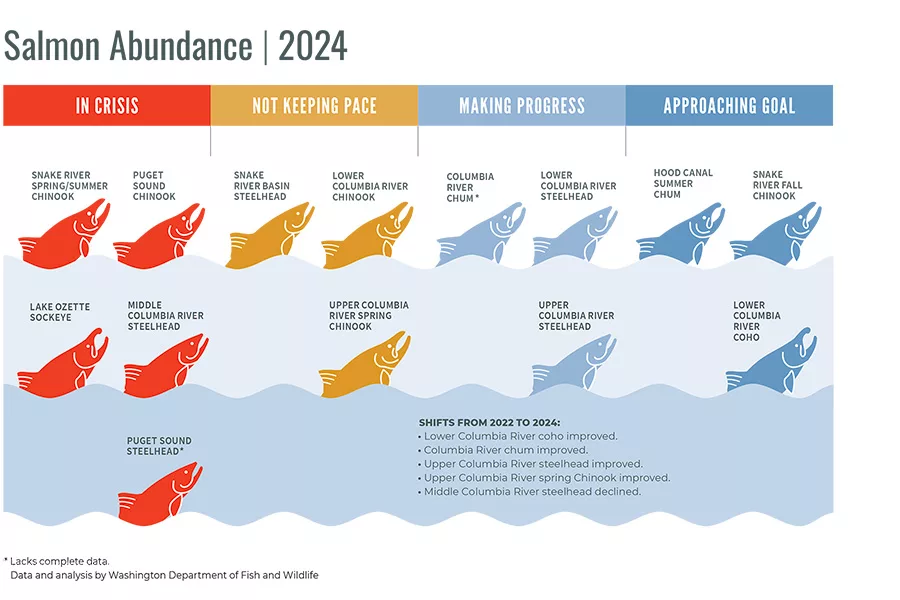
The latest state salmon report highlights some bright spots in efforts to improve salmon and steelhead populations.
Six of the 14 species listed for protection under the federal Endangered Species Act are making progress or approaching population goals, according to the 2024 State of Salmon in Watersheds report, issued this spring by the Governor’s Salmon Recovery Office.
Columbia River chum and Snake River fall Chinook are among the species faring the best.
But there are still declining fish populations, including steelhead from the Snake River basin. And spring and summer Chinook from the Snake are described as “in crisis,” as are Mid-Columbia steelhead.
“Overall, there are some modest signs of improvement,” the report’s executive summary states. “However, there are still far too many salmon in crisis or not keeping pace with recovery goals.”
Economic development officials in the Tri-Cities said they found the report refreshing for its more balanced view. After years of tribes, farmers and ranchers, environmentalists, government agencies and whole communities going toe to toe over how much the four lower Snake River dams are affecting those fish populations, the report equally highlighted other factors likely negatively affecting fish and their habitat and the efforts underway to address them.
“If we could start thinking more holistically ... There’s great work happening here but they need more investment and partnerships,” said David Reeploeg, vice president of federal programs for the Tri-City Development Council, or TRIDEC.
The four lower Snake River dams have long been the focus of debate surrounding salmon recovery in the Pacific Northwest.
Tribal leaders and environmentalists have called for their removal, citing devastating environmental impacts to fish populations that violate tribal treaties. Farmers, ranchers and those concerned with economic development cite the immense benefits the dams provide for transportation, irrigation and power generation.
The Trump administration’s recent decision to withdraw from the Resilient Columbia Basin Agreement, a deal made by former President Joe Biden that could have led to the dams’ removal, is certain to prolong the debate.
Reeploeg and TRIDEC President and CEO Karl Dye said the economic development-focused agency is supportive of salmon recovery efforts, but it also views the region’s hydroelectric generation system as crucial to its economic diversity and sustainability.
The state report names hydropower as among the factors causing salmon to struggle. The state has 1,345 dams, which includes 145 power-generating facilities operated by the federal government.
“Hydropower dams block large areas of salmon habitat, particularly in the Columbia River and its tributaries,” the report stated.
It also lists other contributing factors, including habitat loss – particularly in Puget Sound – climate change, water quality and fish passage barriers such as culverts, predation and harvest. The report is a stark contrast to the “laser focus” that’s been placed on the Snake River dams, TRIDEC officials said.
“I don’t think anyone denies dams have an impact on fish, but there’s been a lot of work done to reduce their impact,” Reeploeg said.
“They’ve spent $1 billion over the years to make the dams more hospitable,” Dye said.
Dye said he’s particularly concerned that efforts to remove the dams could result in severe economic consequences. He referenced the economic decline of the timber industry beginning in the 1980s as the federal government restricted logging in an effort to protect habitat for the endangered spotted owl.
“Now those communities are devastated, infrastructure is lost, and the owls and forests are in worse shape,” Dye said.
There are still frustrations with the state’s efforts, TRIDEC officials said. The state Legislature continues to spend money studying the removal of the Snake River dams, especially when the state’s budget is as tight as it is, Dye said. That money also could be put toward addressing some of the issues identified in the report, such as the replacement of culverts and supporting hatchery operations.
But Dye and Reeploeg said they hope the state report can initiate conversations that lead to a more unified and broad approach to salmon restoration.
“It’s such a complex equation,” Dye said.