Energy Northwest
Coordinated road map shows way to a carbon-free future
At the end of the year, Washington state is scheduled to meet its first Clean Energy Transformation Act (CETA) milestone: Removing coal-fired generation from our electricity system. Within the next five years, CETA requires the electricity sector to be 80% carbon neutral. And in the next 10 years, regional energy needs are predicted to grow by 30,000 megawatts.
How do we prevent those realities from colliding into a crisis? By being forward thinking – anticipating the needs and using every available resource to meet them.
That’s exactly what we’re focused on at Energy Northwest. As a state joint operating agency, we are uniquely positioned to address the regional challenges ahead. We are responding to what our public power members and the region are asking for: greater coordination and more carbon-free power. To that end, we’re launching the Regional Energy Investment Strategy, a coordinated road map that translates regional needs into clear, actionable solutions.
Exploring new resources
Since our founding in 1957, Energy Northwest has provided diverse power resources. Today, we deliver a mix of renewable and baseload resources – including hydroelectric, solar, wind, nuclear and battery energy storage – to ensure the lights stay on year-round. Now, it’s time to investigate new sources of energy.
One of those sources we’re exploring is geothermal energy, drawn from the heat beneath the Earth’s surface. The Pacific Northwest is uniquely suited for geothermal development: its landscape is shaped by a chain of volcanoes and tectonic activity, both strong indicators of geothermal potential. We are partnering with regional and international experts to conduct geological exploration and to identify potential sites for geothermal plants.
Like nuclear power, geothermal power provides “baseload” energy. Unlike wind and solar, it can generate power 24 hours a day, seven days a week. That provides critical energy during times when the sun doesn’t shine or the wind doesn’t blow.
But we’re doing more than looking for new energy sources: We’re also exploring how to use the energy we have more efficiently and store it for high-demand times.
In the Finley community, our Nine Canyon Wind Project has 63 wind turbines that capture the power of the wind to generate electricity for our customers. But as we know, the wind isn’t always blowing. The hilly terrain of the Nine Canyon area provides a unique opportunity for us to deploy gravity-based rail storage technology.
Traditional batteries typically provide only about four hours of power, making them a short-term solution. By contrast, we are studying a gravity-based long-duration storage system that can hold energy for more than 10 hours, enabling us to deliver electricity throughout the day when it is needed most.
In this system, weighted rail cars are pulled uphill by electric motors when excess energy is available, then released downhill to generate power. The technology requires no water or chemicals, is non-flammable and achieves approximately 80% round-trip efficiency.
Advancing nuclear
Our most public project is the effort to build small modular reactors (SMRs) near Columbia Generating Station north of Richland. We are more than one year into our partnership with Amazon and X-energy on advancing the development of a four-module unit that will produce 320 megawatts of electricity around the clock.
The site, now known as the Cascade Advanced Energy Facility, can hold up to three units, for a maximum output of 960 megawatts.
This public-private partnership is vital to developing new technologies. Amazon’s support reduces development risk from our members, allowing them to participate in building the additional units at lower costs.
Successful deployment of SMRs in Richland will be transformative. Nuclear energy is one of the most reliable carbon-free sources of electricity, and it will play a critical role in meeting our goals to remove coal and oil from our electric grid. SMRs allow us to deploy energy where it is needed most, including remote areas where the transmission system may not be fully developed.
Maintaining reliability
New plants and new technology are exciting, but none of it matters if we don’t maintain the resources we already have.
The largest of those is Columbia Generating Station. The region’s only nuclear power plant has been reliably providing enough electricity to power a city the size of Seattle for more than 40 years – and we’re committed to ensuring it continues to power the region for decades to come.
During our last two-year fuel cycle, Columbia operated breaker-to-breaker: generating electricity every single day for 662 days. We intend to do that again this cycle – providing carbon-free energy every day until our next refueling outage in spring 2027.
Part of our effort to keep Columbia operating reliably includes increasing the station’s energy capacity through a project called extended power uprate (EPU). This project was approved by the Energy Northwest Executive Board and received funding approval by the Bonneville Power Administration last spring, after several years of research and planning. Through EPU, we will replace equipment and make strategic investments to allow Columbia to more efficiently use its steam, resulting in 162 megawatts of additional electricity for the region by 2031.
We are already well positioned to pursue a second license extension, and with EPU, our position is even stronger.
The Nuclear Regulatory Commission approved our first 20-year extension of Columbia’s original 40-year license in the early 2010s. We intend to request another 20-year extension in the coming years, and plan to continue to operate Columbia safely, reliably and predictably for 80 years, or beyond.
A reliable partner for the future
Energy Northwest isn’t pursuing these projects for our own benefit. We exist for you – the customers and members of our public utility districts. That includes me and all of our more than 1,200 employees.
We are passionate about carbon-free energy, but it’s also personal. We work hard every day to keep the lights on in our own homes and to build a stronger, more secure energy future for our families, our communities and the generations to come.
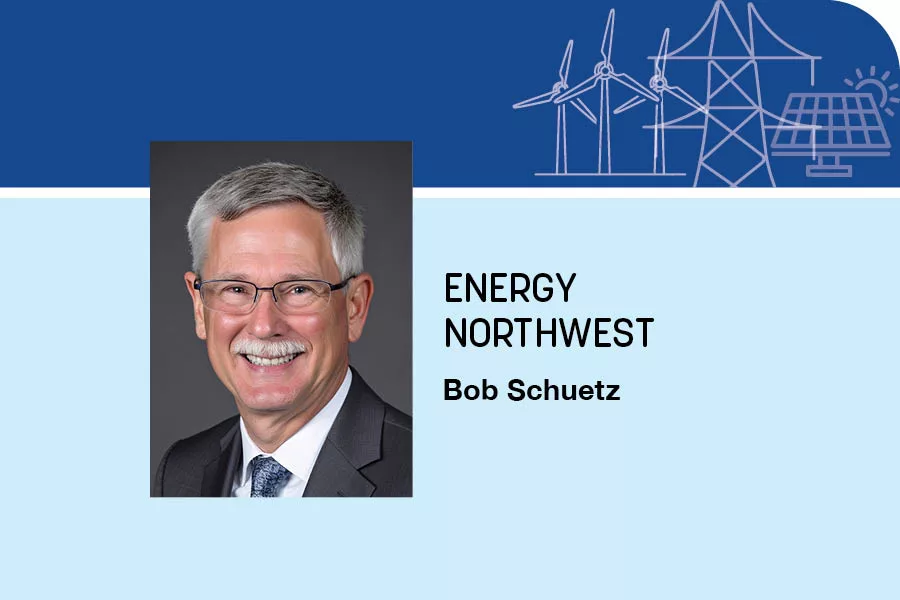
Bob Schuetz is the CEO of Energy Northwest.