Institute for Northwest Energy Futures
Collaboration fuels INEF’s push toward next era of energy
The growing need for resilient energy solutions and increased energy production, both in Washington state and beyond, is a challenge that demands the attention of not just a few scattered experts and specialists – but of everyone.
It’s not enough simply to green-light the construction of new plants and generators, whatever their source of energy might be.
We need continuous research to advance innovation. We need a new workforce of skilled engineers and technicians, as well as teachers and training programs to educate them.
We also know that energy production doesn’t operate in a vacuum, but rather as one part of a larger network of interconnected systems impacting our food and water resources, habitats and ecosystems, and the communities we call home.
How do we move forward to meet this energy challenge while accounting for such a multitude of crucial and informed perspectives?
That’s where the Washington State University Tri-Cities Institute for Northwest Energy Futures (INEF) is uniquely positioned to help.
As one of 25 entities across the WSU system with a focus on energy, we collaborate with many of these internal groups on a wide range of state and national efforts, facilitating connections and conversations where research and goals overlap.
We also work closely with industry and community partners within the Tri-Cities energy hub to bring even more voices together.
In short, we bring a systems approach to assist energy stakeholders with research and analytics to better understand and manage the interrelationship between emerging energy technologies and their impacts on current energy systems, the economy, natural resources and public policy.
Three focus areas
Over the past year, INEF staff and faculty have made important strides in three focus areas: the food-energy-water security nexus, agrivoltaics and advanced nuclear energy.
The first area deals with our understanding of how changes to our food and water systems affect energy infrastructure and vice versa. For example, how do we effectively manage water resources to simultaneously meet the needs of our hydroelectric dams and irrigation for agriculture?
These are pressing questions that go beyond mere science, demonstrating the need for sound policymaking and consensus building. That’s why, for example, we’ve been connecting our INEF student interns with groups like the East Columbia Basin Irrigation District– overseers of the Odessa Groundwater Replacement Program – to spur new research and studies.
The past year also saw INEF faculty involved in a comprehensive study on agrivoltaics, the combining of solar energy panels with traditional crops and livestock facilities. The researchers determined that if adopted at scale among suitable Washington farms, agrivoltaics could generate up to 20 gigawatts of electricity – a sizeable boost to Washington’s energy portfolio.
We remain committed to advancing solutions in nuclear energy through a multipronged effort involving research, workforce training, public outreach and professional networking. INEF leadership has been working with community partners including Avalanche, Energy Northwest, Framatome, Port of Benton, VERTical and others on ways to improve the larger nuclear supply chain.
In May, INEF hosted a panel forum on the past, present and future of small modular reactor (SMR) technology. That hybrid event brought together industry leaders from Energy Northwest, Pacific Northwest National Laboratory and WSU’s Nuclear Science Center, as well as more than 160 online and in-person attendees.
SMR simulator
With the construction of the Cascade Advanced Energy Facility on the horizon, INEF recently partnered with Columbia Basin College (CBC) and Energy Northwest on the installation of an SMR control-room simulator – currently housed in the INEF building in Richland.
With a special ribbon cutting ceremony planned for early 2026, the simulator will soon be used as a hands-on training site for future SMR operators and safety technicians via CBC’s nuclear technology program.
It will also be used in conjunction with the Washington State University Reactor in Pullman, providing further avenues for advanced coursework, credentials and practical training for community members and students across the WSU system.
This fall, INEF is hosting eight undergraduate students in the Energy Ambassadors Network who are delving into topics including fission, fusion, food-energy-water nexus, agrivoltaics and data center impacts on water and power systems.
We’re proud of the progress we’ve made and grateful to every external partner who has entrusted us with their time, energy and expertise.
2026 and beyond
Looking ahead to 2026 and beyond, we’re committed to expanding both the reach and scope of our efforts with the anticipated hiring of five new full-time faculty members here at our Tri-Cities campus. They’ll be joining our incredible INEF leadership team that currently includes Jillian Cadwell, assistant director for program development and student engagement; Yonas Demissie, assistant director of engineering and environment; Chad Kruger, assistant director for agriculture, extension, and outreach; and Georgine Yorgey, assistant director for energy extension.
If you’re interested in engaging with INEF or lending your expertise to our mission, we invite you to connect with us. Maybe you have meaningful energy-related projects in need of assistance, or you’re willing to host a student field trip or activity at your place of work.
We’re also currently on the lookout for more industry mentors to help guide our growing network of talented WSU students and alumni. We’d love to hear from you. You can contact us by email at: [email protected]
Securing a reliable energy future is an effort that requires all of us to step in and play a part.
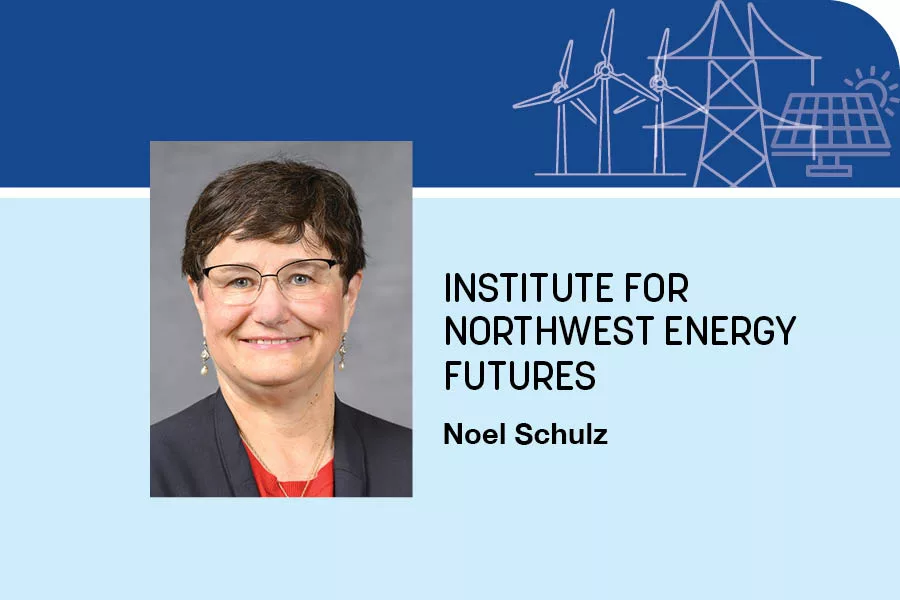
Noel Schulz is the inaugural director of WSU Tri-Cities Institute for Northwest Energy Futures and Bob Ferguson Endowed Professor.