Automation boosts manufacturing efficiency at SIGN
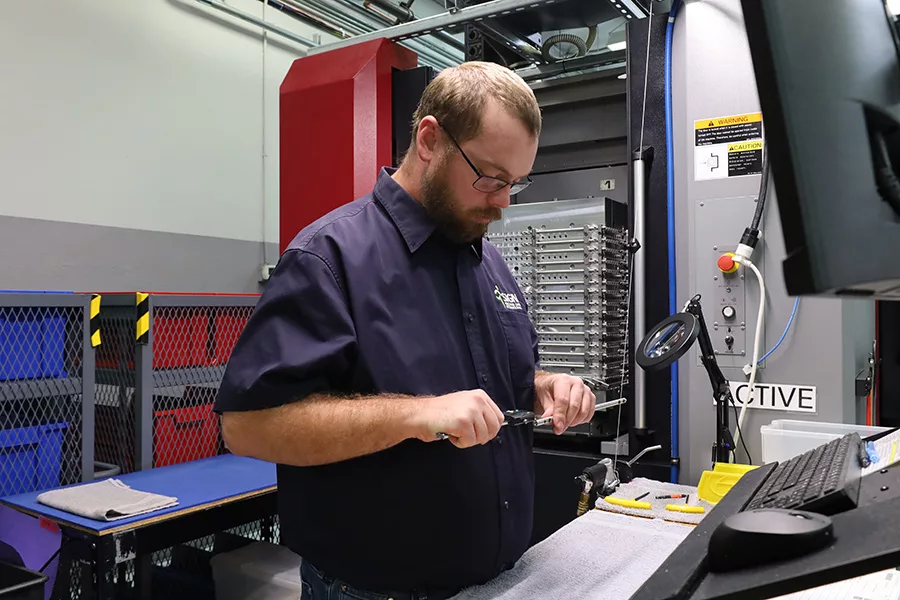
Nicholas Breshears, a machinist at SIGN, holds a nail used in implant surgeries. A new machine at SIGN speeds up the manufacturing process at the nonprofit’s Richland headquarters.
Photo by Rachel VisickA local nonprofit is using automation to increase its manufacturing capacity, priming the organization to help serve more patients in need of orthopedic surgery around the world.
Richland-based SIGN Fracture Care International’s mission is focused on helping treat bone fractures in the working poor in developing countries.
There are two sides to SIGN’s work: manufacturing metal orthopedic implants for surgeons in low-resource hospitals to use and training those surgeons on how to use the implants.
Most of SIGN’s manufacturing takes place locally in Richland, with only a few large instruments outsourced. Each year, SIGN manufactures about 30,000 intramedullary nails, which are implants used to stabilize a fractured bone, and 90,000 to 100,000 screws, which hold each nail in place.
With a new machine up and running this summer and a restructured approach to manufacturing the nails, SIGN has drastically increased its manufacturing capabilities, getting the organization ready for increased demand and programs.
Restructuring
Previously, SIGN was manufacturing at full tilt and barely keeping up, said Sean Bradley, production manager. If anything happened, it was hard to catch up on production.
A single Tornos machine did all of the nail manufacturing. The Swiss machine pumped out completed nails at a rate of about 12 per hour.
Then, about four years ago SIGN had a chance to check out a new machine. One of SIGN’s contract manufacturers was quitting and offered a machine to the nonprofit at a discount.
With a grant from the Murdock Foundation covering half the machine’s cost, SIGN was able to buy it.
The machine came essentially as a blank slate, not designed for a specific product. It had capabilities, but it was up to SIGN’s machinists to decide what tasks they wanted it to do and how to program it.
The team decided to split the nail manufacturing process into two parts, remodeling the manufacturing space and moving machinery in the process.
The original Tornos machine’s task was simplified. Now, it only makes “blank” nails, cutting down 12-foot metal rods to the right size and preparing them for the next step. The simplified process increases the machine's capacity from 12 nails an hour to 28 blanks.

Nicholas Breshears, machinist IV at SIGN, holds up a nail by the Tornos machine, which cuts “blank” nails. The nonprofit has boosted its potential nail production capacity from around 30,000 a year to up to 51,000 a year.
| Photo by Rachel VisickNew machine
The new machine, called the OKK, then cuts the blanks into complete nails.
The OKK is fast-moving and can be automated to safely run through the night, called “lights out” manufacturing. That’s a contrast from the Tornos machine, which requires a skilled operator at all times, said SIGN machinist Nicholas Breshears.
The machine has lots of internal checks and safety barriers in place. Before making cuts, a mechanical arm will probe the dimensions of the nails, which are placed in rows on four sides of a box called a “tombstone.” The machine checks the top and bottom of the nail to find its location, then will retain that information so it can cut the nails when told to start.
After making cuts to the nails on one side of the tombstone, it can rotate, allowing the next side to be cut. Outside the machine, the operator can replace the blanks on one side without interrupting workflow.
SIGN’s manufacturing team did validations of the OKK machine to prove that it could produce nails reliably and consistently, on numerous sizes and lengths.
The report produced from that validation enables SIGN to “trust that when we run this thing lights out and we come in and pull a batch of nails off them, we (are) 100% certain that that product is acceptable and is going to pass inspection,” Bradley said.
Increased capacity
Already, production has gone quickly enough after splitting the nail manufacturing operations between the two machines that the OKK doesn’t need to run at night. In fact, it only runs three days a week, and the machine is fast enough to easily catch up on production if something goes awry.
At full tilt, the machine can produce 256 nails a day, bumping SIGN’s capacity to 51,000 a year. That’s far above SIGN’s goals and not yet needed, Breshears said. And SIGN hasn’t needed to add any more labor.
With an expanded capacity, SIGN’s manufacturing arm will be able to support additional programs and reach more people in need when the time comes.
Bradley said that the manufacturing team’s goal was to be able to have a process in place that could satisfy any of SIGN’s needs in the next 10 years, giving them the ability to produce more nails given the need, funding and material.
The extra time created by the OKK’s speed allows the Tornos machine to be used for other products. And finishing the OKK’s extensive programming has given Breshears and another lead programmer more time to concentrate on different projects.
SIGN also might have the ability to bring some of the work the organization has had to outsource back to Richland, where the nonprofit can keep a close eye on all of its products’ process and quality.
“We have a team that has a lot of zeal for what we do as a profession, but we get to focus it toward this large goal that is just good,” Breshears said.