Sustainable aviation fuel project clears key regulatory hurdle
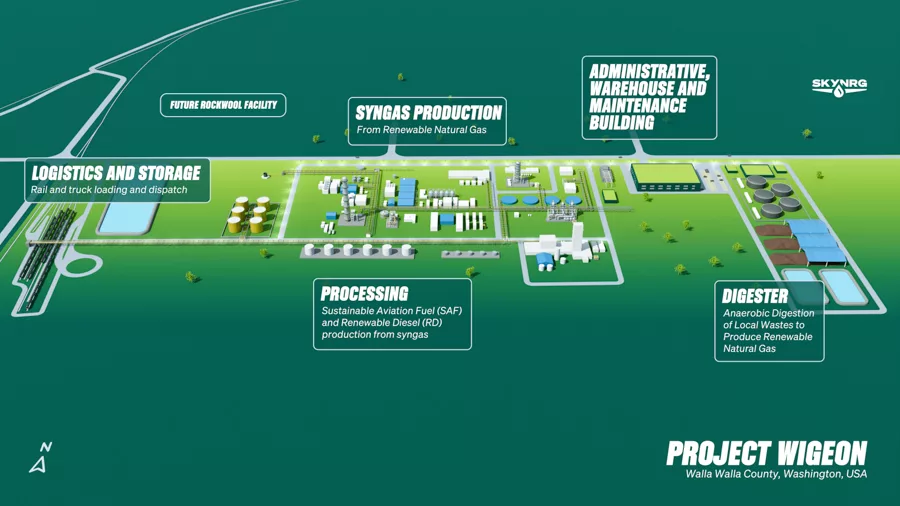
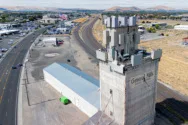
SkyNRG’s planned sustainable aviation fuel production facility south of Burbank has cleared a regulatory hurdle with the state. Once built and operating, it will produce an estimated 50 million gallons of sustainable aviation fuel and renewable diesel annually.
Courtesy SkyNRGA Dutch company planning a sustainable aviation fuel production facility southeast of the Tri-Cities has cleared an important regulatory hurdle for the project.
State Department of Ecology officials in early September determined that SkyNRG’s manufacturing facility, being pursued by its North American unit SkyNRG Americas, would not create significant environmental impacts. The agency’s determination still set requirements for the company and project, from air and water quality precautions to mitigating reduction of habitat for ferruginous hawks.
But company officials said in a statement to the Tri-Cities Area Journal of Business that Ecology’s decision is a critical milestone and they will continue to work with state and local stakeholders so the project continues to move forward.
“This brings SkyNRG closer to realizing a first-of-its-kind facility in the U.S. that will deliver domestic sustainable aviation fuel while advancing innovation and economic opportunity to Eastern Washington and across Washington,” said Nick Zollman of SkyNRG Americas in a statement.
SkyNRG’s facility will convert gaseous feedstocks into sustainable aviation fuel and renewable diesel using chemical processes.
Once operating, the facility will produce an estimated 50 million gallons of sustainable aviation fuel and renewable diesel annually. It already has agreements in place with those wanting to buy its fuels.
SkyNRG has not released details about construction costs for the facility. Company officials have said construction will create up to 600 jobs and the facility itself about 100 jobs once production begins in 2029.
While federal policy toward some clean or renewable energy sources, such as solar and wind power, has soured, sustainable aviation fuel has largely been spared similar treatment.
Congress’ passage of H.R. 1, the so-called One Big Beautiful Bill, scaled back credits for sustainable energy that were instituted a few years ago, such as those supporting the purchase of new and used electric vehicles or installing solar panels on homes.
But the bill extended a tax credit for producing clean fuels including sustainable aviation fuel. The credit initially went through 2027 but now extends through 2029.
The Walla Walla County site provides access to transportation networks and potential synergy with other regional efforts to harness agricultural waste for energy production and other industrial purposes.
Washington State University is globally the top contributing organization to scientific literature in the sustainable aviation fuel field, based on an analysis of articles, papers, editorials and news items published between 2001-23.
Joshua Heyne, director of the Bioproducts, Sciences and Engineering Laboratory at WSU Tri-Cities and co-director of the WSU-Pacific Northwest National Laboratory Bioproducts Institute, was the most cited author.
The SkyNRG project is the one the state has thrown support behind. It received a $1.5 million grant from the state Department of Commerce, as part of the Governor’s Economic Development Strategic Reserve Fund.
“This project aligns with our strategic growth priorities around clean technology and innovation,” said Joe Nguyen, director of the state Department of Commerce, in the statement announcing the grant. “In addition to furthering Washington’s leadership in clean energy and sustainable aviation, it creates family-wage manufacturing jobs that strengthen the local economy and community.”
SkyNRG has had to adjust its original plan to move forward. According to state documents, the company moved the facility to a different area of the business park than originally planned. The new site, located farther from the Columbia River, will have fewer environmental impacts.
Ecology’s recent determination also requires SkyNRG to make improvements to the intersection of Boise Cascade Road and Highway 12 if current state plans to widen and realign the highway don’t proceed. That is a possibility, as state and county officials propose further breaking up the next phase of expanding and rerouting the key route between the Tri-Cities and Walla Walla.
Zollman said the company is grateful for its partners as it looks to next steps.
“Important work lies ahead as we advance a project designed specifically to meet the benchmarks set by state and local partners,” he said.