
Behind the scenes
Paid and volunteer boards shape bank, credit union leadership

Cam Uhling, left, and Dave Strote are two members of Tri-CU Credit Union’s volunteer board of directors.
Photo by Ty BeaverCam Uhling remembers what it was like to sit on the other side of the board room table.
The former CEO of Monad Federal Credit Union, which was based in Pasco and acquired by Numerica Credit Union in 2018, said she knows how a financial institution’s board of directors can make or break day-to-day operations as well as long-term plans.
“Some of my boards would micromanage,” Uhling, who currently serves as a board member for Tri-CU Credit Union, told the Tri-Cities Area Journal of Business. “This is much less stressful.”
While CEOs and other executives are often the most well-paid and public faces at the top of financial institutions, they are beholden to those who sit in the board room and scrutinize their institution’s financial performance, potential risks and long-range goals for growth.
It’s a role that comes with varying levels of involvement and compensation across banks and credit unions. But it’s one Uhling and others in the role say is crucial to protecting the long-term interests of customers.
“Our responsibility is to look out for all (credit union) members,” said Martín Valadez Torres, chairman of Gesa Credit Union’s board of directors. “Our current membership but also our future membership.”
Financial board directors don’t have to have a background in banking or even in finance. Financial institutions have processes to nominate and review potential candidates with an eye toward diverse expertise and perspective on everything from human relations to artificial intelligence, or AI, to help oversee all aspects of the institution’s business.
While Uhling had a long career in credit unions, Valadez Torres spent much of his career working in higher education and was invited to apply for Gesa’s board after making a presentation to the board on how to better serve low-income individuals who have little or no access to banking services.
Another Tri-CU board member, Dave Strote, previously worked at the Hanford site.
“I retired a number of years ago, and the member services staff decided I needed something to do with my time,” he said. “I had absolutely no financial background but was experienced in operational processes so I thought I might be of some use on the board.”
The directors said the job isn’t a full-time role. There are regular board meetings to attend, which can take a couple hours at most. Before those meetings, they review the latest financial reports and other information. There may be an annual workshop or retreat to update long-range documents, such as the institution’s strategic plan. Beyond that, a board’s biggest role is supervising the CEO.
“We pay him for his expertise,” Uhling said, noting that boards should be hands off on day-to-day operations.
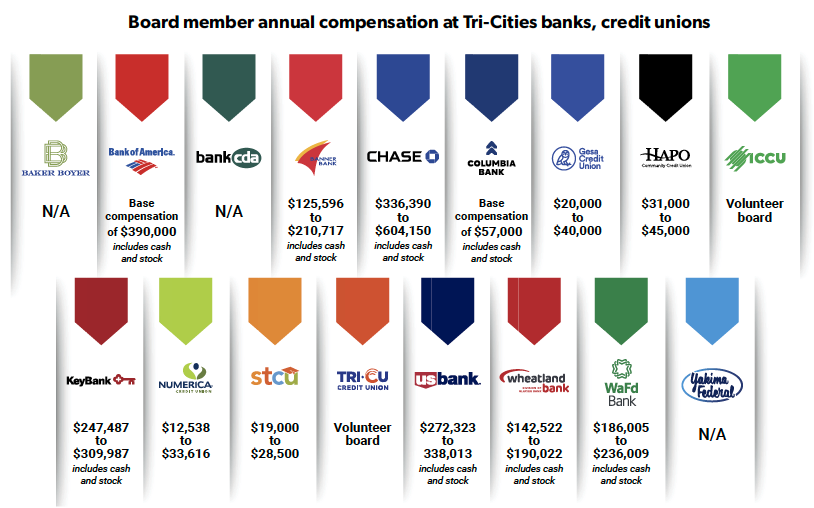
For the biggest banks, being a director can come with a big paycheck: Bank of America non-employee board members earned a base of $390,000 a year in 2024, with $125,000 of that awarded in cash and the remainder in stock options.
 Sources: U.S. Securities & Exchange Commission, Forms 990 and DEF 14A
For credit unions, which are not-for-profits, it’s a bit more complicated. Federally-chartered credit unions are barred from compensating their boards, while it’s up to states to determine whether they can be compensated at the credit unions they charter.
Washington state began permitting compensation for credit union board members about a decade ago. Tri-CU’s board is entirely volunteer while Gesa’s board members each earned between $14,000 and just over $35,000 in 2024.
Board member annual compensation at Tri-Cities banks, credit unions:
- Baker Boyer Bank: N/A
- Bankcda: N/A
- Bank of America: Base compensation of $390,000 (includes cash and dividends)
- Banner Bank: $125,596 to $210,717 (includes cash and dividends)
- Chase: $336,390 to $604,150 (includes cash and dividends)
- Columbia Bank: Base compensation of $57,000
- Gesa Credit Union: $20,000 and $40,000
- HAPO Community Credit Union: $31,000 to $45,000
- ICCU: Volunteer board
- KeyBank: $247,487 to $309,987 (includes cash and dividends)
- Numerica Credit Union: $12,538 to $33,616
- STCU: $19,000 to $28,500
- Tri-CU: Volunteer board
- USBank: $272,323 to 338,013 (includes cash and dividends)
- Washington Federal Bank: $186,005 to $236,009 (includes cash and dividends)
- Wheatland Bank (Glacier Bancorp): $142,522 to $190,022 (includes cash and dividends)
- Yakima Federal Savings & Loan Association: N/A
Sources: U.S. Securities & Exchange Commission, Forms 990 and DEF 14A
Audit committee members also may receive compensation for their work.
The effectiveness of boards for financial institutions has become a focus for regulators in recent years, particularly since the Great Recession in 2008 and after a slew of bank failures in 2023, with the role of compensation at the top for executives and board members being of note.
“The 2023 bank failures showed clear failures at the board level, with a lack of experience and independent judgment,” according to a 2024 report from the Financial Stability Board, an international organization that monitors the financial sector. “Effective boards need to move beyond compliance to actively questioning and challenging risk and compensation practices and outcomes.”
The growing trend of credit unions compensating their board members also has generated scrutiny.
“What is a board member bringing to a credit union that merits a pay of $400-$900 per hour? Especially one who only dedicates an hour or two a week to the credit union. Could that money not be better used to serve the credit union’s membership and community?” wrote Emily Claus, editor of CUSO Magazine, a trade publication serving credit unions.
Uhling and Strote said Tri-CU has done well with its volunteer board. Just like its approach of maintaining only one branch location, not paying board members keeps more money in the institution and with its members.
“Lately we have had many discussions on giving back to our members as we have been financially strong and feel as a board that our mission is to give back to our members and to our community,” Strote said.
Valadez Torres said it was only a few years after the state allowed credit unions to provide compensation to board members that Gesa adopted the practice. And the board put in guardrails, such as term limits, to ensure it didn’t negatively impact the board’s effectiveness.
“We wanted to make sure this wasn’t the reason people stayed on the board,” he said.
And even with compensation, board members still use their own resources to serve their institutions. For Valadez Torres, that’s included using vacation time from his professional career to attend finance industry conferences or go to Washington, D.C., to inform lawmakers on issues facing credit unions.
“One of the reasons I joined the board was expanding access to credit,” Valadez Torres said. “We’re now considered a low-income designated credit union. We’re here to serve our community and all sectors of it.”


Stay Informed. It’s Free.
Subscribe to our newsletters and get the latest news and insights delivered to your inbox.
We respect your privacy.
Unsubscribe anytime.
Thank you!
You’re subscribed. Keep an eye on your inbox for the latest updates.