Supreme Court ruling on controversial wind farm may come soon
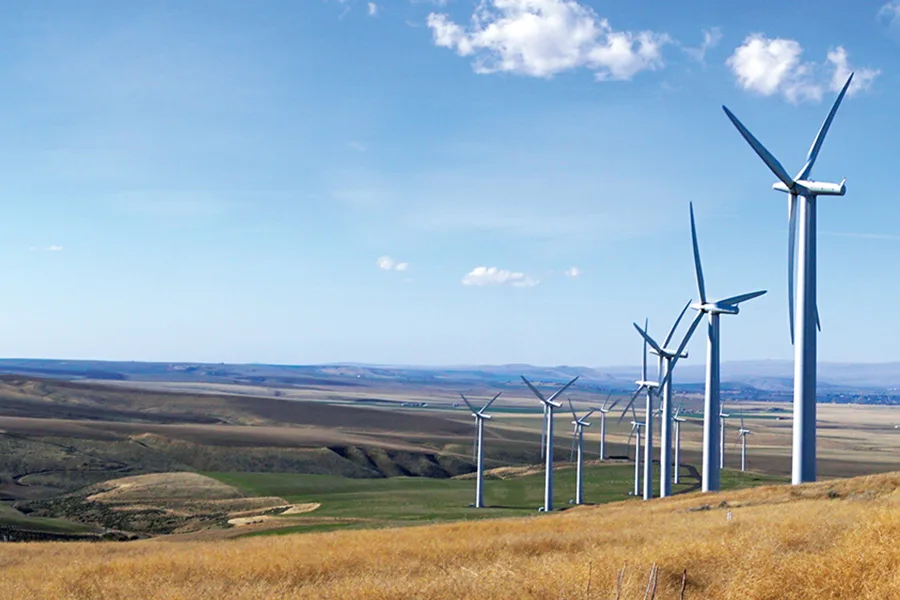
The fate of a proposed wind farm that would be spread across the Horse Heaven Hills may be just weeks away from being decided.
The Washington State Supreme Court on June 11 heard oral arguments in the lawsuit seeking to halt construction of the Horse Heaven Hills Energy Complex. Leaders with Tri-Cities C.A.R.E.S., a grassroots community group, are among those opposed to the project. Theyhey anticipate the court releasing a ruling in mid-July.
“The case has significant implications to energy projects in the state and the region for years to come,” Paul Krupin, one of Tri-Cities C.A.R.E.S leaders, told the Tri-Cities Area Journal of Business.
But that litigation isn’t the only threat to the proposed wind farm. The U.S. Department of War has halted reviews of roughly 150 wind power projects around the country, according to a report from The New York Times. Tri-Cities C.A.R.E.S. and U.S. Rep. Dan Newhouse, R-Washington, have sent letters to the Federal Aviation Administration, as well as the Pentagon, encouraging officials revisit an initial approval of the project.
Dave Kobus, senior project manager with the wind farm’s developer, Scout Clean Energy, told the Journal that the company is not commenting on the federal review process.
Project background
The state Energy Facility Site Evaluation Council (EFSEC) approved the project in November 2024, after former Gov. Jay Inslee rejected an initial approval which required the project to be scaled back.
Company officials have said the project will create an expected 1,000 jobs during construction, generate 1,150 megawatts of power and contribute more than $250 million in local tax revenues throughout its 35-year operating lifespan. Opponents of the project have questioned Scout’s job creation and power generation figures.
The Confederated Tribes & Bands of the Yakama Nation and Benton County commissioners, along with Tri-Cities C.A.R.E.S., have challenged EFSEC’s decision. They allege Inslee, state agencies and the courts violated everything from state environmental protection laws to local land use planning regulations while limiting access to proceedings related to the decision.
Late last year Scout refiled permitting applications for the project that would reduce the number of turbines but would use models with a maximum height of 671 feet, more than 150 feet taller than those initially proposed, surpassing the height of Seattle’s Space Needle.
The change was the result of various factors, such as environmental impacts, manufacturers prioritizing taller turbines due to market demand and wanting to do what is needed to meet power generation targets.
Scout’s changing plans for the wind farm project is why it requires more scrutiny, Tri-Cities C.A.R.E.S. wrote in an April 2026 letter to the Federal Aviation Administration (FAA) and military leaders.
Newhouse wrote to federal officials about similar concerns in December 2025, saying the new, taller turbines posed threats to commercial air traffic flying into and out of the Tri-Cities Airport in Pasco, military training routes, aerial firefighting efforts and even emergency medical air transportation from Oregon to Kadlec Regional Medical Center in Richland.
“There remains a great deal of concern about its impact on safe and reliable air operations,” Newhouse wrote. “I believe a rigorous re-examination of the prior determination of no hazard is essential to properly and accurately assess this project’s impact on the community.”
Approval slowdown
Concerns about Scout’s project, and many others around the country, have found sympathetic ears at the Pentagon.
The Times recently reported the delays for the Pentagon’s wind farm reviews began last summer but have become more severe over the past few weeks, according to officials at two renewable energy companies, speaking on the condition of anonymity to discuss ongoing negotiations.
In a statement to the Times, Joel Valdez, the acting Pentagon press secretary, said the agency “is actively evaluating land-based wind energy projects to ensure they do not impair national security or military operations, in accordance with statutory and regulatory requirements.” He added that the process “involves complex, time-consuming interagency coordination” to “balance renewable energy development with the protection and preservation of testing, training, and operational readiness.”
President Donald Trump and his administration have often derided wind power, along with other clean and renewable energy sources, as part of a “green scam.” Along with halting wind power projects, the Trump administration has sought to curtail funding for electrification projects specifically around vehicles. There have also been deep cuts to federal research around clean and renewable energy sources, such as has been conducted at Pacific Northwest National Laboratory in Richland.