
Utility-grade battery tests begin at PNNL’s Grid Storage Launchpad
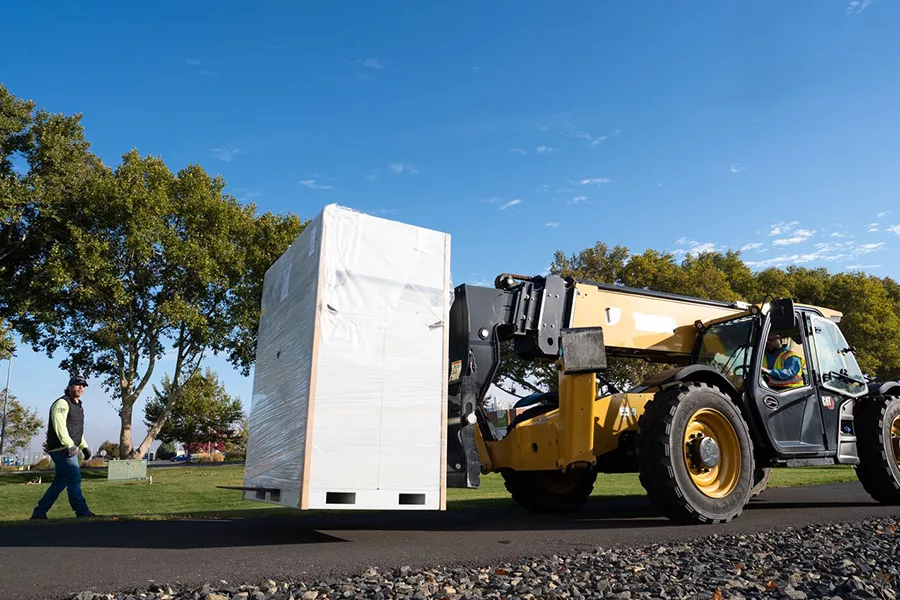
Invinity’s battery module arrives on PNNL’s campus in October 2025.
Photo by Andrea Starr/Pacific Northwest National LaboratoryResearchers at Pacific Northwest National Laboratory are taking the next step in advancing the lab’s goal to help bring more large-scale energy storage systems to market.
The Grid Storage Launchpad recently began testing one of United Kingdom-based Invinity Energy Systems’ vanadium flow batteries, the first such product to approach the facility’s 100-kilowatt testing limit, according to a release.
It’s a milestone that PNNL officials say ushers in the potential for more energy storage technologies to be deployed for real-world use.
“With this first utility-grade battery test, GSL is now fully operational as the nation’s proving ground for grid-scale storage technologies. With the independent, accurate feedback developers receive from GSL’s tests, they can ready their technologies for real-world applications,” said Vince Sprenkle, GSL’s director, in a statement.
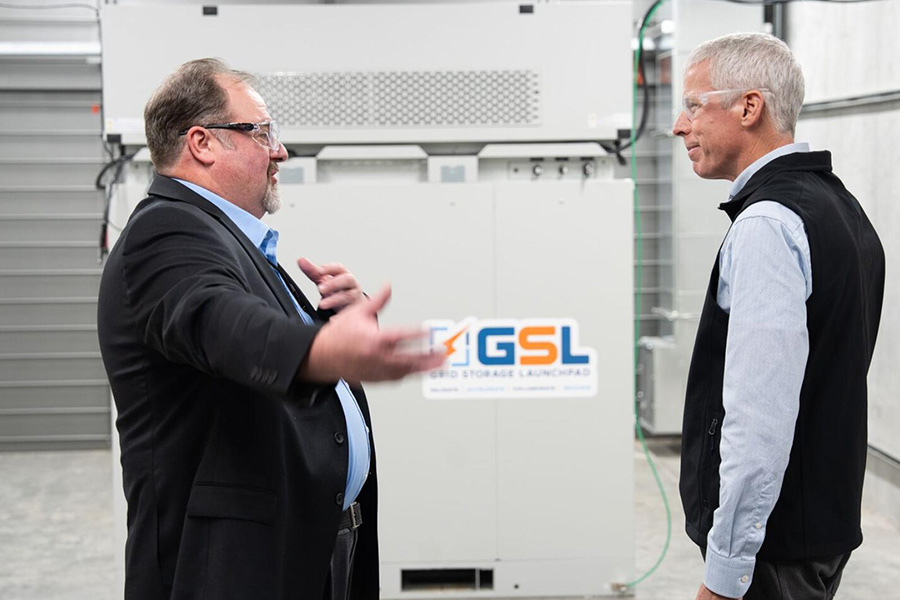
GSL Director Vince Sprenkle, left, speaks with Energy Secretary Chris Wright, who visited the PNNL campus in Richland on Dec. 4, 2025. Wright helped initiate the first test of a utility-grade battery at PNNL, a vanadium flow battery built by Invinity Energy Systems.
| Photo by Andrea Starr/Pacific Northwest National LaboratoryFor the next year, Invinity’s battery will undergo testing akin to real-world conditions, such as its ability to provide power during times of peak demand. GSL researchers can also test a battery’s ability to provide frequency regulation, which helps keep the grid stable.
“Having our battery extensively tested by PNNL’s experts at this advanced facility, in support of DOE’s energy storage program, is yet another important validation of our technology for deployment on the U.S. grid,” said Matt Harper, president of Invinity Energy Systems, in a statement.